Weekly Insights: Markets Pause Amid Inflation Watch

The Federal Reserve held interest rates steady at 4.25%–4.5% for a fourth consecutive meeting, maintaining a cautious stance amid persistent economic uncertainty. Policymaker projections revealed a growing divide, with half expecting no rate cuts this year and the other half still pencilling in two. Chair Jerome Powell reiterated that while the U.S. economy remains resilient, it continues to face headwinds from trade frictions and heightened geopolitical risk. He acknowledged that tariffs may temporarily lift inflation but emphasised that the Fed remains on a gradual easing path – not a sharp pivot.

This week’s U.S. data painted a mixed picture. Retail sales fell 0.9% in May, and housing starts dropped to a five-year low, underscoring ongoing pressure in the residential property sector. Mortgage applications and building permits also softened. However, consumer sentiment rebounded, with the University of Michigan index rising to 60.5 in June, reflecting improved household confidence on the back of disinflation and stable employment conditions. Political and fiscal risks, however, are adding fresh uncertainty. Trump’s proposed tax-and-spending package, along with escalating tariff threats, could add nearly $3 trillion to the national debt. At the same time, rising tensions in the Middle East have supported safe-haven demand.

The Bank of England also held its policy rate at 4.25%, with a dovish tilt as three of nine committee members voted in favour of a cut. Governor Andrew Bailey noted that interest rates remain on a “gradual downward path,” supported by softening data. UK CPI rose just 0.2% in May, while services inflation eased to 4.7%, in line with expectations. Having already cut twice this year, markets are now pricing in two further BoE rate reductions before the end of 2025.

Across Europe, monetary easing gained traction. The Swiss National Bank cut rates to 0%, and Norway delivered its first cut in five years. Inflation across the eurozone remained subdued – Germany’s CPI rose just 0.1%—while industrial production fell 2.4%. Despite weaker economic indicators, sentiment improved, with Germany’s ZEW economic expectations index increasing to 47.5. European Central Bank officials reiterated a flexible, data-dependent approach, keeping the door open for further easing should inflation remain muted.

In Japan, the Bank of Japan kept rates at 0.5% and signalled a slower pace of bond purchase tapering to avoid market disruption. Inflation accelerated, with core CPI rising 3.7% in May – the highest in two years – raising speculation of another rate hike later this year. Trade data disappointed, with exports down 1.7%. Prospects for tariff relief dimmed after talks with the U.S. failed to yield progress, and Japan now faces higher U.S. import levies from July.

China’s May data reflected a two-speed economy. Retail sales surged 6.4%, supported by consumer promotions and government incentives, while industrial production and fixed-asset investment came in below expectations. The property sector remains a key drag, with new home prices posting their sharpest monthly decline in seven months and real estate investment down 12% year-on-year. Economists warn that further price declines could push many homeowners into negative equity, threatening broader financial stability.

Policymakers are expected to announce additional stimulus measures at the upcoming Lujiazui Forum, although several local governments have already exhausted their subsidy allocations. Geopolitical risks have also intensified, with Taiwan blacklisting key Chinese tech firms and the U.S. increasing diplomatic engagement with Taipei.

Tensions in the Middle East escalated further, with Israel and Iran exchanging missile strikes and the humanitarian situation in Gaza deteriorating. Rising civilian casualties prompted sharp criticism of the U.S.-backed aid distribution model. Oil prices surged on the back of the conflict, fuelling stagflation concerns. According to the Fed’s own modelling, a $10 rise in oil could increase U.S. inflation by 0.4% and reduce GDP by a similar margin – highlighting the policy dilemma central banks face if inflation accelerates while growth slows.

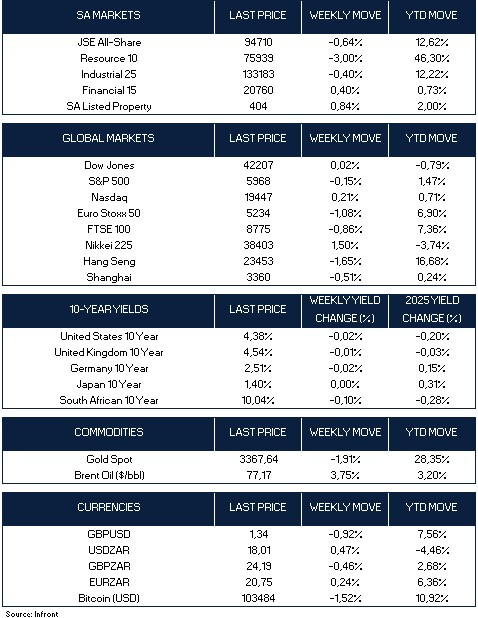
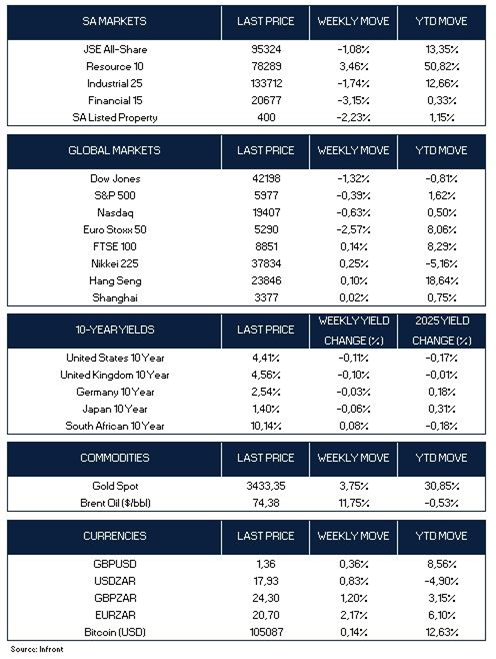
In response to the week’s developments, global equity markets were mixed. In the U.S., the Dow edged up 0.02%, the Nasdaq gained 0.21%, and the S&P 500 slipped 0.15%. European markets saw broader declines, with the Euro Stoxx 50 down 1.08% and the FTSE 100 losing 0.86%. Japan’s Nikkei advanced, while Chinese indices underperformed. Gold retreated 1.91% to $3,367.64, while Brent crude surged 3.75% to $77.17, reflecting the elevated geopolitical risk premium in commodities.

Market Moves of the Week:
In South Africa, inflation remained well contained, with headline CPI unchanged at 2.8% in May and core inflation steady at 3.0%. Despite the subdued inflation backdrop, the South African Reserve Bank has maintained a relatively cautious stance, drawing criticism from some quarters for being too restrictive. That said, the SARB has cut interest rates at three of its last five meetings, reducing the repo rate by 25 basis points at each of the first three meetings of 2025, as it continues to advocate for a lower long-term inflation target.

Retail sales data provided a more upbeat signal. April sales rose 5.1% year-on-year, a notable rebound from March’s revised 1.2% gain. On a seasonally adjusted basis, sales increased 0.9% month-on-month, pointing to some resilience in household consumption. On the infrastructure front, South Africa is courting private capital to support a R450 billion transmission grid expansion. The World Bank is considering a $500 million credit guarantee facility to help unlock financing for the project, which aims to add 14,500 km of transmission lines over the next decade. The SARB’s recent climate stress test also found domestic banks broadly resilient to environmental risks, despite persistent data gaps.

South African equities ended the week weaker, with the JSE All Share Index falling 0.64%. Resource stocks led the declines, down 3.00%, while industrials slipped 0.40%. Financials and listed property provided some offset, gaining 0.40% and 0.84%, respectively. The rand lost ground against the U.S. dollar, closing at R18.01, as global risk sentiment turned more cautious.

Chart of the Week:
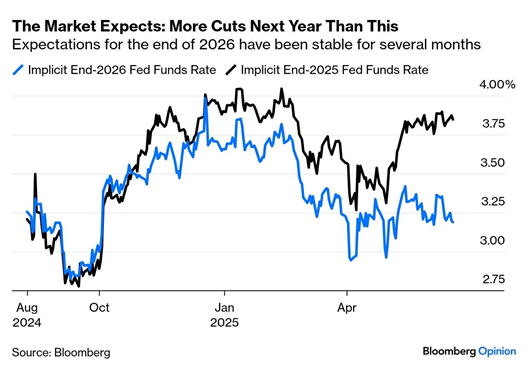
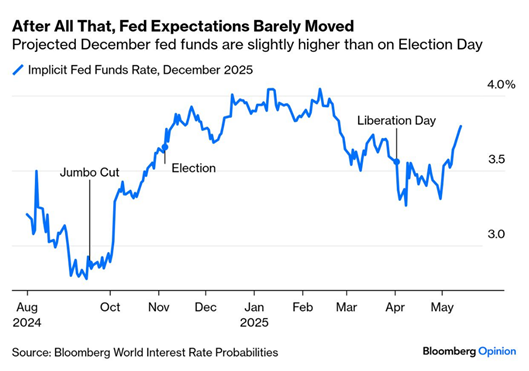
According to Bloomberg’s World Interest Rate Probabilities function, markets anticipate the fed funds rate to fall to between 3.0% and 3.25% by end-2025 – implying more rate cuts than the Federal Reserve’s own projections suggest. This divergence points to greater market concern about future growth. The Fed’s updated economic projections, meanwhile, reflected a marginally more negative growth outlook coupled with slightly higher inflation expectations – a mildly “stagflationary” shift. Source: Bloomberg.

As always, we appreciate your support and value your trust in LNKD Investment Managers. 

Weekly Insights: Oil Prices Soar

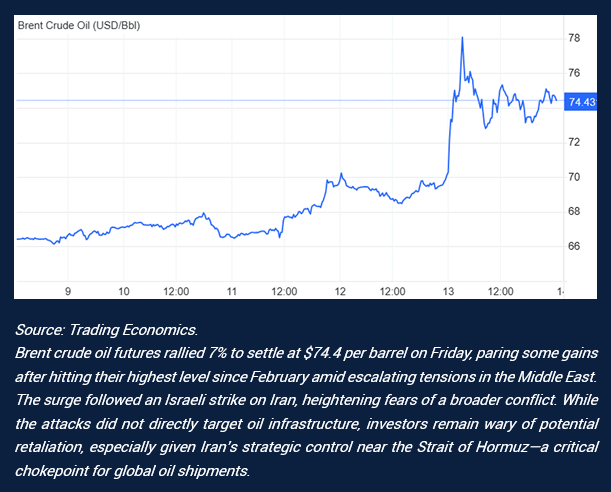
Brent crude rallied on Friday, settling 7.0 % higher at USD 74.23 per barrel after Israel and Iran exchanged air strikes. Intraday, the benchmark briefly touched USD 78.50, its highest level since 27 January. Although no oil facilities were hit, investors remain sensitive to the risk of further escalation, particularly given Iran’s strategic position near the Strait of Hormuz, through which roughly 20 % of global oil supply transits. Iran’s April output of 3.3 million barrels per day underscores the region’s systemic importance. The International Energy Agency stated it retains 1.2 billion barrels of emergency reserves and is prepared to act if required. Even after Friday’s surge, Brent remains more than 10 % below its level a year ago and well off the peaks above USD 100 recorded in early 2022.

U.S. Treasuries generated positive returns through Thursday as yields declined in response to the week’s economic data releases, particularly the softer-than-expected CPI report on Wednesday, although Treasuries across most maturities gave back some gains on Friday morning following Israel’s attack on Iran.

On the equities front, US stocks ended the week lower amid escalating tensions in the Middle East. The Dow Jones Industrial Average fell 1.3 % on the week, turning negative year‑to‑date, while the S&P 500 and Nasdaq Composite retreated more modestly and remain in positive territory.

The US May consumer‑price data surprised on the downside. Headline CPI rose 0.1 % m/m (consensus: 0.3 %) and 2.4 % y/y, while core CPI held steady at 2.8 % y/y. The first full month of new import tariffs had only a marginal impact on core‑goods prices. Consequently, market expectations for Federal Reserve policy were little changed. 

In Europe, the STOXX Europe 50 Index lost 2.6 % as investors grappled with geopolitical risks and uncertainty over U.S. trade policy.

The UK economy shrunk in April by 0.3% m/m, the sharpest decline since October 2023, driven by weakness in services and production. Unemployment rose to 4.6 %, a four‑year high. The FTSE 100 ended the week broadly flat.

Japanese equities were mixed over the week with the benchmark Nikkei 225 index gaining 0.25% amid escalating geopolitical risks and an uptick in trade-related concerns. Safe‑haven demand supported the yen, which strengthened to the high‑JPY 143 range versus the U.S. dollar.

Mainland Chinese stock markets ended flat as the latest inflation snapshot of deflationary pressures persisted, while in Hong Kong, the Hang Seng Index edged up 0.1%.

China’s CPI declined for a fourth consecutive month in May, underscoring weak domestic demand amid the protracted property downturn. Producer prices dropped for a 32nd straight month, marking the steepest fall in almost two years. While the recent tariff détente with the United States has improved the near‑term growth outlook, economists remain cautious on the trajectory of consumer prices.

Market Moves of the Week:

South Africa has successfully completed all 22 action items required by the Financial Action Task Force (FATF), the international body that greylisted the country in February 2023. This development paves the way for a potential removal from the greylist during the FATF’s next review in October.

The achievement reflects a marked improvement since the 2021 FATF assessment, where South Africa was found significantly non-compliant in areas of financial crime enforcement and regulatory oversight. The greylisting has since subjected the local financial sector to heightened international scrutiny, impacting investor sentiment, raising operational costs, and elevating the risk of capital outflows.

The FTSE/JSE All Share Index declined 1.8% on Friday, driven primarily by losses in the Financial 15 Index, which fell more than 2.7% on the day. However, on a weekly basis, the All Share Index posted a more moderate decline of just over 1.0%.
 
Offsetting broader weakness, gold mining stocks rallied strongly, reaching record highs as the gold price surged above USD 3,440/oz—approaching a historical peak—following reports of Israeli air strikes on Iranian nuclear and military infrastructure.

The rand depreciated against a stronger U.S. dollar on Friday, in response to escalating geopolitical tensions. Persistent rand weakness, coupled with a sustained rise in Brent crude oil prices, poses a challenge to the South African Reserve Bank (SARB), which remains focused on containing inflationary pressures. Should these trends continue, consumers can expect higher domestic fuel prices in July and possibly beyond.

Looking ahead, upcoming consumer inflation and retail sales data, due next week, may provide further insight into the SARB’s policy stance, although the next interest rate decision is scheduled for late July.

Chart of the Week:

As always, we appreciate your support and value your trust in LNKD Investment Managers. 

Weekly Insights: U.S. Job Growth Slows in May

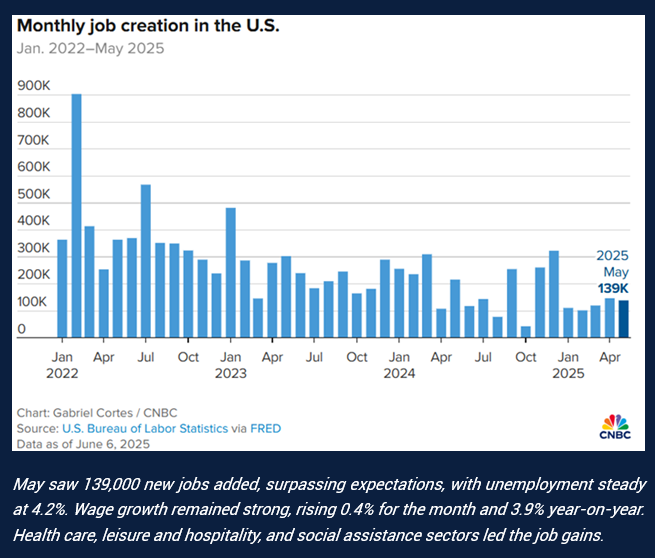
Hiring slowed slightly in May as businesses and consumers contended with tariff concerns and a potentially cooling economy. Nonfarm payrolls rose by 139,000, and the unemployment rate held steady at 4.2%. The broader underemployment rate—which includes discouraged workers and those working part-time for economic reasons—was also unchanged at 7.8%. Wages came in stronger than expected, with average hourly earnings up 0.4% over the month and 3.9% year-on-year. Separately, April data showed job openings and hiring picked up, pointing to continued labour market resilience in the face of the Trump administration’s new global tariffs.

U.S. manufacturing contracted for a third consecutive month, with the ISM manufacturing PMI falling to 48.5, the lowest since November and below expectations. The services sector also weakened, slipping into contraction for the first time since June 2024, with a reading of 49.9.

U.S. President Donald Trump and Chinese President Xi Jinping spoke on Thursday in a long-awaited call, agreeing to restart trade talks soon. Chinese media reported that Xi invited Trump to visit China and said Beijing had followed through on a trade deal made in May—though U.S. officials disagree. Xi also called for the removal of U.S. trade restrictions and urged cooperation over Taiwan. Trump described the call as “very good” and noted that progress was made on rare earth materials, with negotiations set to resume soon.

The European Central Bank cut its main interest rate by 25 basis points to 2.00% on Thursday, marking its eighth reduction since June 2024. President Christine Lagarde said the ECB had “nearly concluded” this policy cycle and that future decisions would depend on incoming data.

Eurozone GDP grew by 0.6% quarter-on-quarter in Q1, double the initial estimate and the fastest pace since Q3 2022. According to Eurostat, the upward revision was led by stronger growth in Ireland and Germany. Inflation eased in May, with headline CPI falling to 1.9% from 2.2% and core inflation moderating to 2.3%, indicating softer underlying price pressures.

A private survey showed China’s manufacturing sector experienced its sharpest contraction since September 2022, as the Caixin manufacturing PMI dropped to 48.3 in May from 50.4 in April, falling short of expectations. The decline primarily reflects the ongoing impact of U.S. tariffs on smaller exporters, which has dampened external demand. In response, there is growing consensus among analysts and policymakers that Beijing will need to implement additional stimulus measures to bolster domestic consumption and investment. Meanwhile, the Caixin services PMI showed modest growth, rising to 51.1 in May from 50.7 the previous month.

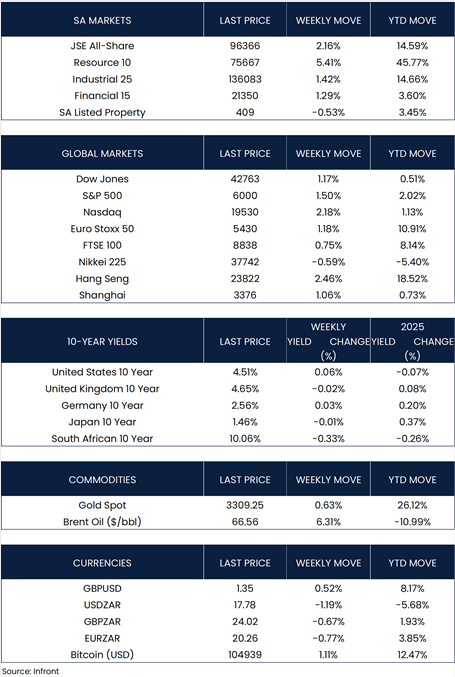
Major U.S. stock indexes closed higher for the second week in a row as  U.S. jobs data appeared to allay fears of a recession. The Nasdaq Composite led with a 2.18% gain, followed by the S&P 500, which rose 1.50%, and the Dow Jones Industrial Average, up 1.17%, pushing all three into positive territory for the year.

The pan-European STOXX Europe 50 Index rose 1.18% in local currency terms, supported by easing inflation and the European Central Bank’s decision to cut rates. The UK’s FTSE 100 Index also advanced, gaining 0.75%.

In Asia, Japan’s stock markets declined over the week, with the Nikkei 225 Index down 0.59%. In contrast, mainland Chinese markets advanced as weaker-than-expected economic data fuelled expectations of further government stimulus. The Shanghai Composite Index rose 1.06% in local currency terms, while Hong Kong’s Hang Seng Index gained 2.46%.

Market Moves of the Week:

South Africa’s economy grew by 0.1% in the first quarter of 2025, a slowdown from the 0.4% recorded in Q4 2024, according to Statistics South Africa. Growth was primarily underpinned by a 15.8% surge in the agriculture, forestry, and fishing sector, which added 0.4 percentage points to overall GDP. However, six out of the ten industries contracted over the quarter, with mining and quarrying posting the steepest decline at -4.1%. On the demand side, household consumption growth moderated to 0.4% from 1.1%, reflecting base effects after the boost from two-pot retirement withdrawals in the previous quarter.

South Africa’s manufacturing sentiment weakened further in May, as ongoing logistical bottlenecks continued to weigh on demand, according to the Absa Purchasing Managers’ Index (PMI). The seasonally adjusted PMI fell to 43.1 from 44.7 in April, marking the seventh consecutive month below the neutral 50-point mark—signalling continued deterioration in business conditions. While forward-looking sentiment showed some improvement, Absa noted that underlying demand and activity remain subdued amid persistent structural constraints.

The JSE All Share Index gained 2.16% over the week, supported by a strong rally in resources (+5.41%), while industrials (+1.42%) and financials (+1.29%) also posted solid gains. The property sector was the only laggard, edging down 0.53%. By Friday’s close, the rand slightly strengthened by 1.19% against the U.S. dollar, trading at R17.78.

Chart of the Week:

As always, we appreciate your support and value your trust in LNKD Investment Managers. 

Weekly Insights: Court Ruling May Spur Trump Tariff Shift

Equity markets opened the week with strong gains after President Trump announced a delay in a newly proposed 50% tariff on EU imports until July 9 and pledged to fast-track negotiations. Stocks surged again midweek after the U.S. Court of International Trade ruled Trump lacked authority for most global tariffs imposed in his second term. However, a quick appeal and a temporary hold by a federal court allowed the tariffs to remain in place while it reviews the government’s filings, reversing some of the earlier market gains. Investor sentiment also weakened late in the week amid stalled U.S.-China trade talks and unverified claims from Trump that China had violated its preliminary trade deal. The week ended with the Nasdaq Composite leading the way, gaining 2.01%, followed by the S&P 500 Index (1.88%) and Dow Jones Industrial Average (1.60%).

The Bureau of Economic Analysis (BEA) reported that U.S. core PCE inflation, the Federal Reserve’s preferred gauge, rose 2.5% y/y in April, down from 2.7% in March and the lowest since 2021. While the slowdown is encouraging, inflation remains above the Fed’s 2% target, and markets largely expect the impact of tariffs to be felt later this summer. Meanwhile, minutes from the Fed’s May 6–7 meeting showed policymakers still see inflation risks as tilted to the upside, citing uncertainty around trade and other economic policies.

The Euro Stoxx 50 ended the week 0.76% higher, after U.S. President Trump said he would give the European Union more time to negotiate a trade deal before 50% tariffs take effect. In the UK, services sector confidence fell to a two and a half year low in the three months to May, as a new employment tax and rising price expectations weighed on sentiment. Investment, hiring, and business volumes also declined. The FTSE 100 ended the week up 0.62%.

Japan’s stock markets rallied over the week, with the Nikkei 225 up 2.17%, driven by optimism over a potential U.S.-Japan trade deal. A reportedly constructive call between Prime Minister Shigeru Ishiba and President Trump on Thursday, ahead of the next round of talks, boosted sentiment. Trump’s support for Nippon Steel’s bid for U.S. Steel also fuelled hopes of a deal ahead of the G7 summit in mid-June, where the two leaders are expected to meet.

Mainland Chinese stocks declined as a quiet economic calendar and a pause in U.S.-related trade talks weighed on investor appetite. The Shanghai Composite slipped 0.23% while Hong Kong’s Hang Seng Index fell 1.33%.

On the commodity front, gold traded around $3288.58 per ounce on Friday, declining -2.05% over the week. Brent crude fell 3.57% to settle at $62.61 per barrel, as traders expected OPEC+ would decide on Saturday to boost oil output for July beyond previous forecasts.

Market Moves of the Week:

On Thursday, the South African Reserve Bank’s (SARB) monetary policy committee reduced the benchmark interest rate by 25 basis points to 7.25%, marking the lowest level in over two years. The decision was not unanimous, with five members supporting the move and one advocating for a deeper 50bps cut. The central bank also lowered its inflation forecasts, citing the National Treasury’s decision to abandon a proposed VAT increase, a stronger exchange rate outlook, and declining global oil prices. Bonds rallied with the SARB arguing strongly in favour of a lower inflation target, which, Governor Lesetja Kganyago said, would lead to structurally lower interest rates.

South Africa’s draft mining bill has reignited policy uncertainty, drawing strong criticism from the mining industry and political partners. Confusion around BEE requirements for exploration, which the sector sees as harmful to investment, has highlighted concerns over the bill’s clarity and intent. While progress is being made with the rollout of a new mining cadastre, the bill’s potential to trigger legal battles and deter investors threatens to undermine efforts to grow the sector and create jobs.

The All-Share Index rose by 0.86% this week, held back by losses in Resources (-2.70%). The local currency weakened against the U.S. dollar, moving to R17.99/$ from last week’s R17.82/$ level. SA government bond yields moved lower on the week, dipping 0.07%.

Chart of the Week:

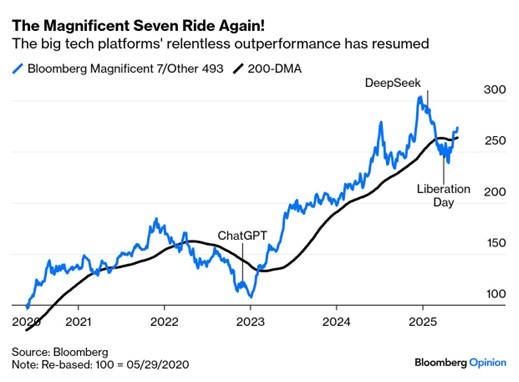
Bloomberg’s index of the Magnificent Seven tech platform groups has resumed its relentless outperformance, a trend that has endured ever since the launch of ChatGPT. The sharp reversal earlier this year now looks like a correction of post-election excess, combined with a fresh understanding after the DeepSeek shock in late January that the big US companies might not be invulnerable. Source: Bloomberg.

As always, we appreciate your support and value your trust in LNKD Investment Managers. 
Weekly Insights: Markets Pause as Fiscal Risks Resurface

Markets took a breather last week after a strong rally, with the S&P 500 pulling back following nearly a 20% rise since April. Investor sentiment cooled as bond yields climbed and renewed trade tensions re-entered the picture. While most headlines focused on President Trump’s tariff threats against the EU and tech imports, several other developments caught the market’s attention. These included a credit rating downgrade of U.S. debt by Moody’s, a weak auction for 20-year Treasuries, and the House passing a major tax package dubbed the “One Big Beautiful Bill.” The bill cleared a major hurdle in the House but still needs to navigate the Senate, where it’s likely to be reshaped.

The Moody’s downgrade stripped the U.S. of its last triple-A rating, citing a lack of progress in curbing deficits and rising interest costs. While not unexpected, it reignited focus on the growing fiscal burden, especially with legislation on the table that could add nearly $3 trillion to the deficit over the next decade. The bill extends Trump-era tax cuts and proposes new breaks, with most spending cuts only coming later. Bond markets reacted sharply – the 10-year yield rose above 4.5%, and the 30-year briefly topped 5%, levels not seen since 2007. With recession risks easing and fiscal stimulus likely on the way, rate-cut expectations have been scaled back, and fixed income markets globally are adjusting. Meanwhile, U.S. business activity picked up in May, with both services and manufacturing beating expectations, though housing data was mixed and rising costs tied to tariffs remain a concern.

In Europe, business activity contracted in May, with the Eurozone composite PMI falling below the 50 mark. Germany and France both saw output shrink, and the European Commission cut its 2025 growth forecast to 0.9%, citing tariff risks and U.S. policy uncertainty. Encouragingly, inflation is forecast to hit the ECB’s 2% target by mid-2025, providing policymakers with some breathing room. The UK delivered mixed data – higher inflation and strong retail sales contrasted with weak business activity, as the manufacturing sector continued to struggle.

In Asia, Japanese bond yields rose to their highest since 2008 amid stronger inflation and expectations of rate hikes. Core machinery orders surged, pointing to healthy capital spending, but services growth slowed, and manufacturing remained under pressure. In China, industrial production surprised to the upside, showing resilience despite escalating U.S. trade tensions. However, retail sales growth softened and fixed asset investment missed expectations, weighed down by a continued slump in the property sector. The data reinforced calls for targeted fiscal support, with analysts expecting Beijing to roll out stimulus in stages.

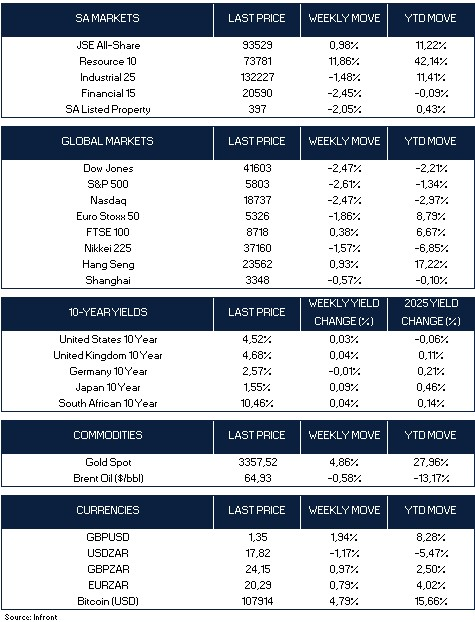
Global equity markets reversed recent gains, reflecting the more cautious tone. In the U.S., the Dow fell 2.47%, the S&P 500 dropped 2.61%, and the Nasdaq lost 2.47%. Europe was mixed, with the Euro Stoxx 50 down 1.86%, while the FTSE 100 rose 0.38%. In Asia, Japan’s Nikkei 225 declined 1.57% and the Shanghai Composite lost 0.57%, while Hong Kong’s Hang Seng Index added 0.93%. Meanwhile, gold rallied 4.86% to close at $3,357.52, as investors shifted to safe-haven assets.

Market Moves of the Week:

It was a busy week for South Africa. Finance Minister Enoch Godongwana delivered a revised 2025/26 Budget, shelving the proposed VAT increase while maintaining the government’s commitment to fiscal consolidation. To offset weaker revenue, Treasury announced R68 billion in spending cuts and a modest fuel levy hike. Growth expectations were revised down to 1.4% for 2025, lifting the projected debt-to-GDP peak to 77.4%.

President Cyril Ramaphosa’s visit to the White House was marred by a tense exchange with U.S. President Donald Trump, who reignited unfounded claims of white genocide and land seizures in South Africa. Ramaphosa had hoped to steer the discussion toward trade relations – especially given that the U.S. is South Africa’s second-largest trading partner – but Trump dominated the meeting with printed media reports and videos. The South African delegation, which included billionaire Johann Rupert and several well-known local golfers, found itself on the defensive. The encounter underlined the fragile state of diplomatic ties and cast fresh uncertainty over a suspended 30% tariff on South African exports.

On the economic front, April’s CPI rose 2.8% year-on-year. Retail sales growth slowed to 1.5% in March from 4.1% previously. While higher food prices nudged up headline inflation, broader price pressures remain subdued. These figures support the view that inflation is well contained, adding to expectations that the South African Reserve Bank may adopt a more dovish tone in coming meetings.

Looking ahead, markets are focused on next week’s SARB interest rate decision. Although no rate cut is anticipated, the combination of easing inflation, a pause in U.S. tariffs, and improved fiscal signals could lay the groundwork for future easing. Meanwhile, the JSE All Share Index rose 0.98% for the week, driven by a strong 11.86% rebound in resource stocks. Industrials and financials underperformed, while the rand strengthened 1.17% to close at R17.82/USD.

Chart of the Week:

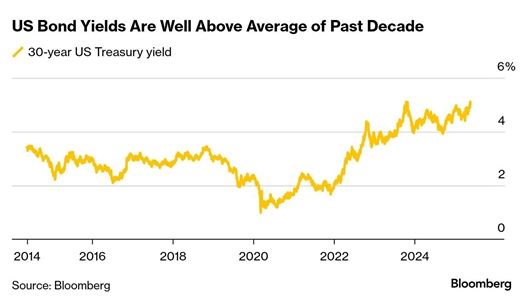
The yield on 30-year U.S. Treasury bonds has risen above 5%, signalling investor anxiety over the country’s worsening fiscal position. Moody’s downgrade of the U.S. sovereign rating last week added to concerns around rising debt and political inaction. As doubts grow over the sustainability of U.S. borrowing, the dollar has come under pressure – falling nearly 1% this week and over 7% year-to-date, its worst annual start since 2005. Source: Bloomberg.

As always, we appreciate your support and value your trust in LNKD Investment Managers.
Weekly Insights: US–China Tariff Pause Lifts Market Sentiment

The United States and China have agreed to a 90-day suspension of recently imposed tariff measures as part of efforts to reset bilateral trade negotiations. Under the terms, the effective U.S. tariff rate on the bulk of Chinese imports will be scaled back from a peak of 145% to 30%, while China will reduce its applied tariffs on U.S. goods from 125% to 10%. The accord, reached during bilateral consultations in Geneva, also covers the withdrawal of recent non-tariff barriers, marking a temporary de-escalation in a dispute that has disrupted trade flows and heightened geopolitical risk.

The U.S. Bureau of Labor Statistics reported that inflation eased in April, with the Consumer Price Index rising 0.2% month-on-month and 2.3% year-on-year—the slowest annual pace in over four years. Cooler food prices helped offset persistent rental inflation, while core CPI, which excludes food and energy, also increased 0.2% for the month, with an annual rate of 2.8%.

Separately, the Bureau released data showing that producer prices unexpectedly declined 0.5% in April after a revised flat reading in March. This drop was led by the largest fall in service costs since 2009, reflecting weaker demand for air travel and hotel stays. The report also noted narrower profit margins, suggesting companies are absorbing some of the cost pressures from higher tariffs.

U.S. retail sales growth slowed sharply in April, with headline sales up just 0.1% after a 1.7% surge in March. The fading boost from front-loaded auto purchases ahead of tariffs weighed on momentum, while broader consumer spending softened amid rising economic uncertainty. Core retail sales, which align closely with the consumption component of GDP, fell 0.2%, signaling a more cautious consumer heading into the second quarter.

Britain’s economy expanded 0.7% in the first quarter, exceeding expectations and accelerating from 0.1% growth in the previous quarter. Growth was driven by strong contributions from the services sector, fixed investment, and net exports, demonstrating resilience ahead of the U.S. tariffs implemented on 2 April. Meanwhile, the UK labour market showed signs of softening, with the Office for National Statistics reporting the unemployment rate rising to 4.5% from 4.4% in the three months through March.

Industrial production in the euro area surged 2.6% in March, signaling a potential recovery from a two-year contraction in the sector. The expansion was primarily driven by robust gains in capital goods and durable consumer goods, surpassing February’s 1.1% increase.
 
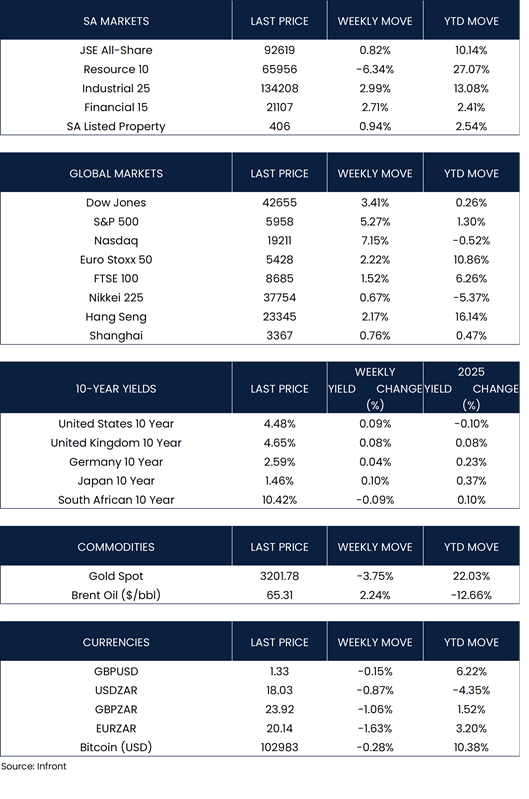
Global equity markets rallied over the week, buoyed by easing trade tensions between the U.S. and China. In the U.S., the Nasdaq Composite led with a 7.15% increase, while the S&P 500 and Dow Jones Industrial Average rose 5.27% and 3.41%, respectively.

European markets also advanced, with the STOXX Europe 50 up 2.22% and the UK’s FTSE 100 gaining 1.52% in local currency terms. In Asia, the Nikkei 225 added 0.67%, while the Shanghai Composite and Hang Seng Index rose 0.76% and 2.17%, respectively.

Market Moves of the Week:

South Africa’s official unemployment rate rose to 32.9% in Q1 2025, up from 31.9% in the previous quarter, according to Statistics South Africa. Employment fell notably in the formal sector, particularly in trade, construction, and social services. However, there were modest gains in the informal sector and in industries such as transport, finance, and utilities.

Deputy Finance Minister David Masondo recently indicated that the Treasury and the South African Reserve Bank are finalising revisions to the country’s inflation-targeting framework, with an announcement expected soon. SARB Governor Lesetja Kganyago has advocated for tightening the inflation target to a single point around 3%, in line with emerging market peers, to better anchor inflation expectations. However, persistent structural inflationary pressures—particularly from administered prices linked to state-owned entities—pose significant challenges. This suggests that interest rates may remain elevated for longer, potentially constraining GDP growth and employment recovery in the near to medium term.

Mirroring global trends, the JSE All-Share Index increased by 0.82% over the week, supported by a 2.99% gain in the industrial sector. The financial and property sectors also advanced by 2.71% and 0.94%, respectively. Conversely, the resources sector declined by 6.34%, weighing on overall market performance. By Friday’s close, the rand appreciated 0.87% against the U.S. dollar, trading at R18.03/$.

Chart of the Week:

US inflation eased for the third consecutive month in April, despite a peak in import tariffs. While lower inflation typically signals room for Fed rate cuts, rising optimism about avoiding a recession has tempered expectations for monetary easing.

As always, we appreciate your support and value your trust in LNKD Investment Managers.

Weekly Insights: U.S. and UK agree to trade deal

This week marked a notable development in international trade relations as U.S. President Donald Trump and U.K. Prime Minister Keir Starmer jointly announced a limited bilateral trade agreement. The deal retains the existing 10% baseline tariff on British exports, while carving out modest improvements in agricultural market access for both nations and reducing U.S. tariffs on British automobile exports. Though incremental, the agreement is seen as a signal that core tariff structures—particularly the 10% baseline and 25% sectoral duties—will remain entrenched as negotiations with other countries unfold.

The announcement, the first new trade deal since the Trump administration implemented reciprocal tariffs on April 2, briefly lifted investor sentiment. However, broader market caution prevailed as attention shifted to high-stakes U.S.-China trade talks scheduled for the weekend in Geneva. President Trump suggested a potential reduction in tariffs on Chinese imports from 145% to 80%, while asserting that “many trade deals” are currently underway.

As expected, the Federal Reserve left its benchmark interest rate unchanged, maintaining the federal funds target range at 4.25% to 4.50%. In its post-meeting statement, the Federal Open Market Committee (FOMC) acknowledged growing risks of both rising unemployment and persistent inflation. Chair Jerome Powell emphasized the importance of policy patience in the face of elevated uncertainty, indicating that the Fed is positioned to wait for clearer economic signals before taking further action.

Looking ahead, Fed officials—including Chair Powell—are scheduled to speak throughout the coming week. April inflation data, expected to show a 0.3% month-on-month increase in both headline and core consumer prices, will also be closely watched as markets assess the impact of recent trade policies.

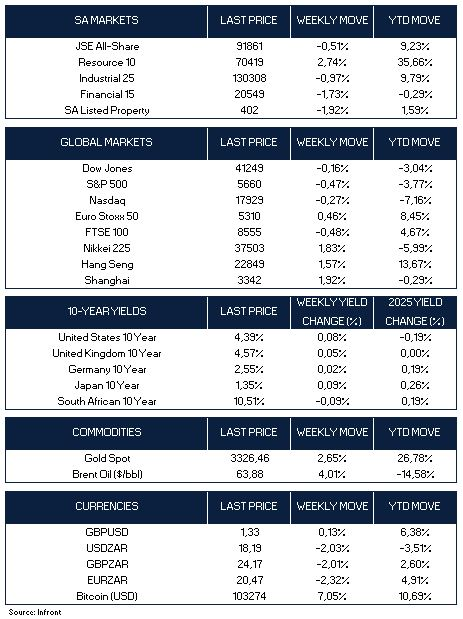
For the week, despite a momentary lift from the U.S.-U.K. trade news, equities ended the week lower. The S&P 500 declined 0.5%, the Nasdaq lost 0.3%, and the Dow slipped by 0.2%.

High-level trade negotiations between the U.S. and China are set to resume in Switzerland this weekend. U.S. Treasury Secretary Bessent and Trade Representative Greer will meet with Chinese Vice Premier He Lifeng in a bid to de-escalate tensions. Meanwhile, new customs data showed Chinese exports to the U.S. plummeted 21% year-over-year in April, falling to $33 billion amid steep U.S. tariffs—a stark reminder of the ongoing economic toll.

In the UK, the Bank of England narrowly voted to cut its key interest rate by 25 basis points to 4.25%, citing the need for a “gradual and careful” policy path. The FTSE 100 Index eased 0.48% on the week, while in Europe the STOXX 50 Index rose 0.46%, lifted by hopes of a thaw in U.S.-China trade tensions.

In Japan, markets were buoyant in the holiday-shortened week, with the Nikkei 225 Index rising 1.83% as a weaker yen and global trade optimism boosted sentiment.

Chinese equities also ended the week firmer as the benchmark Shanghai Composite Index advanced 1.92%, supported by trade talk optimism and policy support from the People’s Bank of China, which cut its seven-day reverse repo rate to 1.4% and trimmed the reserve requirement ratio by 50 basis points.

In a concerning geopolitical development, the conflict between India and Pakistan deepened as Islamabad launched a military operation in response to overnight Indian strikes on Pakistani military installations. The situation represents the most significant escalation in decades between the two nuclear-armed nations. Global leaders have called for urgent restraint to avoid further deterioration.

Market Moves of the Week:

South African President Cyril Ramaphosa this week announced the second phase of Operation Vulindlela (OV), a strategic reform initiative jointly led by the Presidency and the National Treasury. The new phase outlines 30 key structural reforms, with a sharpened focus on unlocking growth in the digital economy and strengthening local government performance. OV aims to remove persistent bottlenecks in South Africa’s economy and accelerate implementation of high-impact policy changes.

According to the Bureau for Economic Research, if the planned reforms are fully implemented, South Africa could achieve GDP growth of 3.5% by 2029. This is a marked contrast to more modest near-term forecasts: the National Treasury projects 1.9% growth in 2025, while Moody’s Ratings Agency lowered its 2025 growth forecast to 1.5% earlier this week.

In a significant political and legal development, the Democratic Alliance (DA) has launched a constitutional challenge to Section 15A of the Employment Equity Amendment Act. The section grants the Labour Minister the authority to set sector-specific employment targets aimed at improving representation of Black South Africans, women, and people with disabilities. The DA argues the provision is discriminatory and may inadvertently lead to job losses and constrain economic growth.

The South African rand ended the week trading at 18.19 to the U.S. dollar, approximately 2% stronger week-on-week. Market sentiment has been buoyed by signs of stability in South Africa’s coalition government, particularly after Finance Minister Enoch Godongwana abandoned plans to increase the value-added tax (VAT). His revised national budget, expected on May 21st, is now in sharper focus as markets assess fiscal policy continuity.

The JSE All Share Index posted a modest decline for the week, with the financial sector underperforming and shedding 1.7%. Market participants remain cautious ahead of global trade talks and await further details on domestic economic reform and budgetary policy.

Chart of the Week:

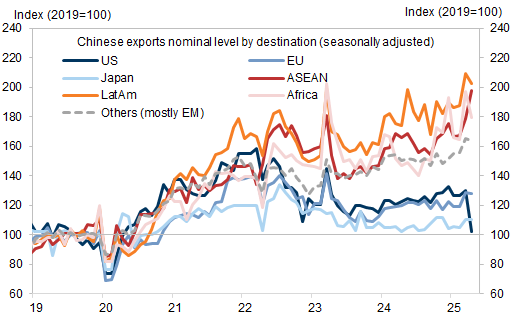
Source: China Customs, Goldman Sachs Global Investment Research.

China’s exports surged 8.1% in April on the back of a jump in shipments to Southeast Asian countries, offsetting a sharp drop in outbound goods to the U.S. as prohibitive tariffs kicked in. Exports to the U.S. stood at $33 billion last month, a drop of approximately 21.0% year on year (vs. +9.1% yoy in March) as the world’s two largest economies prepare for de-escalation talks.

As always, we appreciate your support and value your trust in LNKD Investment Managers.

Weekly Insights: U.S. Equities Regain Ground Lost in April

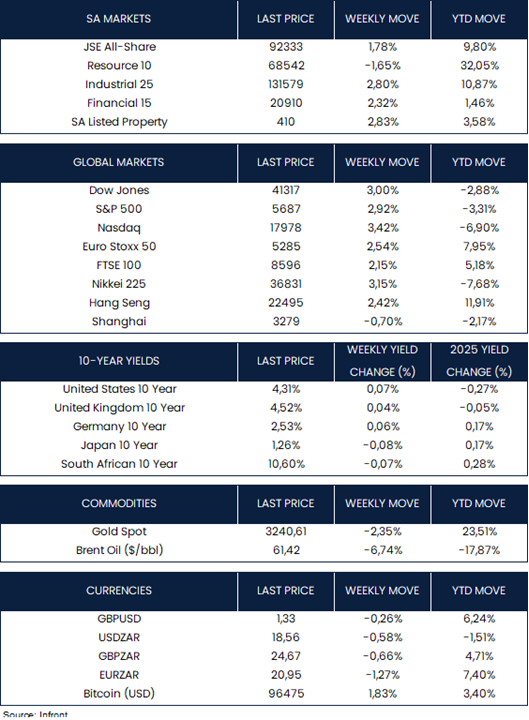
U.S. stocks ended the week higher, with the S&P 500 (+2.9%) posting a second straight weekly gain and a nine-day winning streak. The index erased the early April 13.8% drop amid solid earnings reports, hopes for a lessening of the US–China trade friction, and resilient U.S. labour data. The Nasdaq jumped 3.4% on strong tech earnings, while small and mid-caps rose for a fourth consecutive week. The Dow Jones gained 3% on the week.

Late in the week, attention turned to earnings, with companies representing nearly 40% of the S&P 500’s market cap – including four Magnificent Seven names – reporting Q1 results. Despite limited forward guidance due to trade uncertainty, sentiment stayed upbeat as investors bet on resilience amid slowing growth and tariff risks.

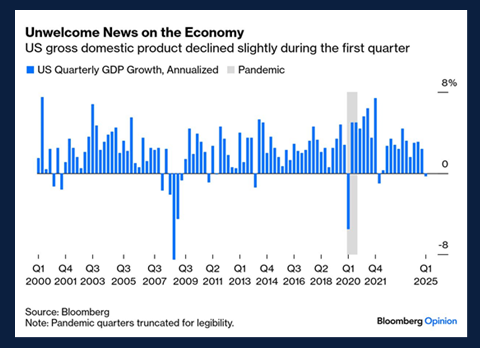
The week’s U.S. economic data offered mixed signals. Job openings fell to a seven-month low, and ADP reported a sharp slowdown in private payroll growth. However, Friday’s official jobs report beat expectations with 177,000 new jobs, steady unemployment at 4.2%, and modest wage growth, lifting market sentiment. The BEA’s advance estimate showed the U.S. economy contracted 0.3% in Q1 – the first decline since 2022 – driven by weaker consumer and government spending and a surge in imports, likely tied to businesses front-loading ahead of new tariffs.

Eurozone economic growth picked up to 0.4% in Q1, doubling the prior quarter’s pace and beating the 0.2% consensus forecast from FactSet. In other news, Bloomberg reported that the European Union plans to ease trade barriers with the U.S., boost investment, cooperate on strategic issues, and increase purchases of U.S. goods like LNG and tech. The Euro Stoxx 50 index ended the week up 2.5% while the FTSE 100 gained 2.2%.

Japanese stocks advanced for the week, with the Nikkei 225 up 3.2%. The Bank of Japan kept interest rates unchanged Thursday but lowered its growth forecast for the fiscal year ending March 2026 to 0.5%, down from 1.1%, citing export pressures from U.S. tariffs.

China will remove tariffs on certain U.S. imports, such as semiconductors, chipmaking equipment, medical supplies, and aviation parts, that cannot be sourced elsewhere. Beijing also introduced measures to support exporters and stimulate domestic consumption to offset U.S. tariffs. The tech-heavy Hang Seng index ended the week up 3.2%, while the broader Shanghai index dipped 0.7%.

On the commodity front, “safe haven” Gold fell 2.4% over the week, while Brent oil slumped 6.7% after Saudi Arabia signalled it might increase oil production.

Market Moves of the Week:

South Africa’s seasonally adjusted Absa Purchasing Managers’ Index (PMI) fell to 44.7 in April 2025 from 48.7 in March, marking the sixth straight month of contraction in manufacturing activity and signalling a sharp overall decline. Survey participants pointed to global trade tensions, political uncertainty at home, heavy rainfall, and the return of scheduled power outages as key factors behind the weak sentiment.

During a media briefing on Wednesday, Finance Minister Enoch Godongwana announced that the third Budget speech is scheduled for 21 May. This follows last week’s reversal of the proposed 0.5% VAT increase, originally included in the March 2025 Budget. The Minister also stated that neither he nor the Treasury will be responding to questions about the budget’s preparation ahead of the 21 May address.

The All-Share Index rose 1.8% for the week, in line with global markets, despite a 1.7% decline in Resources. The local currency strengthened against the U.S. dollar, moving from R18.67/$ to R18.56/$ w/w. South Africa’s 10-year government bond yield fell by 7 bps.

Chart of the Week:

Wednesday brought the news that the first estimate of gross domestic product for the quarter ended March 2025 declined 0.3%, only the second quarterly fall since the pandemic and the first in three years. Source: Bloomberg.

As always, we appreciate your support and value your trust in LNKD Investment Managers.

Weekly Insights: March CPI Reveals Inflation Progress Amid Trade Tensions

President Trump announced a 90-day deferral of higher reciprocal tariffs for most U.S. trading partners to facilitate negotiations. However, China was excluded from the pause, with the U.S. administration escalating tariffs on Chinese imports, first by doubling them and later increasing them to 145%. In retaliation, China imposed additional duties on U.S. goods in two phases, first raising them to 84%, and then to 125%. Beijing criticised the U.S.’s latest tariff increase, describing it as a “numbers game” with no meaningful economic impact. A Ministry of Commerce spokesperson indicated that if the U.S. continued with this strategy, China would disregard it.

The minutes from the Federal Reserve’s March meeting revealed that policymakers saw increased downside risks to economic growth and employment, while inflationary pressures were expected to rise due to higher tariffs. There was significant uncertainty surrounding the economic outlook, leading most members to favour a cautious approach to monetary policy. While the Fed remains ready to adjust policy as needed in response to incoming data, members noted the possibility of difficult trade-offs if inflation proves more persistent, while growth and employment face downward pressures.

The Bureau of Labor Statistics released March’s Consumer Price Index (CPI) data, showing a moderation in inflation. The headline CPI declined by 0.1% on a seasonally adjusted basis, lowering the year-on-year inflation rate to 2.4% from 2.8% in February. Core inflation, which excludes food and energy, rose by 0.1% month-over-month, marking the smallest increase in nine months. On an annual basis, core inflation increased by 2.8%, the lowest 12-month rise since March 2021.

Meanwhile, the University of Michigan reported a sharp increase in its Index of Consumer Sentiment’s year-ahead inflation expectations, which surged to 6.7% in April, the highest level since 1981. This spike reflects growing concerns about trade war developments, which have fluctuated throughout the year, contributing to heightened uncertainty about future inflation and economic stability.

The UK economy grew by a faster-than-expected 0.5% in February, driven by stronger services output. On a year-over-year basis, GDP rose 1.4%, surpassing consensus estimates. The Office for National Statistics highlighted broad-based growth across all sectors, including a notable recovery in the manufacturing industry, which bounced back from a long downturn. 
 
China’s consumer prices contracted for the second consecutive month, with the Consumer Price Index declining 0.1% year-on-year in March, following a 0.7% contraction in February, according to the National Statistics Bureau. Core inflation, which excludes volatile food and fuel prices, rose 0.5%, rebounding from a 0.1% drop in February, though still lower than the 0.6% growth recorded in January. Meanwhile, producer price deflation deepened, with the Producer Price Index falling 2.5% year-on-year in March, marking the 29th consecutive monthly decline and the largest contraction since November 2024.

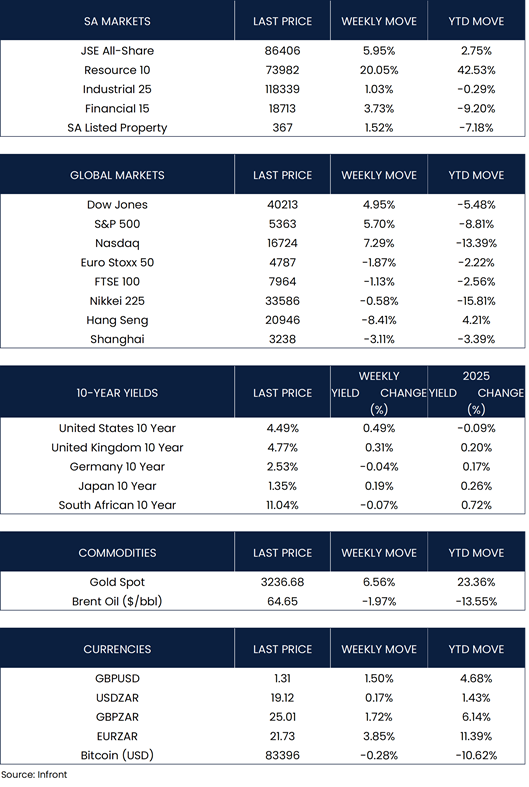
U.S. equities ended the week higher, recovering from earlier volatility as trade-related headlines continued to steer investor sentiment. The Nasdaq Composite outperformed with a 7.29% gain, followed by the S&P 500, which rose 5.70%, and the Dow Jones, up 4.95%.

In contrast, European markets declined, with the Euro Stoxx 50 down 1.87% and the UK’s FTSE 100 falling 1.13%, amid escalating trade tensions.

In Asia, Japan’s Nikkei 225 slipped around 0.6%, while mainland Chinese markets also ended lower—the Shanghai Composite lost 3.11%—though expectations of fresh policy support helped limit further downside. The Hang Seng Index in Hong Kong saw a sharper drop, falling 8.41% over the week.

Market Moves of the Week:

The African National Congress (ANC) has reaffirmed its commitment to the Government of National Unity (GNU) but has voiced growing frustration with the Democratic Alliance, calling for a “reset” in the coalition arrangement. Following a National Working Committee meeting, ANC Secretary General Fikile Mbalula announced that the party intends to “hit the reset button” and re-engage with parties both within and outside the GNU. The move comes amid a deadlock over the 2025 budget, which has highlighted deep divisions within the unity government.

The All-Share Index partially recovered from last week’s losses, rising 5.95% over the week, supported by broad-based gains across all sectors. The Resource sector led the rebound, surging 20.05% and contributing the most to the overall recovery. The rand weakened slightly against the U.S. dollar to R19.12/$ but recovered somewhat from the record low of R19.93/$ reached earlier in the week. Meanwhile, South African government bonds held relatively firm, with the 10-year yield easing by 7 basis points over the week.

Chart of the Week:

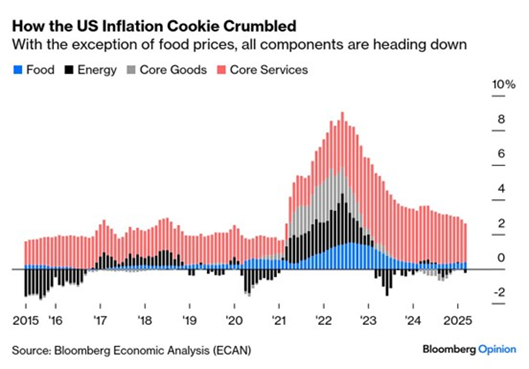
March CPI data came in stronger than expected, offering reassurance that inflation pressures are easing. Core inflation remained contained, and sticky prices—on goods less responsive to market shifts—fell to their lowest level since early 2022. Although food prices edged higher, the overall report signalled progress in taming inflation. However, despite this positive news for U.S. consumers, the dollar weakened globally, as investor attention shifted to uncertainties around tariffs and broader confidence in the economic outlook. Source: Bloomberg.

As always, we appreciate your support and value your trust in LNKD Investment Managers. 
Weekly Insights: Trump’s Tariffs Spark Fears

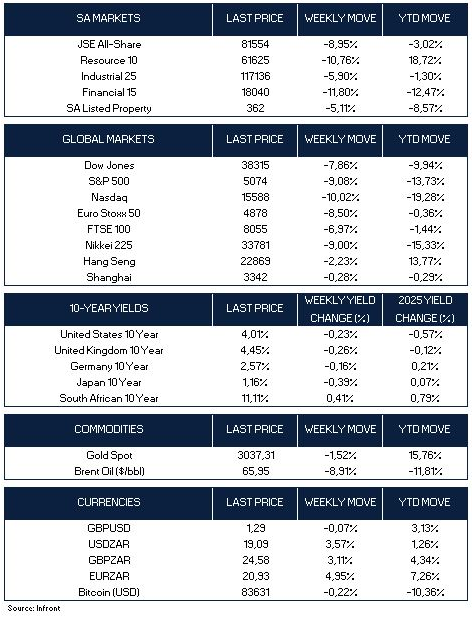
Stock markets fell sharply this past week following the Trump administration’s announcement of sweeping new tariffs. From 5 April, the U.S. will impose a minimum 10% tariff on all imported goods, with significantly higher rates for countries running large trade surpluses with the U.S. – China, for example, will face a 34% tariff, while the EU and Japan will be subject to rates of 20% or more. This marked shift in U.S. trade policy, aimed at rebalancing global trade, has raised fears of slower growth, rising inflation, and recession risks. Retaliatory measures, particularly from China, have added to market unease.

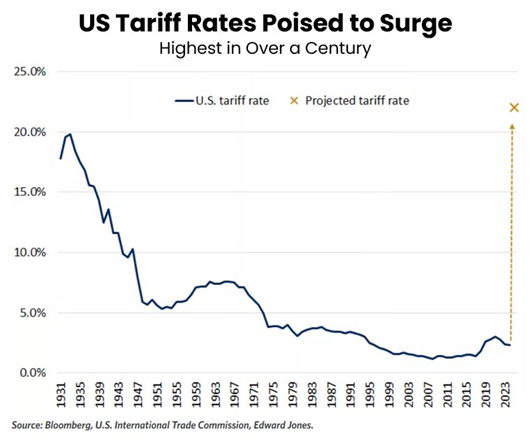
The average U.S. tariff rate is now expected to rise from around 2.3% in 2024, to between 20% – 25% – the highest in over a century. Markets responded with broad declines: the S&P 500 and Dow Jones recorded their worst one-day drops since 2020, with equities closing the week near their lowest levels since October 2024. Investors shifted into safe-haven assets like U.S. Treasuries, and expectations for Federal Reserve rate cuts in 2025 increased. While Fed Chair Jerome Powell acknowledged growing risks, he maintained that the economy remains on solid footing and that the central bank will wait for more clarity before adjusting policy.

Economic data painted a mixed picture. U.S. manufacturing slipped back into contraction, with the ISM Manufacturing PMI falling below 50 and new orders weakening. Input costs rose sharply, largely due to the impact of tariffs. The services sector continued to grow, but at a slower pace, with the ISM Services PMI easing to 50.8 – below expectations. Cost pressures remained elevated, with many businesses citing increased expenses linked to trade uncertainty. The labour market offered some reassurance. The U.S. added 228,000 jobs in March, well above forecasts and a strong improvement on February’s figures, although the unemployment rate ticked up slightly to 4.2%.

In Europe, the economic picture showed modest signs of improvement. The eurozone services PMI rose to 51, and inflation continued to ease, though producer prices increased more than expected. France’s firm stance on U.S. tariffs suggests trade tensions could hinder the recovery. UK data was more subdued: the manufacturing PMI fell to 44.9, house prices were flat in March, and mortgage approvals reached their lowest since August 2023.

The European Central Bank remains cautious. While headline inflation fell to 2.2%, policymakers highlighted the risks posed by U.S. trade policy. President Christine Lagarde noted that further progress is needed to sustainably meet the 2% inflation target. Markets now see a 90% chance of a rate cut in April, with a full cut expected by June.

In Asia, China’s factory activity accelerated, with the Caixin Manufacturing PMI rising to 51.2 and services improving. However, U.S.-China trade tensions escalated as Beijing responded swiftly to U.S. tariffs with a matching 34% levy and broader trade restrictions. Analysts estimate the tariffs could shave 1–2% off China’s GDP, though further fiscal support is expected. Japan’s data was softer, and with increased global uncertainty, the Bank of Japan may delay its next interest rate hike.

It was a volatile week for global markets. The Dow fell 7.86%, the S&P 500 lost 9.08%, and the Nasdaq dropped 10.02%. In Europe, the Euro Stoxx 50 fell 8.50% and the FTSE 100 declined 6.97%. Japan’s Nikkei 225 dropped 9.00%, while Chinese markets, closed on Friday, saw more modest moves by Thursday’s close. Heightened fears of a global slowdown and growing expectations of rate cuts pushed bond yields lower. While unsettling, such corrections are not unusual – historically, the S&P 500 sees a 10% pullback roughly once a year, and larger declines every few years as part of the normal market cycle.

Market Moves of the Week:

This week’s local headlines were dominated by the national budget vote and escalating tensions within the Government of National Unity (GNU). The DA opposed the proposed fiscal framework, rejecting a VAT hike and calling for widespread spending cuts. The ANC pushed back against what it labelled an “austerity budget” and rallied support from several smaller parties – both within and outside government – to pass the framework in parliament by 194 votes to 182. In response, the DA has filed a legal challenge, citing procedural flaws, and is reconsidering its role in the GNU, with negotiations between the parties ongoing.

In trade developments, South Africa was included in new U.S. tariff measures, facing a 30% levy that could negatively affect exports. Despite the political and trade headwinds, there were signs of resilience in the economy. February’s trade balance posted a R20.9 billion surplus, and March vehicle sales were strong, with overall volumes up 12.5% and passenger cars rising 25%.

The local market came under significant pressure this week, with the JSE All Share Index falling by 8.95% as all three major sectors recorded losses. By Friday’s close, the rand had weakened to R19.09 against the U.S. dollar.

Chart of the Week:

President Trump announced U.S. reciprocal tariff plans that were more aggressive than expected. The new tariffs are estimated to raise the effective tariff rate on U.S. imports from 2.3% in 2024 to between 20% – 25%, the highest in at least 100 years. From 2000 – 2024, the average U.S. tariff rate for all imports was a modest 1.7%. Based on the announced tariffs, the average U.S. tariff rate is expected to jump to between 20% – 25%. In 2024, the U.S. economy imported roughly $3.3 trillion of goods. Assuming an average tariff rate of 20%, this would equate to tariff revenue of roughly $660 billion, or roughly 2.3% of 2024 GDP. Source: Bloomberg, U.S. International Trade Commission, Edward Jones.

As always, we appreciate your support and value your trust in LNKD Investment Managers.