Weekly Insights: US GDP Surpasses Expectations

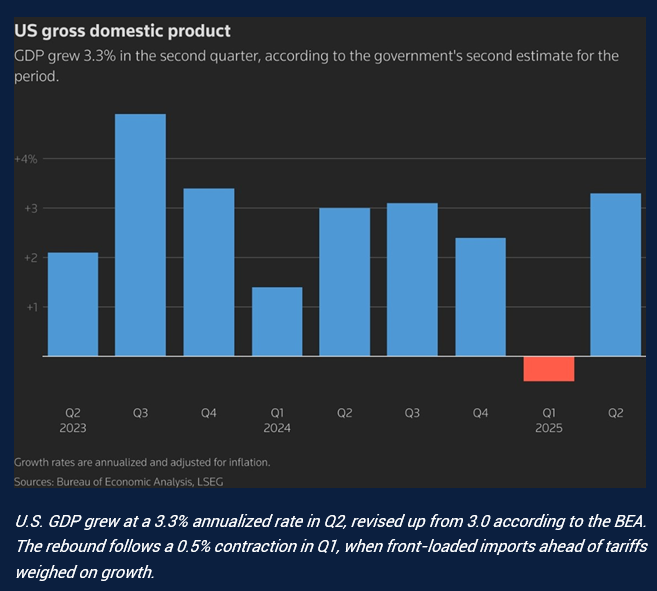
The U.S. economy expanded at a stronger-than-expected pace in Q2, with GDP revised up to 3.3% annualised from the initial 3.0% estimate. The revision was largely driven by robust business investment in intellectual property—particularly in areas such as artificial intelligence, which grew at a 12.8% rate, the fastest in four years. While consumers and businesses have so far held up against tariff-related volatility, ongoing trade pressures continue to cloud the outlook.

U.S. inflation edged higher in July, with the broader PCE index rising 2.6% year-on-year and 0.2% month-on-month. Core PCE, which excludes volatile food and energy components and is the Federal Reserve’s preferred measure, increased 2.9% annually and 0.3% for the month. While broadly in line with expectations, the data suggest underlying price pressures remain sticky, supporting the view that the Fed will approach further rate cuts cautiously, and indicating that tariffs are beginning to feed through the U.S. economy.

President Donald Trump announced this week that he had fired Federal Reserve Governor Lisa Cook, citing allegations of mortgage fraud, though the legality of his action is now under review. Cook has sued, arguing the President lacks the authority to remove her from office, and a federal judge has yet to rule on whether the dismissal will stand. While the attempt raised concerns over Fed independence, market reaction was muted.

The U.S. has raised tariffs on most Indian imports to 50%, doubling the previous rate and extending them to sectors including garments, jewellery, seafood, and furniture. The decision, effective 27 August, is linked to India’s ongoing purchases of Russian oil, which Washington argues help fund the Ukraine war and undermine sanctions. Analysts estimate the tariffs could cut India’s export earnings by over $35 billion and weigh on growth, while also straining trade ties between the two countries.

European Central Bank (ECB) policymakers kept the deposit facility rate at 2.0% in July, but meeting minutes revealed a split over inflation risks. Some members pointed to weaker growth, U.S. tariffs, and a stronger euro as downside pressures, while others highlighted energy prices and currency volatility as potential upside risks. President Christine Lagarde said U.S. tariffs are having only a limited effect on eurozone growth as firms adjust. Speaking at the Jackson Hole symposium, ECB officials signalled that a September rate cut is unlikely, though further easing could be considered later in the year if economic momentum slows.

In the UK, retail sales volumes weakened for an 11th consecutive month in August. Meanwhile, shops raised prices by the most since the end of 2023, according to the Confederation of British Industry distributive trades survey.

China’s industrial profits fell 1.5% in July, a smaller decline than expected, as strong tech sector earnings offset weakness in industries facing soft demand and deflationary pressures. Other data released earlier in the month showed slowing momentum, with retail sales, factory activity, and fixed-asset investment all underperforming. Economists anticipate the slowdown will persist in the coming months, likely prompting additional stimulus measures, possibly as soon as September.

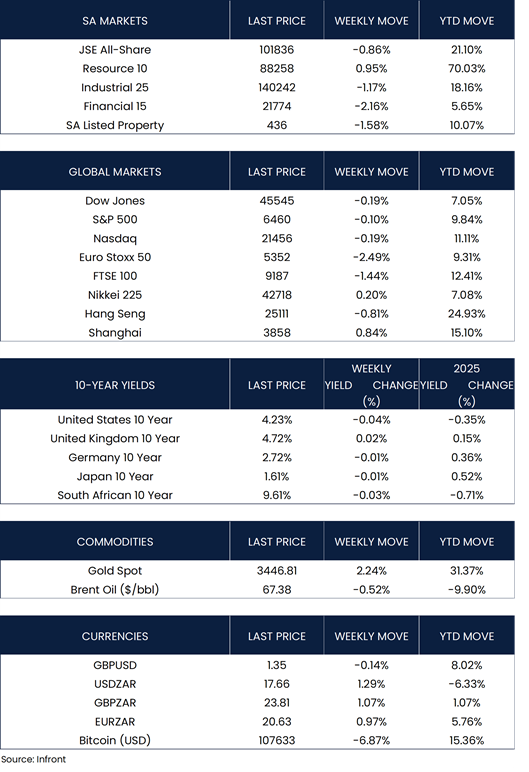
U.S. equity markets ended the week slightly lower on light trading volumes, with the Dow Jones and Nasdaq Composite each down 0.19% and the S&P 500 slipping 0.10%. In Europe, the STOXX Europe 50 fell 2.49%, weighed down by renewed tariff uncertainty, political instability in France, and ongoing tensions between Russia and Ukraine, while the UK’s FTSE 100 declined 1.44%.

In Asia, Japan’s Nikkei 225 advanced 0.20%, and mainland Chinese equities extended their recent rally, with the Shanghai Composite up 0.84%, largely driven by ample domestic liquidity rather than stronger economic fundamentals. Conversely, Hong Kong’s Hang Seng Index lost 0.81%.

Market Moves of the Week:
South Africa’s Producer Price Index (PPI) rose sharply to 1.5% in July 2025, up from 0.6% in June, according to Statistics SA, highlighting notable increases in domestic production costs. Meanwhile, the country recorded a preliminary trade surplus of R20.3 billion in July, driven by exports of R184.3 billion against imports of R164.0 billion, slightly below June’s revised surplus of R21.0 billion.
 
The JSE All-Share Index posted modest losses last week, declining 0.86%, primarily due to weakness in the Financial sector (-2.16%). Listed property (-1.58%) and the Industrial sector (-1.17%) also weighed on performance, while gains in the Resource sector (+0.95%) partially offset the slide. The rand weakened 1.29% against the U.S. dollar, ending the week at R17.66/USD.

Chart of the Week:
As always, we appreciate your support and value your trust in STRATEGIQ Capital. 

Weekly Insights: Federal Reserve Signals Dovish Shift

U.S. Federal Reserve Chair Jerome Powell, speaking at the Jackson Hole Symposium on Friday, struck a dovish tone by hinting at potential rate cuts. He highlighted growing downside risks to employment amid slowing labour market conditions, while acknowledging that tariffs are adding upward pressure to consumer prices, though the extent and timing remain uncertain. The Fed’s baseline view is for a one-off upward shift in prices, but Powell cautioned that these effects may take time to materialize. Overall, he described the economy as facing upside risks to inflation and downside risks to employment, suggesting the evolving balance may justify a policy adjustment. U.S. stocks rose after the remarks, and traders assigned a nearly 90 percent probability of a 0.25% interest-rate cut next month, up from about 75 percent earlier.

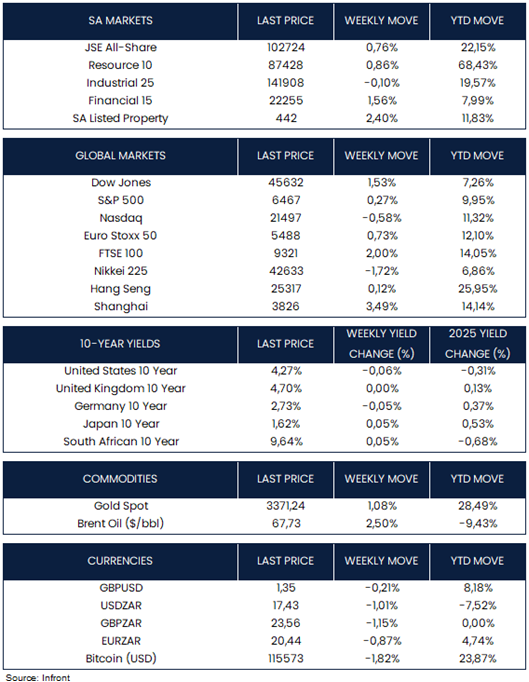
The S&P 500 (+0.27%) rebounded on Friday, closing slightly higher after four consecutive days of losses. Within the index, the energy, real estate, financials, and materials sectors posted the biggest gains. Large-cap value stocks outperformed their growth counterparts, which lost ground. The tech-heavy Nasdaq Composite (-0.58%) ended the week lower, with profit-taking weighing on sentiment amid renewed doubts over the sustainability of heavy AI-related infrastructure spending. The Dow Jones ended the week up 1.53%.

An early reading of the S&P Global U.S. PMI showed business activity in August expanding at the fastest pace this year, with the composite index rising to 55.4, well above expectations and marking the 31st straight month of growth. Services activity eased slightly to 55.4, while manufacturing surged to a 39-month high of 53.3, driven by stronger demand and inventory building. However, both sectors reported the steepest rise in input costs since May, with tariffs pushing prices higher and firms passing these increases on to customers at the fastest pace since August 2022.

UK annual inflation rose to 3.8% in July, the highest in 18 months, fuelled by higher food and airfare costs. Services inflation, a key gauge for the Bank of England, also climbed to 5.0% from 4.7%. On the market front, the UK’s FTSE 100 Index reached a record high this week, climbing 2.00%. In Europe, the Euro Stoxx 50 index gained 0.73% on the week.

Japan’s stock market fell over the week, with the Nikkei 225 Index declining 1.72%. The 10-year Japanese government bond yield climbed to 1.62%, near its highest since 2008, after stronger-than-expected July inflation reinforced expectations of another BoJ rate hike as early as October.

Mainland Chinese stocks rose this week, supported by easing U.S.-China trade tensions. The Shanghai Composite rose 3.49% and Hong Kong’s Hang Seng added 0.12%. Retail investors have fuelled the rally, with margin debt hitting its highest level since 2015 as households seek better returns amid low interest rates and limited investment options.

In commodities, Brent oil rose 2.5% on the week, while gold advanced 1.1% amid growing expectations of rate cuts.

Market Moves of the Week:

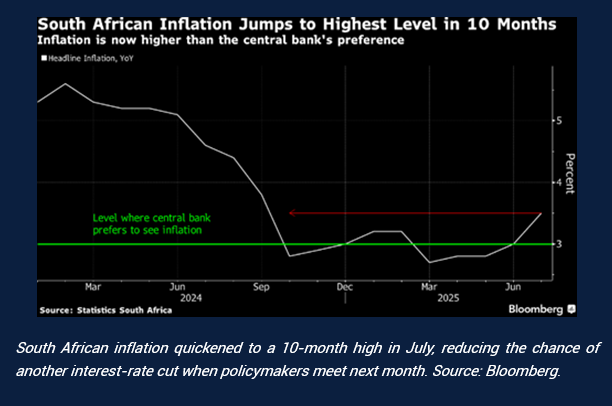
South Africa’s CPI rose to 3.5% y/y in July (from 3.0% in June), the highest since Sept 2024, with prices up 0.9% m/m on food, municipal tariffs, and fuel. Food inflation remains the key driver, accelerating to 5.7% y/y, led by meat (+10.5%), vegetables, and other food items. Beef prices surged on supply disruptions from foot-and-mouth disease, while risks from avian flu may keep food costs elevated into Q3. Although global supply (notably Brazil) could ease pressures later in the year, persistently high food prices continue to erode lower-income households’ spending power.

A significant milestone has been reached in South Africa’s rail reform journey, with the government announcing on Friday that 11 of the 25 train operating companies (TOCs) that applied for third-party participation in Transnet’s rail network have met the requirements and will move to the next stage of negotiations and contracting. Minister of Transport Barbara Creecy stressed that this step is not about cannibalising Transnet’s freight business but about adding much-needed capacity, with private operators securing slots across 41 routes that carry bulk commodities such as coal, iron ore, chrome, manganese, sugar and fuel. The initiative, which includes firms like Grindrod, is expected to improve efficiency in a network long hampered by Transnet’s operational challenges, while also laying the groundwork for economic growth, job creation and greater sustainability.

The All-Share Index rose 0.76% this week, boosted by Property and Financials. The local currency strengthened against the U.S. dollar, moving to R17.43/$ from last week’s R17.61/$ level. SA government bond yields edged higher on the week, rising 0.05%.

Chart of the Week:

As always, we appreciate your support and value your trust in STRATEGIQ Capital. 

Weekly Insights: Markets Rise on Growing Fed Cut Expectations

US markets ended the week stronger, lifted by growing confidence that the Federal Reserve is edging closer to interest rate cuts. The S&P 500 and Nasdaq touched fresh records midweek before easing into Friday, while the Dow also advanced. Gains reflected optimism that softer headline inflation, resilient consumer demand, and labour-market stability could allow the Fed to start easing policy, even as underlying price pressures remain sticky. Futures now price nearly 90% odds of a September rate cut, with Chair Jerome Powell’s Jackson Hole speech later this month expected to give clearer policy guidance.

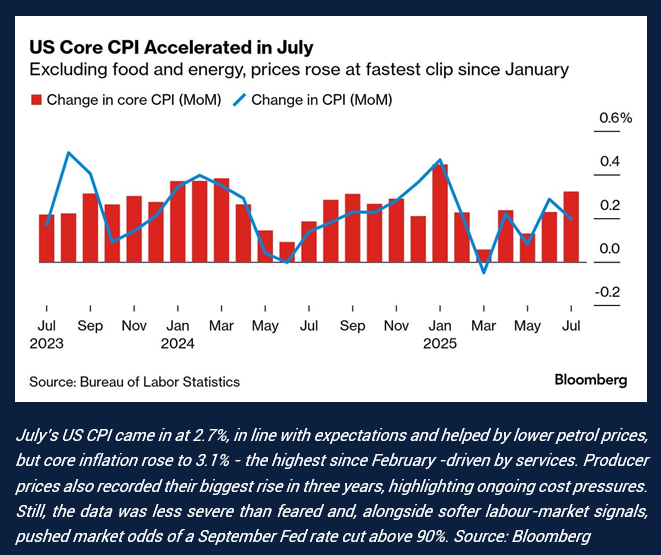
US inflation data was mixed. Headline CPI slowed to 0.2% in July, helped by lower energy and grocery prices, but core CPI rose 0.3% – its fastest pace this year. Producer prices also jumped 0.9%, the biggest increase in three years, keeping inflation concerns alive. On the positive side, retail sales rose 0.5% and jobless claims declined, pointing to resilience in household spending and employment. Still, consumer sentiment dipped as inflation worries resurfaced, highlighting the challenge the Fed faces in balancing growth with price stability.

In the UK, GDP growth surprised on the upside, with the economy expanding 0.4% in June and 0.3% for the second quarter, ahead of expectations but slower than earlier in the year. The labour market cooled slightly but remained stable – unemployment held at 4.7% while wage growth slowed. Retail sales softened and housing sentiment weakened further, pointing to pressure on households. Across Europe, momentum slowed as eurozone GDP barely grew (0.1% in Q2), industrial production fell, and investor confidence – particularly in Germany – dropped sharply. Norway’s central bank kept rates unchanged at 4.25% but signalled the possibility of further cuts later this year.

China’s data showed clear signs of slowing momentum. Industrial production, retail sales, and investment all missed expectations, while the property market weakened further with home prices down 2.8%. Household loan demand contracted, inflation was flat, and producer prices fell for the 34th straight month, underscoring persistent deflationary pressures. A 90-day extension on US-China tariff talks provided a short-term lift to sentiment, but weak data reinforced expectations that Beijing will need to ramp up fiscal support to stabilise growth.

Japan was a positive outlier. GDP expanded at an annualised 1.0% in the second quarter, well above forecasts, supported by stronger exports, resilient investment, and firmer consumer spending. Producer prices rose 2.6% year-on-year, adding to evidence of cost pressures. The yen strengthened and 10-year government bond yields climbed, as markets increasingly expect the Bank of Japan could raise rates later this year or in early 2026.

Geopolitical risks also remained in focus. Ukraine’s President Zelenskiy rejected Russian demands to cede the Donbas region ahead of US-Russia talks, while Russia’s banking sector came under renewed strain. State-owned VTB reported a near 50% collapse in lending profits, reflecting the heavy toll of sanctions and war financing.

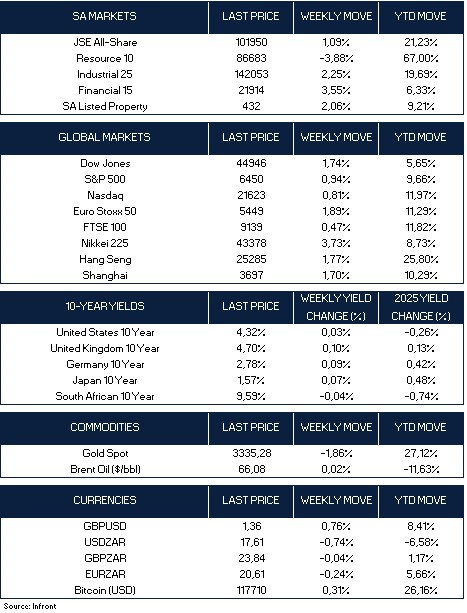
Global equities advanced last week, with most major indices ending higher. In the US, the Dow Jones gained 1.74%, while the S&P 500 and Nasdaq added 0.94% and 0.81% respectively. European markets were firmer, with the Euro Stoxx 50 rising 1.89% and the FTSE 100 up 0.47%. In Asia, sentiment was buoyant: Japan’s Nikkei jumped 3.73%, Hong Kong’s Hang Seng rose 1.77%, and China’s Shanghai Composite advanced 1.70%.

Market Moves of the Week:

South Africa’s unemployment rate edged higher in Q2, rising to 33.2% from 32.9% in Q1, underlining the fragility of the labour market. Manufacturing offered a bright spot, with output up 1.9% year-on-year in June, ahead of expectations and stronger than May’s 0.7% increase. Retail sales were weaker, rising just 1.6% year-on-year, with gains in textiles and clothing offset by declines at general dealers.

On the corporate front, ArcelorMittal South Africa remained in focus as government and the IDC held crisis talks over the future of its Newcastle mill. Without a resolution, the facility could close by 30 September, putting 3,500 direct jobs at risk and affecting industries reliant on its steel. Meanwhile, government announced plans for a $569 million credit-guarantee vehicle to support private infrastructure investment, with R2 billion in equity funding committed by the state.

South Africa’s government also rejected a US administration report that criticised the country’s human rights record, describing it as inaccurate and unreflective of South Africa’s constitutional democracy.

The JSE All Share Index gained 1.09% over the week, lifting year-to-date returns to 21.23%. Financials led the advance, climbing 3.55%, while industrials gained 2.25% and property added 2.06%. Resources pulled back 3.88% but remain the standout performer this year with a 67% gain. Despite headwinds, local equities continue to deliver strong returns in 2025.

Chart of the Week:

As always, we appreciate your support and value your trust in STRATEGIQ Capital.

Weekly Insights: Oil Prices Decline

U.S. equity markets posted strong weekly gains, recovering from the prior week’s pullback. The S&P 500 rose 2.4%, the Dow Jones Industrial Average added 1.4%, and the Nasdaq surged 3.9%. Technology shares led the rally, with Apple unveiling a $600 billion U.S. investment plan.

Investor sentiment was further buoyed by expectations of Federal Reserve rate cuts following President Trump’s nomination of Stephen Miran, Chair of the Council of Economic Advisers, to the Fed Board. Markets are now pricing in a ~90% probability of a September rate cut, with several Fed officials signalling openness to multiple cuts before year-end.

US corporate earnings remained robust with 90% of S&P 500 companies having reported Q2 results, blended earnings per share are up 11.7% year-on-year and revenue growth stands at 6.3% (FactSet).

The U.S. implemented a new round of global tariffs on Thursday, including a 50% tariff on Indian exports effective in three weeks due to India’s continued oil purchases from Russia. Tariffs on semiconductor imports were also announced, though exemptions were granted for companies investing in U.S. production facilities, notably benefiting Apple and major Asian chipmakers.

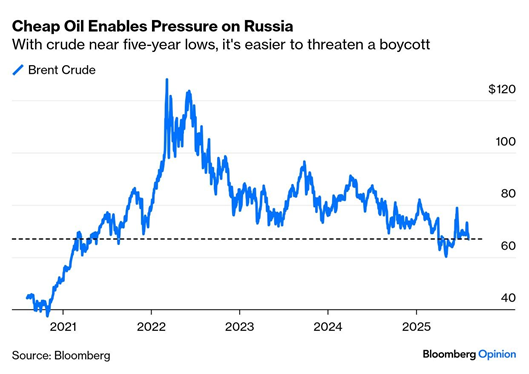
Brent crude fell more than 4% for the week to $66.6/bbl, despite potential supply risks from U.S. tariffs on Indian oil imports. OPEC+ announced that in September it will fully unwind the remaining voluntary 2.2 million barrels per day production cut introduced in late 2023, adding a further 574,000 barrels per day to global supply.

The STOXX Europe 50 Index gained 3.5%, supported by strong earnings and improved economic sentiment with robust retail sales reinforcing signs of a resilient eurozone economy in the second quarter. In the UK, the Bank of England cut rates by 25 bps to 4% in a close 5–4 vote, signalling a slower pace of easing ahead. The FTSE 100 rose 0.3% for the week.

Japan’s Nikkei 225 gained 2.50% for the week on solid corporate earnings. Mainland China’s Shanghai Composite rose 2.11% amid strong export growth (+7.2% YoY) and stable consumer prices, while Hong Kong’s Hang Seng gained 1.43%.

Gold prices held steady at ~$3,400/oz, supported by safe-haven demand from renewed trade tensions.

Looking at the week ahead, markets will watch U.S.–China trade talks ahead of the August 12 tariff deadline, as well as a possible Trump–Putin meeting with additional sanctions on Russian oil shipments remain under consideration if no ceasefire is reached in Ukraine.

Market Moves of the Week:

South African Reserve Bank (SARB) Governor Lesetja Kganyago signalled confidence that the central bank and National Treasury will reach an agreement on a new inflation target, following last week’s announcement that policymakers will now aim for 3%. The move drew criticism from Finance Minister Enoch Godongwana, who called it unilateral and a breach of the “established consultation process.” The two institutions have been reviewing the inflation framework since last year; the target has remained unchanged since its introduction in 2000.

U.S. imports from South Africa are set to face a 30% duty—currently the highest among Sub-Saharan African nations—which kicked in this week on August 8. President Cyril Ramaphosa’s office confirmed that he held a call with U.S. President Donald Trump, with both leaders agreeing that their trade teams would hold detailed negotiations in the coming days in pursuit of a revised arrangement.

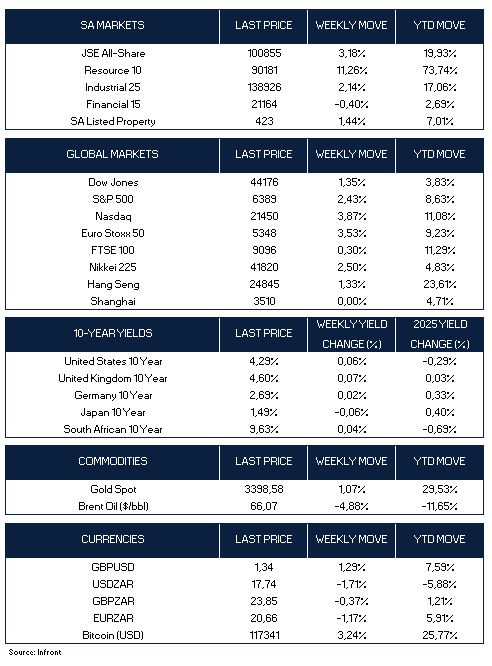
For the week, the JSE All Share Index posted strong gains (3.18%), driven by a rally in resource stocks on surging commodity prices. The rand strengthened to around 17.74/$, its firmest level since July 25, supported by a weaker U.S. dollar amid rising expectations of Federal Reserve rate cuts and ongoing global trade uncertainties.

Chart of the Week:

Last weekend’s OPEC+ meeting, which agreed to increase production in an already oversupplied market, pushed oil prices lower this week. Even the announcement of an additional 25% tariff on India (Russia’s largest oil customer, importing up to 1.7 million barrels per day) for purchasing Russian oil failed to stem the decline. Meanwhile, President Trump is pressuring Russia to agree to a ceasefire in Ukraine, warning of 100% “secondary tariffs” on countries continuing to import Russian crude.

As always, we appreciate your support and value your trust in LNKD Investment Managers. 

Weekly Insights: Global stocks fall amid Tariff Concerns

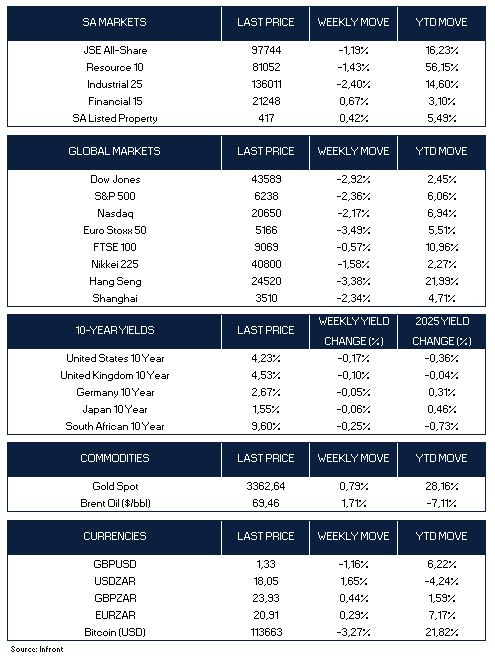
U.S. equities closed the week significantly lower, with major indices recording their steepest declines since the tariff-driven sell-off in early April. The downturn followed the expiration of President Trump’s 90-day moratorium on proposed “reciprocal” tariffs, compounded by the release of a weaker-than-expected July employment report. All three major indexes ended the week in negative territory: the S&P 500 fell 2.4%, marking its worst weekly performance since May 23; the Dow Jones Industrial Average declined 2.9%, its sharpest weekly loss since April 4; and the Nasdaq Composite retreated 2.2% over the same period.

The July employment report missed expectations by a wide margin. Nonfarm payrolls rose by just 73,000, well below the 100,000 forecast. More troubling were sharp downward revisions to previous months: June jobs were revised down to 14,000 (from 147,000) and May jobs fell to 19,000 (from 125,000). The unemployment rate ticked up to 4.2%, and the unexpectedly weak figures pushed Treasury yields lower as markets ramped up bets on a September Fed rate cut—now seen as more than 80% likely.

The Federal Reserve concluded its July monetary policy meeting on Wednesday, opting—as widely anticipated—to maintain the target federal funds rate within the range of 4.25% to 4.50%. However, the decision was not unanimous, with Governors Michelle Bowman and Christopher Waller dissenting in favour of a 25 basis point cut. The FOMC’s statement noted that economic activity had moderated in the first half of the year, a detail viewed by some investors as dovish.

In his post-meeting press conference, Chair Jerome Powell reaffirmed the Fed’s data-dependent approach, emphasizing that inflation remains above target and that no decisions had been made regarding a potential rate cut in September. His comments, combined with concerns over the inflationary impact of new tariffs, tempered market expectations for near-term easing.

Data released by the Bureau of Economic Analysis (BEA) on Thursday revealed that inflation picked up in June, adding complexity to the Federal Reserve’s policy outlook. The core Personal Consumption Expenditures (PCE) index—the Fed’s preferred inflation gauge—rose 0.3% month over month, up from 0.2% in May. On an annual basis, core PCE increased 2.8%, remaining well above the Fed’s 2% target and marking one of the fastest monthly gains this year.

At the same time, consumer spending showed minimal growth, reflecting underlying economic softness. Real disposable income was flat, following a decline in May, while wages and salaries posted only modest gains, suggesting a cooling labour market.

Meanwhile, U.S. economic growth moderated in the first half of the year amid subdued consumer activity and heightened trade policy uncertainty. Inflation-adjusted GDP expanded at an annualized rate of 3% in Q2, according to official data. However, average growth for the first half stood at just 1.25%, significantly below the 2024 pace, highlighting the broader slowdown in economic momentum.

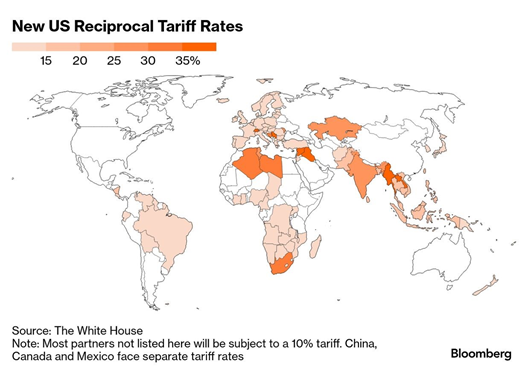
On Thursday, President Trump signed an executive order imposing increased tariffs on the majority of U.S. trading partners, with updated duties ranging from 10% to 41% effective August 7. The announcement followed a series of developments throughout the week, including new trade agreements with the European Union and South Korea, as well as a 90-day extension for ongoing negotiations with Mexico.
 
Among countries facing the steepest “reciprocal” tariffs, Syria has the highest rate at 41%. Exports from Laos and Myanmar to the U.S. will face a 40% duty. Switzerland and South Africa will be hit with tariffs of 39% and 30%, respectively. For some Asian nations that have not confirmed a trade pact with the U.S., the latest executive order offered some relief with lower duties. The new tariff rates on imports from Thailand will be lowered to 19% from 36%, and those from Malaysia will be reduced to 19% from the 24% rate set earlier. Shipments from Taiwan will face a 20% tariff, lower than the 32% rate set earlier.

Trump also followed through on his plan to raise tariffs on exports from Canada to 35% from 25%, starting Friday, barring goods that are covered under the U.S.-Mexico-Canada free trade pact he signed during his first term.

All goods that are considered to have been transshipped to avoid applicable duties will also be subject to an additional 40% tariff, according to the White House.

In local currency terms, the pan-European STOXX Europe 50 Index declined 3.5%, reflecting disappointment over the U.S.–EU trade framework. The UK’s FTSE 100 Index slipped 0.57%, supported in part by the weakening of the pound against the U.S. dollar. Robust eurozone economic data appeared to ease pressure on the European Central Bank to cut rates further. Headline inflation remained at 2.0% in July, slightly above the 1.9% forecast and matching the ECB’s target. GDP grew 0.1% in the second quarter, while the unemployment rate held steady at a record low of 6.2% in June.

In Japan, equity markets declined, with the Nikkei 225 down 1.58% while the 10-year government bond yield slipped to 1.55%. As expected, the Bank of Japan kept its policy rate unchanged at 0.5% and raised its core CPI forecast for FY2025 to 2.7%, citing continued food price inflation.

Chinese markets retreated amid concerns over new U.S. tariffs and signs of domestic economic slowing with recent PMI data pointed to sluggish domestic demand and persistent global uncertainty. The benchmark Shanghai Composite lost 2.3%, while Hong Kong’s Hang Seng Index dropped 3.4%.

Commodity markets were mixed. Spot gold rose nearly 2% to above $3,350 per ounce on expectations of a U.S. rate cut, following signs of labour market cooling, while Brent crude futures fell 2.8% to $69.70 per barrel on speculation that OPEC+ may agree to increase output by 548,000 barrels per day in September.

Looking ahead, markets will remain focused on U.S. trade policy following the August 1 tariff announcement. Key U.S. data releases include the ISM Services PMI, trade balance, factory orders, and preliminary Q2 productivity and labor cost figures. Globally, monetary policy decisions are expected from the Bank of England, Reserve Bank of India, and Mexico’s central bank.

Market Moves of the Week:

The JSE experienced its largest intraday decline since June 13 on Friday, reacting to the imminent expiration of a key deadline to avoid new U.S. tariffs on South African exports. The long-anticipated 30% tariff, set to take effect in seven days, triggered a broad sell-off after South Africa’s efforts to negotiate a more favourable trade agreement with the Trump administration failed. In response, the Department of Trade, Industry and Competition (DTIC) announced mitigating measures to ease the impact.

The All Share ended the week 1.19% lower, led by declines in industrial and resource stocks. The rand weakened to R18.29 against the dollar in early trade on Friday – its lowest level since 7 May, before recouping some losses to end the week at R18.05/$.

On Thursday, the South African Reserve Bank’s (SARB) Monetary Policy Committee cut the repo rate, citing improved domestic economic conditions. The July MPC meeting, which unanimously approved the 25bp cut, also revised inflation forecasts downward by 0.9 and 1.4 percentage points for 2026 and 2027, respectively, to 3.3% and 3.0%. The bank adjusted its GDP growth forecast, lowering 2026 expectations by 0.2 percentage points to 1.3%, while raising the 2027 outlook by 0.2 percentage points to 2.0%, citing balanced risks to growth and inflation.

In a significant policy shift, the SARB effectively lowered its inflation target from 4.5% to 3%, moving focus from the midpoint to the lower bound of the 3–6% target range. National Treasury plans to address this change in its October Medium Term Budget Policy Statement.

Chart of the Week:

U.S. President Donald Trump signed an executive order on Thursday imposing “reciprocal” tariffs ranging from 10% to 41% on imports from dozens of countries and foreign locations, shortly after extending the deadline for a tariff deal with Mexico by another 90 days. The order listed higher import duty rates that would start from 7 August for 69 trading partners.

As always, we appreciate your support and value your trust in LNKD Investment Managers. 

Weekly Insights: US and Japan Reach Trade Agreement

The US and Japan announced a broad trade agreement on Tuesday that lowers tariffs on Japanese exports, including autos, from 25% to 15%, while granting tariff-free access for US goods into Japan. As part of the deal, Japan committed to $550 billion in equity, loans, and loan guarantees to support US-bound investment – a component Treasury Secretary Scott Bessent described as central to the pact. Japan also agreed to open its market to US vehicles, agricultural products, Boeing aircraft, and defence exports. Notably, the 50% tariff on Japanese steel remains in place.

President Trump renewed criticism of Federal Reserve Chair Jerome Powell, accusing the Fed of keeping interest rates elevated for political reasons and calling the Fed board “lacking in courage.” During a contentious visit to the Fed’s Washington headquarters – amid scrutiny over costly renovations – Powell appeared visibly uncomfortable. Trump later said he did not see removing Powell as necessary. Meanwhile, Treasury Secretary Bessent called for a systemic review of the Fed’s governance amid ongoing controversy.

Economic data offered a mixed picture. S&P Global’s flash PMI for July showed private sector growth accelerating to a seven-month high of 54.6, driven by a strong services sector (55.2). Manufacturing, however, contracted, dropping to 49.5`the lowest since December.

At its 24 July meeting, the European Central Bank held its deposit rate steady at 2.0% after eight consecutive cuts since June 2024. ECB President Christine Lagarde highlighted persistent global uncertainties, particularly trade tensions, as justification for a cautious “wait-and-see” stance. Meanwhile, Eurozone business activity improved modestly, with the HCOB flash composite PMI rising to 51.0 in July from 50.6, supported by gains in both services and manufacturing.

In the UK, retail sales rose 0.9% in June, rebounding from a steep May decline. Despite warmer weather, consumer demand remained subdued. The July flash composite PMI also edged down to 51.0 from 52.0 as services weakened and employment indicators signalled labour market strain, pressured by higher payroll taxes and ongoing trade frictions.

Tokyo’s core CPI rose 2.9% year-on-year in July, slightly below expectations and down from June’s 3.1%. Despite easing, inflation remains above the Bank of Japan’s 2% target. With reduced uncertainty following the trade deal, investor expectations are shifting toward another BoJ rate hike later this year.

U.S. Treasury Secretary Scott Bessent is scheduled to meet Chinese officials in Stockholm this week for a third round of talks aimed at extending the current trade deal expiring in August. Previous discussions in Geneva and London led to a temporary tariff pause and eased export controls. Though tensions persist after April’s 145% U.S. tariff hike on Chinese imports, talks have eased fears of a complete decoupling.

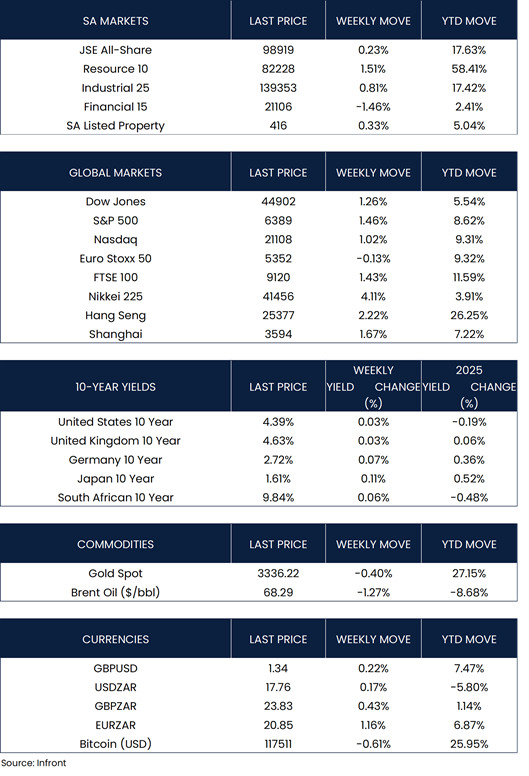
Equity markets broadly advanced as trade developments helped lift investor sentiment. In the U.S., the S&P 500 (+1.46%) and Nasdaq (+1.02%) recorded fresh all-time highs for the second consecutive week, while the Dow rose 1.26%, supported by announcements of new trade deals with Japan, Indonesia, and the Philippines.

In Europe, the pan-European STOXX Europe 50 slipped -0.13% (local currency), as optimism around a potential EU-U.S. trade deal was tempered by warnings of possible retaliatory tariffs. Meanwhile, the UK’s FTSE 100 rose 1.43%
  
Asian markets posted strong gains. Japan’s Nikkei 225 rallied 4.11%, buoyed by news of a trade agreement with the U.S., which helped offset concerns around political uncertainty following the ruling coalition’s loss of its upper house majority. Chinese equities also advanced, with the Shanghai Composite up 1.67% and the Hang Seng climbing 2.22%, as markets looked ahead to another round of U.S.-China trade talks.

Market Moves of the Week:

Statistics South Africa (Stats SA) reported on Wednesday that annual consumer price inflation rose to 3.0% in June, up from 2.8% in May, ending two months of stability. The consumer price index (CPI) increased 0.3% month-on-month, with food and non-alcoholic beverages recording their highest annual inflation in over a year. Core inflation, which excludes volatile items like food, fuel, and energy, eased slightly to 2.9% from 3.0%. This data precedes the South African Reserve Bank’s Monetary Policy Committee meeting on 31 July, where a potential rate cut remains under consideration.

Meanwhile, the U.S. House Foreign Affairs Committee advanced the “U.S.–South Africa Bilateral Relations Review Act,” which could sanction South African officials over concerns about the country’s foreign policy, including ties with China and Russia. President Cyril Ramaphosa acknowledged the bill, expressing hope for diplomacy to prevail and stating that it will not change South Africa’s approach to its relationship with the United States.

The JSE All Share Index rose modestly by 0.23% over the week, buoyed primarily by a 1.51% gain in the resources sector. Industrials (+0.81%) and property (+0.33%) also contributed positively, while the financial sector was the sole laggard, slipping 1.46%. By Friday’s close, the rand weakened slightly by 0.17% against the U.S. dollar, trading at R17.76, pressured by a stronger dollar and declining gold prices.

Chart of the Week:

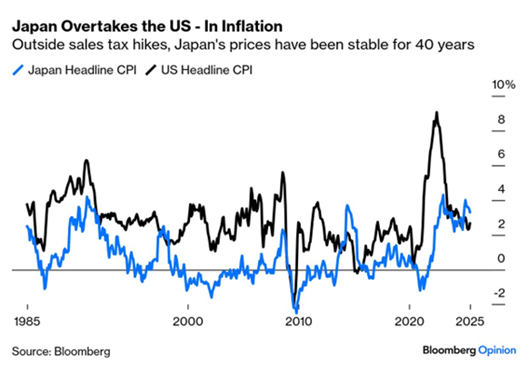
Japan’s inflation has rarely exceeded U.S. CPI over the past four decades, aside from brief spikes caused by sales tax hikes. However, recent data show Japanese inflation surpassing U.S. levels, marking a significant shift in long-term trends. Source: Bloomberg.

As always, we appreciate your support and value your trust in LNKD Investment Managers. 

Weekly Insights: Robust U.S. Data Drives Stocks to Record Highs

In June, U.S. consumer and producer price data hinted at the early effects of rising tariffs, but overall figures remained modest, suggesting a minimal impact so far. Inflation expectations continued to ease, with the University of Michigan’s year-ahead gauge falling to a five-month low of 4.4%. Retail sales exceeded forecasts, with core sales up 0.5%, and jobless claims dropped to their lowest level since April. Despite tariff-related uncertainty, the U.S. economy remains resilient.

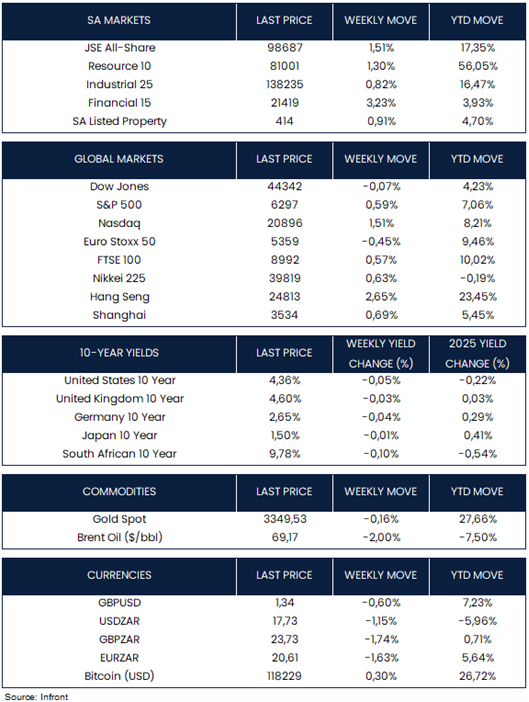
The S&P 500 (+0.59%) and Nasdaq Composite (+1.51%) reached new record highs during the week, buoyed by strong corporate earnings and broadly positive economic data. In contrast, the Dow Jones Industrial Average (-0.07%) ended the week in negative territory. Earnings season kicked off on Tuesday, with major banks leading the way. JPMorgan Chase and Citigroup both delivered better-than-expected second-quarter results. Later in the week, consumer-focused companies such as PepsiCo, United Airlines, and Netflix also posted earnings that surpassed analyst forecasts. Elsewhere, chipmaker NVIDIA rallied after announcing it had received approval from the Trump administration to sell its H2O AI chips to China.

With the August 1 deadline nearing, U.S. trade talks continue. President Trump announced a deal with Indonesia involving the purchase of Boeing jets, energy, and agricultural goods, while setting U.S. import tariffs at 19%, down from a proposed 32%. U.S. exports to Indonesia will remain tariff-free, and the deal may serve as a model for other Southeast Asian countries. Meanwhile, Trump threatened 30% tariffs on the EU and Mexico, pressing for reduced barriers and tougher action on narcotics. The EU is preparing countermeasures and Canada’s PM Carney said a deal is close, though avoiding all U.S. tariffs may be unlikely.

UK inflation rose unexpectedly to 3.6% in June, the highest since January 2024, driven by higher transport and fuel costs. Services inflation held steady at 4.7%, defying expectations of a decline and signalling ongoing price pressures. Meanwhile, the labour market softened, with unemployment edging up to 4.7% – a four-year high. The FTSE 100 gained 0.57% w/w, supported in part by a weaker pound against the U.S. dollar. In Europe, the Euro Stoxx 50 dipped -0.45% w/w as investors awaited developments in U.S.-Europe trade talks.

Mainland Chinese markets posted weekly gains, with the Shanghai Composite rising 0.69% in local currency terms. In Hong Kong, the Hang Seng Index advanced 2.65%. China’s GDP grew 5.2% y/y in the second quarter, slightly below the 5.4% pace in Q1. However, the better-than-expected result is seen as reducing the urgency for additional stimulus from Beijing, according to analysts. Elsewhere in Asia, Japan’s stock market posted modest weekly gains, with the Nikkei 225 up 0.63%. Gains were limited by political uncertainty ahead of the July 20 Upper House election, where the ruling coalition risks losing its majority.

On the commodity front, oil prices fell on the week, with Brent oil dipping 2%. Gold dropped -0.16% w/w as risk sentiment improved globally.

Market Moves of the Week:

South Africa’s retail sector is gaining momentum, supported by lower inflation, Two-Pot retirement withdrawals, and falling fuel prices. Stats SA data showed retail sales rose 4.2% y/y in May, after a 5.2% increase in April. Six out of seven retail groups grew, led by textiles, clothing, footwear, and leather goods, which surged 12.5%.

In other news, China has expressed interest in strengthening supply chain cooperation with SA and expanding collaboration in sectors such as new energy and the digital economy, according to its commerce ministry. The two countries are also expected to deepen engagement under platforms like the WTO, G20, and BRICS.

UK Chancellor Rachel Reeves has announced a plan to support SA infrastructure by offering technical expertise to fast-track major projects. President Ramaphosa estimates the country needs R4.8 trillion in investment by 2030, while the Treasury has committed R1 trillion over the next three years. Meanwhile, SA is in discussions to secure a R54 billion loan from a consortium of lenders, including the World Bank, KfW, and the African Development Bank, Finance Minister Enoch Godongwana told Bloomberg TV.

The All-Share Index rose by 1.51% this week, boosted by Financials (+3.23%). The local currency strengthened against the U.S. dollar, moving to R17.73/$ from last week’s R17.93/$ level. SA government bond yields moved lower on the week, dipping 0.10%.

Chart of the Week:

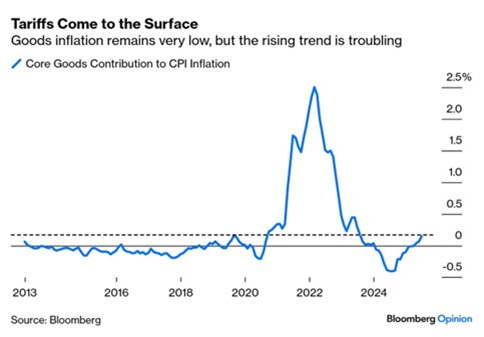
Are tariffs at last beginning to push up inflation? Core goods inflation had been negative for many years before the post-pandemic spike. Its current rate is the highest in more than a decade, outside of that spike. Source: Bloomberg.

As always, we appreciate your support and value your trust in LNKD Investment Managers. 

Weekly Insights: Tariff Threats Resurface

Global markets were rattled this week by renewed trade tensions, with President Trump confirming the imposition of 25% tariffs on Japanese and South Korean imports from 1 August. Fourteen other countries – including South Africa – have been warned of similar hikes unless trade concessions are made. While the White House extended its original tariff deadline to August, the threats are already impacting sentiment. Analysts estimate that if fully implemented, these measures could raise the U.S. effective tariff rate by 1.4 percentage points. Commodity markets reacted quickly, with metals prices trading at a 25% premium to the London Metal Exchange, reflecting supply disruption concerns.

Adding to the uncertainty, the Federal Reserve Bank of Dallas warned that Trump’s stricter immigration policies could shave between 0.8% and 1.5% off U.S. GDP over the next few years due to lower labour force participation. U.S. economic data was mixed – mortgage applications rose 9.4% on the back of lower rates, but small business optimism fell to its lowest in over a year, underscoring the drag from policy volatility and trade uncertainty.

In other news, a senior Trump administration official claimed on Friday that Fed Chair Jerome Powell is “considering resigning” amid calls for a probe into whether he misled Congress about costly renovations to the Fed’s Washington headquarters. Bill Pulte, chair of Fannie Mae and Freddie Mac, who posted on X that he had “heard reports” of Powell possibly not completing his term – though no evidence was provided.

In the UK, GDP shrank by 0.1% in May after a 0.3% contraction in April, weighed down by declines in construction, manufacturing, and retail. Although house prices stabilised, activity in the housing market remains weak. Slowing wage growth may allow the Bank of England to cut rates further, with two more reductions expected this year.

Across Europe, economic signals also varied. German industrial production rose 1.2% in May, reversing April’s decline, but exports continued to fall. Eurozone retail sales dipped 0.7% month-on-month, while annual growth slowed to 1.8%. EU officials are working to secure a deal with the U.S. to limit tariffs to 10%, hoping to avoid further escalation. Meanwhile, investor sentiment improved slightly on the back of falling inflation and a more dovish stance from the European Central Bank.

Japan also felt the impact of U.S. trade policy, with tariffs on its exports set to rise to 25%. The yen weakened, and equity markets dipped as investors reacted to rising political risk ahead of the July 20 Upper House election. In economic news – wage growth disappointed, but household spending rebounded strongly, rising 4.7% year-on-year.

In China, factory-gate deflation deepened, with the Producer Price Index falling 3.6% – the biggest drop in nearly two years. While consumer prices edged up 0.1%, analysts caution this is more likely a result of stimulus than improved demand. Policymakers are expected to announce further easing measures at the upcoming Lujiazui Forum, as they try to stabilise prices, profits, and consumer confidence.

Elsewhere, Brazil’s President Lula downplayed the importance of U.S. trade, saying the country would seek new partners if needed. Global investors remain cautious as tariff threats, Middle East tensions, and policy fatigue continue to shape the economic outlook for the second half of the year.

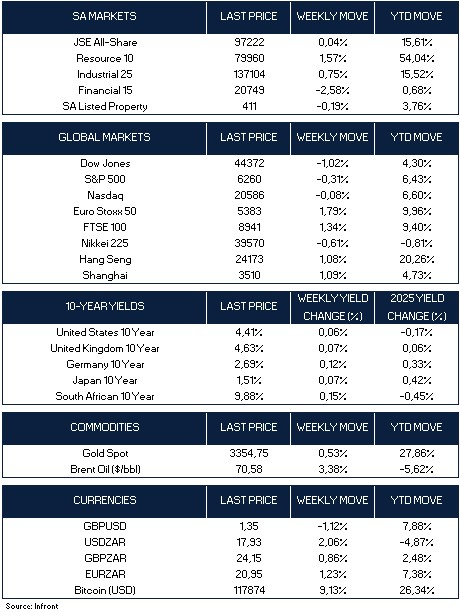
Global equity market performances were uneven. U.S. indices were slightly lower, with the Dow down 1.02%, the S&P 500 off 0.31%, and the Nasdaq slipping just 0.08%. European stocks performed better – Euro Stoxx 50 rose 1.79% and the FTSE 100 gained 1.34%. In Asia, Japan’s Nikkei fell 0.61%, while the Hang Seng and Shanghai Composite both advanced over 1%. U.S. bond yields edged higher, with the 10-year Treasury yield rising to 4.41%. Gold gained 0.53%, and Brent crude surged 3.38% to $70.58 amid ongoing supply concerns. The dollar strengthened, and Bitcoin jumped over 9% for the week.

Market Moves of the Week:

The Trump administration imposed a 30% tariff on all South African exports to the U.S. from 1 August, with threats of further hikes if South Africa retaliates. This raises concerns for key export sectors. Domestically, political pressure mounted ahead of President Ramaphosa’s Sunday address to the nation, following allegations implicating senior police and political figures. The Democratic Alliance has laid criminal charges against the police minister, intensifying post-election coalition tensions.

Manufacturing production surprised to the upside, rising 0.5% year-on-year in May after a steep decline in April. In the energy sector, Shell received environmental approval to drill five ultra-deep-water wells off South Africa’s west coast, targeting the Orange Basin. While the potential is significant, regulatory and environmental hurdles remain. A successful outcome could help reduce reliance on fuel imports and support long-term energy security.

South African equities ended the week marginally positive, with the JSE All Share Index up 0.04%. Resource stocks led the gains, rising 1.57%, followed by industrials which added 0.75%. In contrast, financials fell sharply by 2.58%, while listed property dipped 0.19%. The rand weakened notably against the U.S. dollar, depreciating by 2.06% to close at R17.93, amid broader dollar strength and shifting global risk appetite.

Chart of the Week:

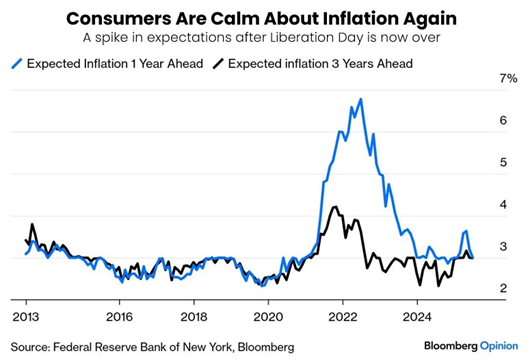
Consumer inflation expectations have eased back to pre-tariff levels, according to the New York Fed’s June survey. Median one-year ahead inflation expectations declined to 3%, marking a second consecutive monthly drop. Longer-term expectations held steady at 3.0% (three-year) and 2.6% (five-year). This aligns with recent government data showing softer inflation than anticipated, despite concerns that Trump’s trade policies could rekindle price pressures. Source: Bloomberg.

As always, we appreciate your support and value your trust in LNKD Investment Managers. 

Weekly Insights: U.S. Job Growth Beats Expectations

U.S. lawmakers made meaningful progress on the long-debated budget reconciliation bill this week. The Senate passed the legislation on Tuesday, and the House approved it Thursday afternoon after a lengthy speech by House Minority Leader Hakeem Jeffries briefly that delayed proceedings. With a key procedural hurdle cleared earlier that day, the bill now awaits final adoption.

Meanwhile, the U.S. Labor Department reported 147,000 jobs added in June—exceeding expectations and up from May’s revised 144,000. The unemployment rate edged down to 4.1%, and average hourly earnings rose 0.2% month over month. This stronger report followed a surprise 33,000 drop in private payrolls from ADP data earlier in the week—the first decline since March 2023.

U.S. manufacturing contracted for the fourth consecutive month in June. The ISM Manufacturing PMI rose slightly to 49.0 from 48.5 in May, indicating slower contraction but remaining below the 50.0 expansion mark. Softer demand and uncertainty weighed on factory activity. In contrast, the services sector showed resilience, with the ISM Services PMI climbing into expansion at 50.8, driven by stronger business activity and new orders.

Tensions between President Trump and Federal Reserve Chair Jerome Powell have increased, with Trump calling for Powell’s resignation over persistently high interest rates. Though Powell focuses on inflation risks, the administration is reportedly exploring replacements. Experts note removing Powell before his 2026 term ends would face legal challenges.

Eurozone inflation edged up in June, with the headline rate reaching the ECB’s 2.0% target, up from 1.9% in May. Core inflation remained steady at 2.3%, signalling persistent underlying price pressures. Services inflation rose slightly to 3.3% from 3.2%, underscoring ongoing challenges in bringing inflation sustainably to target.

The UK manufacturing sector showed early signs of stabilisation in June. The S&P Global/CIPS Manufacturing PMI rose for the third month to 47.7 from 46.4 in May. Though still below 50.0, the upward trend and firms’ ability to raise prices amid rising wages suggest gradual improvement after a prolonged downturn.

China’s economic data was mixed. The official manufacturing PMI edged up to 49.7 in June from 49.5 in May, the first full month post the U.S.–China tariff truce. Despite remaining below expansion territory, the slight gain raises questions about further stimulus from Beijing. The Caixin General Services PMI fell to a nine-month low of 50.6 from 51.1, with slower new business growth and hiring weakness, indicating subdued confidence among service providers.

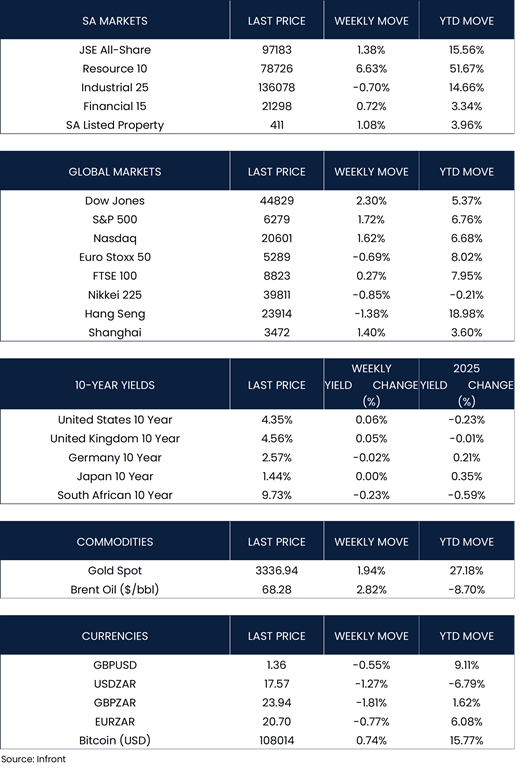
Major U.S. equity indices ended the holiday-shortened week in positive territory. Both the S&P 500 and Nasdaq Composite recorded all-time closing highs for a second consecutive week, gaining 1.72% and 1.62%, respectively. The Dow Jones Industrial Average also advanced, rising 2.30% over the week.

In Europe, performance was mixed. The Euro Stoxx 50 Index declined by 0.69%, while the UK’s FTSE 100 edged slightly higher, ending the week up 0.27%. Asian markets also varied. Japan’s Nikkei 225 Index declined by 0.85%, while mainland Chinese equities posted gains, with the Shanghai Composite Index rising 1.40% in local currency terms. In contrast, Hong Kong’s Hang Seng Index fell 1.38% over the same period.

Market Moves of the Week:

South Africa has formally requested an extension to the 9 July deadline for the U.S.’s proposed tariffs on key exports, including steel, aluminium, and automotive products. In an effort to secure a bilateral trade agreement, South Africa has offered to increase imports of U.S. liquefied natural gas (LNG) and proposed capping tariffs at 10% instead of the initially proposed 31%. Discussions between South African trade officials and the U.S. Trade Representative are ongoing as both sides work to align on a new Africa-focused trade framework. The extension aims to provide additional time to finalise terms that protect vital sectors of the South African economy and safeguard approximately 35,000 jobs, particularly in manufacturing and agriculture.

The JSE All-Share Index advanced 1.38% over the week, supported notably by a strong 6.63% gain in the resources sector. Financials and property sectors posted modest gains of 0.72% and 1.08%, respectively, while the industrial sector declined by 0.70%. Meanwhile, the rand strengthened modestly, appreciating 1.27% against the U.S. dollar to close at R17.57 on Friday.

Chart of the Week:

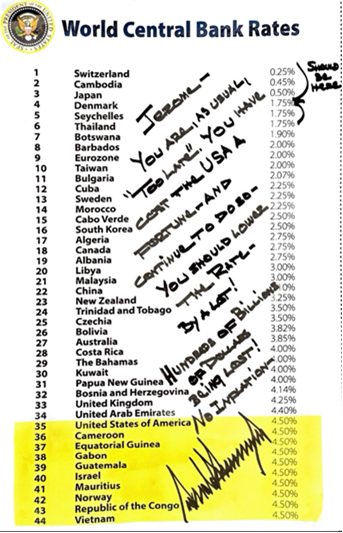
President Trump has called for interest rates to be cut to 1%, criticising the Federal Reserve for keeping policy too tight. The remarks have fuelled renewed scrutiny over Fed independence and raised questions about the future of monetary policy under his administration.

As always, we appreciate your support and value your trust in LNKD Investement Managers. 

Weekly Insights: Markets rise on Improved Geopolitical, Trade Outlook

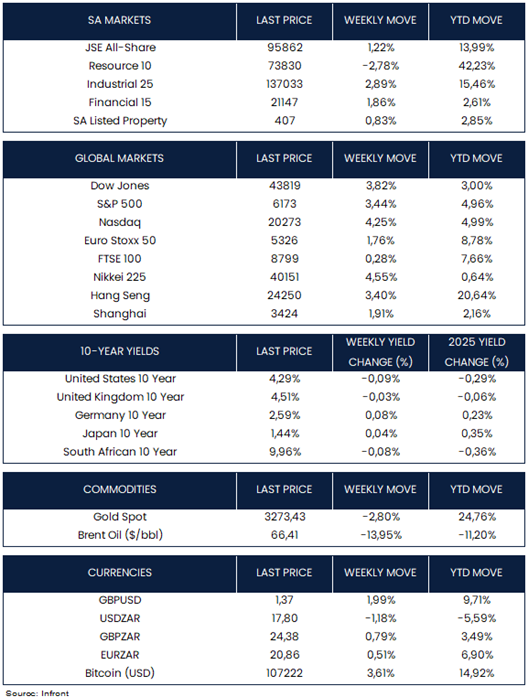
U.S. stocks rallied over the week, lifted by a string of positive developments, including easing tensions in the Middle East, dovish signals from several Federal Reserve officials, news of a signed U.S.-China trade deal and indications from U.S. policymakers that further trade deals were nearing completion. The S&P 500 gained 3.4% and the Nasdaq rose 4.3% – both closing at record highs. The Dow Jones Index also managed a 3.8% w/w gain.

On the U.S. economic data front, the Fed’s preferred inflation measure ticked up slightly in May, with core PCE rising 0.2% m/m and 2.7% y/y, both just above estimates. Personal income and spending both declined, missing forecasts. Meanwhile, consumer inflation expectations for the year ahead fell sharply from 6.6% to 5%, and the University of Michigan’s consumer sentiment index jumped 16% to 60.7.

NATO Secretary General Mark Rutte announced this week that all member states are on track to meet the 2% of GDP defence spending goal, with plans to raise that to 5% annually by 2035. Germany said it will increase defence spending by two-thirds by 2029. Just before the meeting in The Hague, the EU and Canada signed a new security pact, strengthening their defence ties. Following the summit, Trump reaffirmed U.S. support for NATO’s Article 5 mutual defence commitment.

European Central Bank President Christine Lagarde said that the central bank anticipates slower short-term growth but expects inflation to settle sustainably around the 2% target. Bank of England Governor Andrew Bailey told parliament that UK monetary policy focuses more on domestic rather than international factors, noting a softening labour market and rising economic slack. He said interest rates will likely decline gradually and cautiously. In market activity, the Euro Stoxx 50 rose 1.8% while the FTSE 100 eked out a 0.3% gain.

Japan’s stock market saw strong gains this week, with the Nikkei 225 rising 4.6%. Technology stocks performed well, boosted by reduced fears of a global trade war and early indications that the Iran-Israel ceasefire is holding, helping lift investor risk appetite.

Mainland Chinese stocks rose after the U.S. and China finalised a trade framework from last month’s Geneva talks. The Shanghai Composite rose 1.9%, and Hong Kong’s Hang Seng jumped 3.4%. The framework, announced by U.S. Commerce Secretary Howard Lutnick, eased trade tensions temporarily. Beijing confirmed parts of the deal, including commitments on rare earth exports, but details were limited and key issues like fentanyl trafficking were not addressed.

On the commodity front, oil prices fell over 18% from Monday’s highs to Tuesday’s lows before stabilizing in the mid-$60s as the near-term threat of a disruption to Middle East oil supplies receded (Brent Oil, -14% w/w). Gold dipped -2.8% w/w as risk sentiment improved globally.

Market Moves of the Week:

South Africa recorded its first consecutive primary budget surplus in 16 years, underscoring a renewed focus on fiscal discipline. The SA Reserve Bank’s latest Quarterly Bulletin showed a surplus of R48.9 billion ($2.8 billion), or 0.7% of GDP, for the year ending March 2025. While this aligns with the National Treasury’s May forecast, it falls short of the earlier R61 billion estimate for 2024. The surplus is likely to be welcomed by investors and the unity government, which delivered its first budget after months of political wrangling over tax hikes.

President Ramaphosa’s dismissal of DA Deputy Minister of Trade, Industry and Competition Andrew Whitfield without explanation has strained the fragile government of national unity. The DA claims Whitfield was fired for traveling abroad without approval, while ANC members implicated in corruption remain in office. Despite calling the move an “assault,” the DA backed the national budget bill, saying their support was for the country, not politics.

The All-Share Index rose by 1.22% this week, held back by losses in Resources (-2.78%). The local currency strengthened against the U.S. dollar, moving to R17.80/$ from last week’s R18.01/$ level. SA government bond yields moved lower on the week, dipping 0.08%.

Chart of the Week:

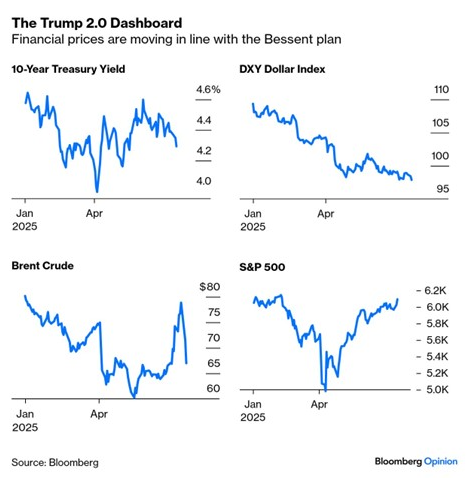
International markets are handing Trump 2.0 another victory. The S&P 500 is back to its record. Treasury Secretary Scott Bessent has targeted lower bond yields, cheaper oil, and a weaker dollar. The market is delivering all of them. Source: Bloomberg.

As always, we appreciate your support and value your trust in LNKD Investment Managers.