Weekly Insights: U.S. consumer sentiment falls on economic fears

The U.S. Conference Board’s consumer confidence index dropped to 92.9 in March from 100.1 in February, marking its fourth consecutive decline. The expectations index fell 9.6 points to 65.2, its lowest in 12 years, staying below the recession-warning threshold of 80 for a second month. The report noted fading optimism about future income, reflecting growing economic and labour market concerns.

U.S. stock indexes fell over the week, weighed down by declines in the technology and communication services sectors, while value stocks outperformed growth for a sixth straight week. Markets started with cautious optimism, but sentiment shifted after new tariff announcements on Wednesday, including a 25% levy on non-U.S.-made cars, effective April 3.

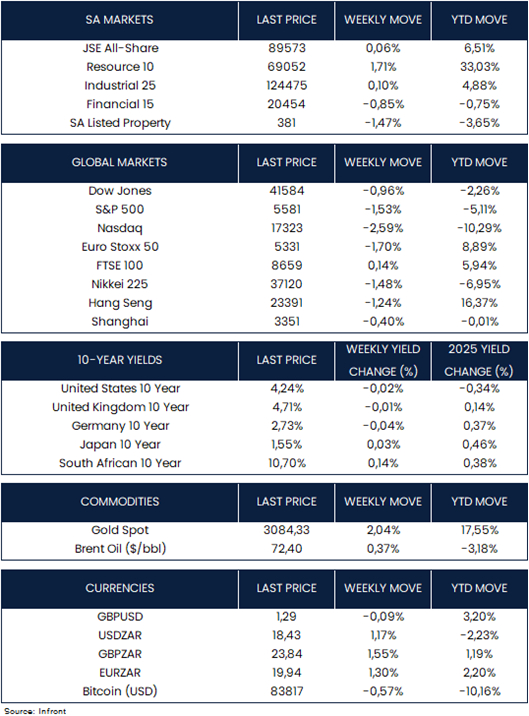
Adding pressure, the Bureau of Economic Analysis reported core PCE inflation rose 0.4% in February (up from January’s 0.3% reading), with annual inflation at 2.8%, exceeding the Fed’s 2% target. Sluggish consumer spending and inflation fears contributed to a market selloff, pushing stocks lower into the week’s close. The Dow Jones (-0.96% w/w) faired best, while the S&P 500 (-1.53%) and Nasdaq (-2.59%) experienced steeper declines.

The Euro Stoxx 50 Index closed -1.70% over the week as Trump’s fresh auto tariffs hurt sentiment. The blanket application was the worst-case scenario for Europe, as there had been hopes that some countries might be granted an exemption. This marked a disappointing week for European markets, which had begun positively, buoyed by favourable economic updates and geopolitical news.

In the UK, British Chancellor Rachel Reeves presented the annual Spring Statement, announcing additional spending cuts. The Office for Budget Responsibility (OBR) lowered its UK economic growth forecast for 2025 to 1%, also predicting higher unemployment and inflation this year. However, the OBR raised its growth projections for 2026-2029. On a positive note, UK inflation eased to 2.8% in February from 3% in January, keeping the prospect of a May interest rate cut alive. The FTSE 100 ended the week 0.14% higher.

Japan’s stock market declined over the week, with the Nikkei 225 Index dropping 1.48%. Japan’s Prime Minister Shigeru Ishiba called the impact of the U.S. auto tariff on Japan’s key auto industry and economy “significant,” noting that autos make up about one-third of Japan’s U.S. exports. He emphasized the need for appropriate responses, with all options considered. Japan is pushing for an exemption from the tariff through diplomatic efforts, including increased investments and energy purchases. Elsewhere in Asia, China’s Shanghai Index (-0.40%) ended the week little changed amid a light economic calendar.

On the commodity front, “safe haven” Gold (+2.04% w/w) hit all-time highs on Friday ($3,086) after the release of US PCE data. Brent oil ended the week up 0.37% for its third weekly gain. 

Market Moves of the Week:
The South African (SA) government is establishing a Private Sector Participation (PSP) unit to attract investment in ports and rail, mirroring the success of the independent power producers’ office. Transport Minister Barbara Creecy said a deal with the Development Bank of Southern Africa (DBSA) and National Treasury is in its final stages, with the DBSA set to host the unit.

SA retail confidence fell from 54% to 50% in Q1 2025, according to the Bureau for Economic Research (BER). Despite the dip, confidence remains above the long-term average, with half of retailers satisfied with business conditions. The BER noted improving sentiment in the motor trade sector, especially among new vehicle dealers, as a positive sign for consumer health.
Foreign investors offloaded South African equities at the fastest rate in over a year during Q4 2024, favouring the country’s bonds instead. This shift contributed to a 26% decline in portfolio inflows, which fell to 33.4 billion rand ($1.8 billion) compared to the previous quarter, according to the South African Reserve Bank’s Quarterly Bulletin released on Thursday.
On the political front, News24 reported Friday that the ANC rejected the DA’s request for a deal on jointly managing economic policy. The DA had reportedly tied its budget support to securing such an agreement.
The All-Share Index edged higher on the week (+0.06%), driven by gains in Resources (+1.71%). The local currency weakened against the U.S. dollar, moving to R18.43/$ from last week’s R18.22/$ level. SA’s 10-year government bond yield rose 0.14% over the week.

Chart of the Week:
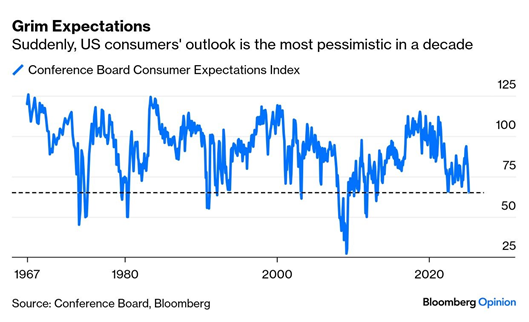
The latest survey of consumer sentiment by the Conference Board found expectations dropping to their lowest level in a decade (a period that includes both the pandemic and the inflation spike): Source: Bloomberg.

As always, we appreciate your support and value your trust in LNKD Investment Managers. 

Weekly Insights: Fed Holds Rates Steady Amid Rising Economic Uncertainty

The U.S. Federal Reserve held interest rates steady at 4.25% to 4.5% following its latest policy meeting, but officials signalled the possibility of two rate cuts later this year. The Fed revised its 2023 GDP growth forecast to 1.7%, from 2.1%, and raised its inflation projection to 2.7%, citing increased uncertainty driven partly by President Trump’s tariff policies, which have raised inflation expectations. Fed Chairman Jerome Powell acknowledged the high level of unpredictability in the economic landscape.

U.S. retail sales rose by 0.2% in February, recovering slightly from a revised 1.2% decline in January—the sharpest drop since November 2022, according to the Commerce Department’s Census Bureau. This modest rebound indicates subdued consumer spending, with discretionary purchases under pressure due to economic uncertainty, ongoing tariffs, and significant federal job cuts.

U.S. manufacturing production exceeded expectations in February, driven by a sharp increase in motor vehicle output. The sector, which makes up 10.3% of the economy, has shown signs of recovery, supported by the Federal Reserve’s rate cuts since September, though tariffs continue to dampen the outlook.

The Bank of England kept interest rates at 4.5% and cautioned against expectations of imminent rate cuts due to deep uncertainty surrounding the UK and global economies. The Monetary Policy Committee (MPC) voted 8-1 to maintain rates, noting growing global trade tensions, particularly those initiated by the United States. While the MPC expects inflationary pressures to ease, it made clear that monetary policy is not on a pre-set path in the coming months.

Eurozone price pressures were revised lower in February, reinforcing expectations that inflation is gradually moving toward the European Central Bank’s 2% target. Headline inflation rose 2.3% year-on-year, down from 2.5% in January, according to Eurostat data. Core inflation, excluding energy and food, eased to 2.6% from 2.7%, marking its lowest level since January 2022. Despite the easing inflation, investor expectations for future price trends remain subdued.

China’s new-home prices declined for the 21st consecutive month in February, highlighting ongoing challenges in the country’s property sector. Official data showed declines in prices, investment, and sales, suggesting that government measures and promises of additional stimulus have done little to revive demand in the crisis-hit market. New home prices edged down 0.1% month-on-month after two months of relative stability, while on a year-on-year basis, prices fell 4.8%, slightly improving from a 5.0% drop in January.

China’s economy showed modest recovery in the first two months of the year, with retail sales rising 4.0% year-on-year in January-February, an improvement from 3.7% in December and the fastest pace since November 2024. Industrial production grew 5.9%, slowing from 6.2% in December. The National Bureau of Statistics attributed the uptick to stimulus measures but also highlighted the ongoing challenges of a complex external environment, weak domestic demand, and operational difficulties for businesses.
 
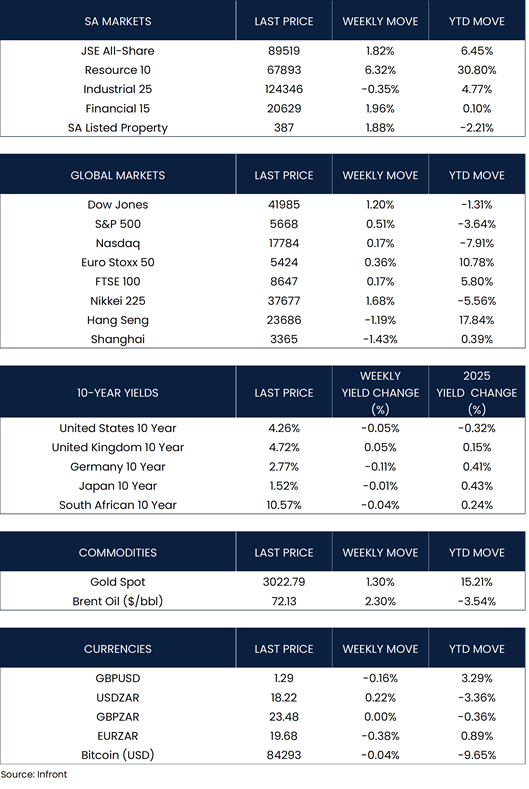
U.S. equities ended the week higher, with most major indexes reversing multi-week declines. The Dow Jones Industrial Average led gains, advancing 1.2%, while the S&P 500 added 0.51%. Large-cap technology stocks lagged, weighing on the Nasdaq Composite, which was the weakest performer.

In Europe, the Euro Stoxx 50 Index edged up 0.36% in local currency terms, while the FTSE 100 posted modest gains of 0.17%.

Asian markets were mixed. Mainland Chinese equities declined as investors turned cautious following two weeks of gains, with the Shanghai Composite Index losing 1.43%. In Hong Kong, the Hang Seng Index declined 1.19%. Meanwhile, Japan’s Nikkei 225 advanced 1.68% over the week.

Market Moves of the Week:

The South African Reserve Bank (SARB) kept its benchmark repo rate at 7.5% in its latest Monetary Policy Committee (MPC) meeting, leaving the prime lending rate at 11%. The decision to hold rates steady after three consecutive 25 basis point cuts reflects concerns over the global economic landscape. Four MPC members voted to keep rates unchanged, while two favoured a 25 basis point cut. The SARB’s decision follows the US Federal Reserve’s move to keep its benchmark rate unchanged, highlighting a more cautious global monetary policy stance.

In the holiday-shortened week, the JSE All-Share Index climbed 1.82%, with most sectors contributing to the gains. Resources led the advance, returning 6.32%, while Industrials was the sole laggard, slipping 0.35%. The rand depreciated 0.22% against the dollar, closing at R18.22/USD.

Chart of the Week:

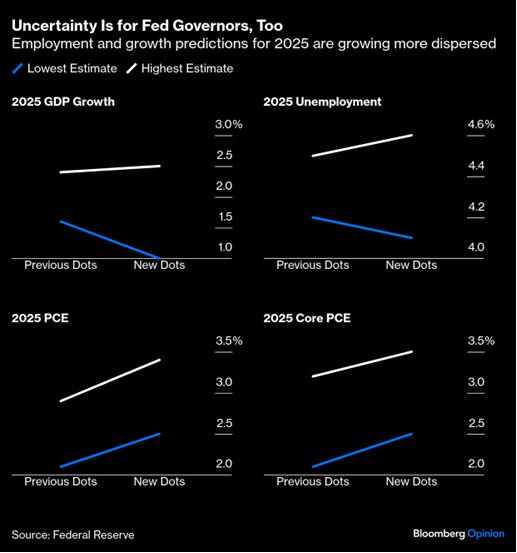
Amid growing uncertainty over the economic outlook, Fed Chairman Powell highlighted the confusion surrounding the new administration, particularly regarding tariffs. The FOMC’s latest dot-plot forecasts showed wider ranges for growth and unemployment, with inflation expectations rising. Clarity on 2025 should emerge by mid-year, but the committee’s projections remain more dispersed than in December.

As always, we appreciate your support and value your trust in LNKD Investment Managers. 

Weekly Insights: Tariff Uncertainty Rattles Markets

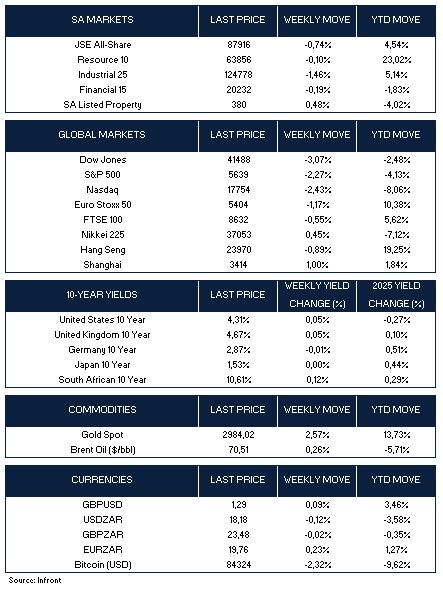
U.S. stocks ended a turbulent week with losses, as ongoing trade policy uncertainty weighed on investor sentiment. Despite a strong Friday rebound—led by tech stocks that helped the Nasdaq surge 2.6%—the S&P 500 and Nasdaq both finished the week down over 2%, while the Dow posted a steep 3.1% decline, marking its worst weekly performance since March 2023.

Inflation data provided some relief, with the Consumer Price Index (CPI) showing a 2.8% year-over-year rise in February, a slowdown from January’s 3% increase. Core CPI, which excludes food and energy, also eased to 3.1%, its lowest annual increase since April 2021. Meanwhile, the Producer Price Index (PPI) remained flat for the month, with a 3.2% year-over-year rise. Both reports came in slightly below expectations, reinforcing hopes that inflationary pressures are easing.

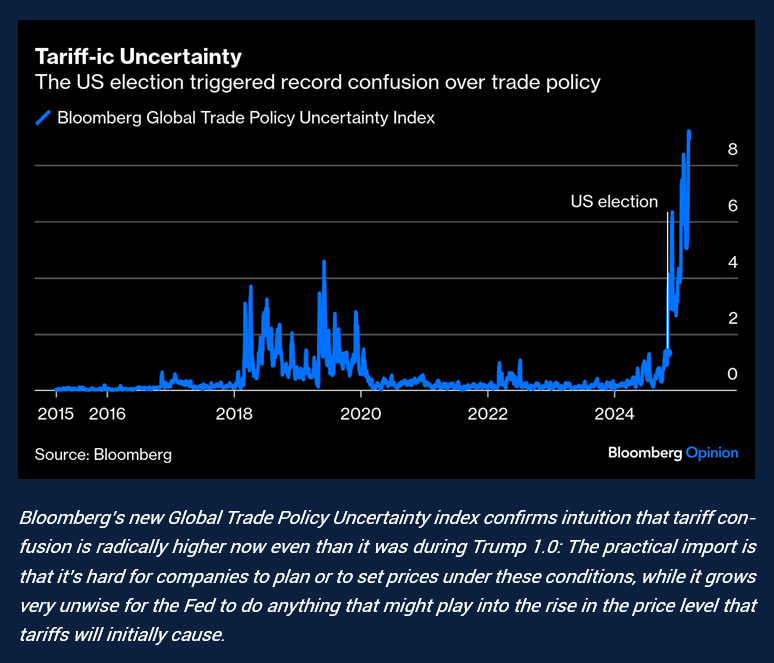
Trade tensions escalated midweek as the U.S. imposed a 25% tariff on steel and aluminium imports. In response, Canada implemented its own 25% tariffs on U.S. goods, while the European Union announced plans to impose countermeasures on $28 billion worth of American products next month, though negotiations remain possible.

European markets also struggled, with the STOXX 50 Index falling 1.17% as investors worried about trade disruptions and monetary policy uncertainty. However, optimism around a potential Ukraine-Russia ceasefire and Germany’s increased state borrowing plans helped limit losses. In the UK, economic data disappointed, with GDP shrinking 0.1% in January. The FTSE 100 ended the week down 0.55%.
 
In Asia, Japan’s Nikkei 225 edged up 0.45%, supported by a weaker yen benefiting exporters, but trade concerns loomed as the U.S. considered 25% tariffs on imported cars—a major segment of Japan’s exports. Meanwhile, China’s stock markets posted gains, with the Shanghai Composite rising 1% on hopes for further stimulus, though Hong Kong’s Hang Seng Index dipped 0.9%.
 
Gold hit a historic milestone, breaking past the $3,000 mark on Friday, as investors flocked to safe-haven assets amid economic uncertainty. Brent crude oil also rose 1%, settling at $70.5 per barrel as geopolitical tensions surrounding Ukraine remained in focus.
 
Looking ahead, all eyes are on the Federal Reserve’s upcoming policy meeting. The Fed is expected to keep rates steady at 4.25%-4.5% but will release updated economic projections that could hint at future policy moves. In the UK, the Bank of England is also anticipated to hold rates at 4.5%, while the Bank of Japan’s decision will be closely analysed for signals on future rate adjustments.

Market Moves of the Week:

The South African Reserve Bank’s Monetary Policy Committee (MPC) is set to meet next week, with most analysts expecting interest rates to remain unchanged at 7.50%. Policymakers remain in a cautious stance as global trade risks and ongoing budget challenges shape the economic outlook.
 
This week, Finance Minister Enoch Godongwana proposed a more modest value-added tax (VAT) increase in his revised 2025/2026 budget. For the first time since 2018, VAT will rise, generating an additional R42.5 billion over the next two fiscal years. The increase will be implemented in two phases—0.5 percentage points on May 1, 2025, and another 0.5 points on April 1, 2026—bringing the rate to 16%. The additional revenue is earmarked for education, healthcare, and public transport improvements.
 
Economic growth is projected to average 1.8% over the next three years, unchanged from October’s forecast. However, logistical bottlenecks, particularly within the country’s struggling rail and port systems, continue to weigh on output.
 
Debt remains a pressing concern, with South Africa currently spending R1.1 billion daily to service its obligations—amounting to R424.9 billion for the year. By the 2027/28 financial year, this figure is expected to climb to R478.6 billion (or R1.3 billion per day). The National Treasury now projects government debt will peak at 76.2% of GDP in 2025/26, higher than previous estimates. On Friday, Fitch Ratings expressed scepticism over the government’s ability to stabilize debt levels as outlined in the revised budget.
 
In the markets, the rand strengthened for the week, closing at R18.18/$, supported by record-high gold prices. However, the All-Share Index declined 0.74%, with losses across all three major sectors.

Chart of the Week:

As always, we appreciate your support and value your trust in LNKD Investment Managers.

Weekly Insights: U.S. stocks sell off amid trade policy uncertainty

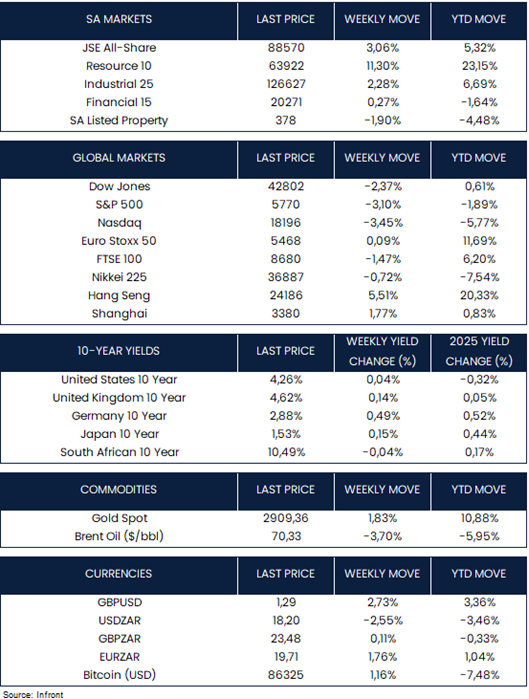
Major U.S. indexes fell this week, with the S&P 500 & Nasdaq Composite shedding over 3%, while the Dow Jones Industrial Average fell 2.37%, erasing most of its year-to-date gains. Trade policy uncertainty remained a key focus throughout the week, as Tuesday marked the deadline for President Donald Trump’s previously announced tariffs – 25% on Canadian and Mexican imports and 10% on Chinese imports. Later in the week, the Trump administration introduced several exemptions and delays, including a one-month exemption for goods covered under the U.S.-Mexico-Canada Agreement. However, the ongoing uncertainty and shifting policies weighed on investor sentiment.

On the U.S. economic data front, the U.S. added 151,000 jobs in February, missing the 160,000 forecast. Unemployment rose to 4.1% and wages grew 0.3%. The federal government lost 10,000 jobs. The ISM manufacturing PMI edged down to 50.3% in February, signalling a slight expansion, while new orders fell into contraction at 48.6%. The services PMI rose to 53.5%, marking eight months of expansion, with employment hitting its highest level since December 2021. Despite growth, concerns over tariffs and federal spending cuts persist.

Incoming German Chancellor Friedrich Merz backed a plan to invest over €1 trillion in defense and infrastructure, exempting defense from Germany’s strict debt limits. Initially opposed, Merz shifted his stance amid security concerns and NATO uncertainty. The announcement sent German 10-year bund yields up 30 basis points, the largest jump since 1990. Meanwhile, the EU proposed an €800 billion defense plan exempt from debt rules.

The European Central Bank (ECB) cut its key rate to 2.5% this week, calling policy “meaningfully less restrictive.” Citing “phenomenal uncertainty,” President Lagarde noted its impact on investment and exports. The ECB lowered its 2025 growth forecast to 0.9% and raised its 2025 inflation projection to 2.3%. On the market front, the Euro Stoxx 50 (+0.09%) eked out a small gain over the week, while the UK’s FTSE 100 fell 1.47%.

In Asia, Japan’s stock markets was mixed over the week, with the benchmark Nikkei 225 Index ending 0.72% lower, meanwhile the yen gained against the U.S. dollar on safe-haven demand.

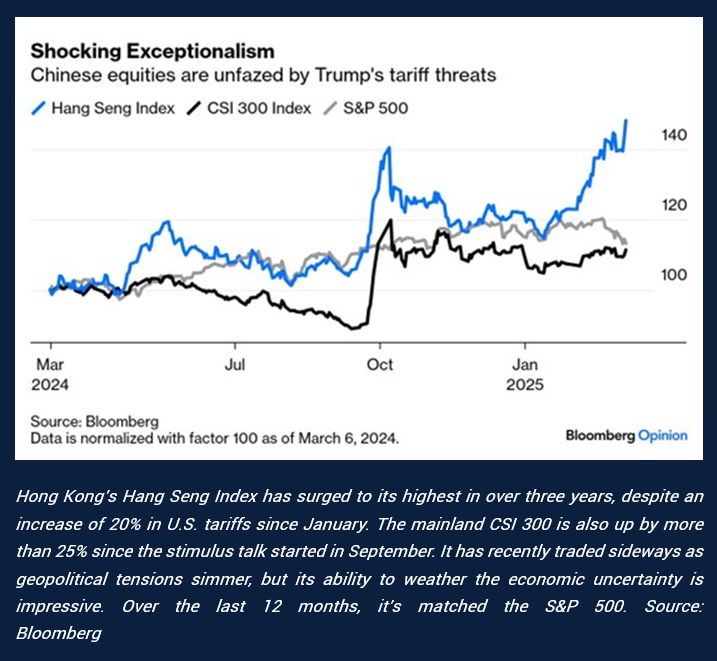
Mainland Chinese stocks gained for the week as Beijing set growth targets in line with expectations and hinted at further stimulus amid the U.S. trade war. The Shanghai Composite added 1.77% while Hong Kong’s Hang Seng surged 5.91%.

On the commodity front gold traded around $2,910 per ounce on Friday, remaining close to record highs as investors reacted to weaker-than-expected jobs data, while Brent crude advanced 1.3% to settle at $70.3 per barrel Friday, after US President Donald Trump threatened sanctions on Russia if it fails to reach a cease-fire with Ukraine.

Market Moves of the Week:

South Africa’s (SA) economy grew at its slowest rate in four years in 2024, as logistical challenges, weak consumer spending, drought conditions, and sluggish fixed investment hindered growth across most sectors. Gross domestic product expanded 0.6% in 2024, compared to 0.7% in 2023, increasing by a modest 0.6% q/q in the fourth quarter of 2024, below consensus expectations.

The latest Business Confidence Index in SA indicates that sentiment among companies remains stagnant, with most still largely pessimistic about operating conditions. The RMB/BER Business Confidence Index (BCI) stood at 45 in the first quarter, falling five points below the neutral level of 50. Although this marks an improvement from the same period last year and slightly exceeds South Africa’s long-term trend, the Bureau for Economic Research (BER) cautioned that it remains a concerning signal.

The All-Share Index rose by 3.06% this week, driven by gains in Resources (+11.30%) and Industrials (+2.28%). The local currency strengthened against the U.S. dollar, moving to R18.20/$ from last week’s R18.67/$ level. SA government bonds remained relatively stable, as yields on the 10-year dipped 0.04% over the week.

Chart of the Week:

As always, we appreciate your support and value your trust in LNKD Investment Managers. 

Weekly Insights: Trade Tensions Fuel Market Volatility

Global markets experienced heightened volatility, with the Nasdaq recording its steepest decline since September as technology stocks tumbled. The so-called “Magnificent Seven”, particularly NVIDIA, suffered sharp losses, while trade tensions resurfaced as Donald Trump reaffirmed plans to impose new tariffs by March. The S&P 500 briefly erased its year-to-date gains before rebounding, as broader markets shifted to a risk-off stance amid economic uncertainty and weaker consumer confidence.

In the United States, House Republicans sought to extend Trump’s 2017 tax cuts, proposing a $4.5 trillion reduction plan. However, economic indicators pointed to a weakening outlook, with consumer confidence plunging to its lowest level since 2021. Fourth-quarter GDP growth slowed to 2.3%, while inflation eased to 2.6%, though it remained above target. Despite rising incomes, consumer spending declined, reflecting heightened caution amid economic uncertainty.

The labour market also weakened, with jobless claims reaching a four-month high. Layoffs at major firms including Starbucks, Meta, and Southwest Airlines signalled corporate cost-cutting measures. Meanwhile, the housing market presented mixed signals – home prices rose, yet sales slumped. Trade tensions escalated further as the US imposed new tariffs on Canada, Mexico, and China. Given these uncertainties, the Federal Reserve is expected to maintain a cautious stance.

In other news, Trump and Zelensky clashed at the White House, with Trump urging Kyiv to negotiate with Russia or risk losing US support. The confrontation overshadowed a US-Ukraine minerals deal, as Trump accused Zelensky of lacking gratitude for US aid, warning he was “gambling with World War Three”. Zelensky stood firm, rejecting compromises, while Trump insisted Kyiv must make concessions. Russia, which invaded Ukraine in 2022, controls 20% of Ukrainian territory.

In Europe, the economic slowdown deepened, with Germany slipping into a second consecutive quarter of contraction. Eurozone inflation fell, and France’s inflation rate reached a four-year low. The European Central Bank (ECB) remains confident that inflation is easing, but it warned of risks to economic growth. Meanwhile, in the United Kingdom, house prices rose by 0.4% in January, supported by lower borrowing costs.

In Asia, Japan’s inflation cooled, while industrial production rebounded. In China, markets saw most of their weekly declines on Friday, following Trump’s announcement of an additional 10% tariff on Chinese imports from 4 March, alongside 25% tariffs on Canada and Mexico. Beijing is expected to retaliate ahead of its annual “Two Sessions” political event, where key economic priorities and targets will be outlined. Analysts anticipate China will maintain a 5% GDP growth target while raising its fiscal deficit ratio to 4% of GDP.

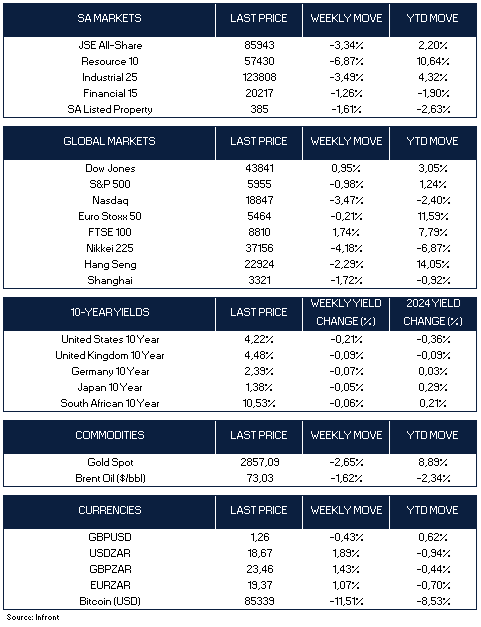
Markets mostly softened this week. In the US, the Dow Jones gained 0.95%, while the S&P 500 and Nasdaq fell 0.98% and 3.47%, respectively. European markets were mixed, with the Euro Stoxx 50 down 0.21% and the FTSE 100 up 1.74%. In Asia, the Nikkei 225 fell 4.18%, the Hang Seng declined 2.29%, and the Shanghai Composite dropped 1.72%. Developed market bond yields declined, while Bitcoin retreated 11.51% to $85,339.

Market Moves of the Week:

South Africa’s headline inflation edged up from 3.0% in December to 3.2% in January, aligning with market expectations. Despite inflation remaining relatively subdued, the South African Reserve Bank (SARB) has refrained from cutting interest rates. SARB Governor Lesetja Kganyago cited global uncertainty – particularly concerns surrounding Trump’s trade policies – as a key risk. However, with inflation projected to rise only gradually toward 4.5%, the midpoint of SARB’s target range, there appears to be scope for a more accommodative stance.

On the policy front, the Hospital Association of South Africa has launched a legal challenge against the contentious National Health Insurance (NHI) Act, questioning its constitutionality and financial viability. Meanwhile, the ANC’s Fikile Mbalula dismissed calls for an “Austerity Budget,” reaffirming the party’s commitment to maintaining public spending.

The local market faced pressure this week, with the JSE All Share Index declining by 3.34%. All three major sectors ended in the red – resources dropped 6.87%, industrials fell 3.49%, and financials slipped 1.26%. By Friday’s close, the rand weakened to R18.67 against the US dollar.

Chart of the Week:

As always, we appreciate your support and value your trust in LNKD Investment Managers

Weekly Insights: China’s Tech Rally Extends on Earnings

The January Federal Open Market Committee (FOMC) minutes highlighted the need for further progress on inflation before considering rate cuts, with trade and immigration policies cited as potential factors affecting the outlook. While policymakers expect inflation to move toward 2% over time, they acknowledged that the path may be uneven. The Fed is also considering pausing or slowing the pace of quantitative tightening until the U.S. debt ceiling situation is resolved.

S&P Global reported that U.S. business activity growth softened in February, with the flash Composite Purchasing Managers’ Index (PMI) declining to 50.4, a 17-month low. A PMI reading above 50 indicates expansion, while a reading below 50 signals contraction. The services sector slipped into contraction for the first time in over two years, with a PMI of 49.7, while manufacturing activity remained in expansion. According to the report, uncertainty surrounding federal government policies and rising input cost pressures contributed to the overall slowdown in business activity.

In the UK, stronger-than-expected inflation and wage data prompted markets to dial back expectations for three Bank of England (BoE) rate cuts this year. Annual consumer price inflation accelerated to 3.0% in January from 2.5% in December, its fastest pace since March 2024, driven by higher transport costs and rising food and non-alcoholic beverage prices. Services inflation—a key metric for policymakers—rose to 5.0% from 4.4%, while core inflation, which excludes volatile food and energy prices, climbed to 3.7% from 3.2%.

Meanwhile, wage growth remained strong, with average earnings excluding bonuses rising 5.9% year-on-year in the three months to December, up from 5.6% in the previous quarter. Separately, the UK unemployment rate held steady at 4.4% over the same period, slightly below consensus expectations, according to data released on Tuesday.

Eurozone business activity remained in expansionary territory for a second consecutive month in February, with the HCOB Flash Eurozone Composite PMI Output Index unchanged at 50.2, according to S&P Global. The data highlighted diverging trends across the region—Germany saw output expand for a second month, while France experienced a sharp contraction. The rest of the bloc posted solid growth.

Stronger-than-expected earnings from Alibaba and other Chinese tech firms fuelled renewed investor interest in the country’s internet sector, following local AI startup DeepSeek’s technological showcase in January. Sentiment was further buoyed by a high-profile meeting between President Xi Jinping and leading tech entrepreneurs, reinforcing a more supportive stance toward the private sector.
 
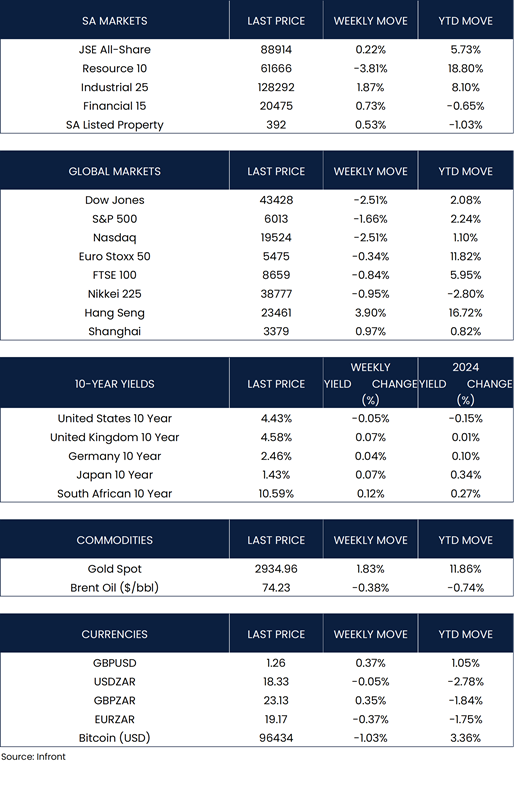
Major U.S. equity indices declined over the holiday-shortened week, with the Dow Jones Industrial Average and Nasdaq Composite both falling 2.51%, while the S&P 500 lost 1.66%

In Europe, the Euro Stoxx 50 Index ended the week 0.34% lower, as investors weighed U.S. trade policy developments and ongoing diplomatic efforts to resolve the Russia-Ukraine conflict. The UK’s FTSE 100 also edged lower, finishing the week down 0.84%.

Mainland Chinese equities advanced, supported by strength in technology stocks. The Shanghai Composite Index gained 0.97% in local currency terms, while Hong Kong’s Hang Seng Index rose 3.90%, driven by a rally in Alibaba shares. In contrast, Japanese equities weakened, with the Nikkei 225 slipping 0.95% amid yen appreciation and rising domestic bond yields.

Market Moves of the Week:

The South African government’s annual budget speech, originally scheduled for 19 February 2025, was unexpectedly postponed due to disagreements within the Government of National Unity (GNU). The key point of contention was the proposed 2% increase in the value-added tax, which faced opposition from coalition partners, notably the Democratic Alliance (DA). The budget speech has been rescheduled for 12 March 2025, allowing for further deliberations to achieve consensus within the government.

This week, the G20 Foreign Ministers’ Meeting convened in Johannesburg on the 20th and 21st of February 2025, bringing together foreign ministers and senior diplomats to address pressing global challenges. Discussions centred on the Russia-Ukraine conflict, with South African President Cyril Ramaphosa emphasising the need for cooperation on geopolitical tensions, climate change, and economic insecurity. South African Foreign Minister Ronald Lamola highlighted the importance of peace initiatives, while China signalled support for U.S.-led diplomatic efforts on Ukraine. Australia also engaged in discussions with Russia, raising specific humanitarian concerns.

The JSE All-Share Index advanced 0.22% over the week, driven by a 1.87% gain in industrials, while financials and property posted modest increases of 0.73% and 0.53%, respectively. In contrast, the resource sector declined 3.81%, weighing on overall performance. By Friday’s close, the rand slightly strengthened by 0.05% against the U.S. dollar, trading at R18.33.

Chart of the Week:

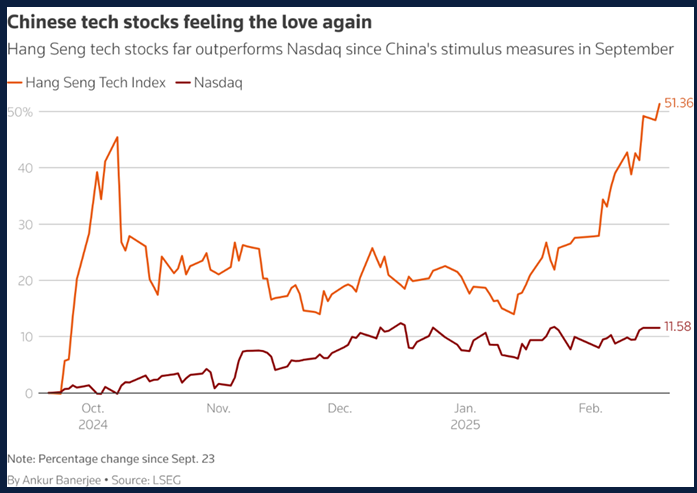
The Hang Seng Tech Index has surged over 50% since September, far outpacing the Nasdaq’s 12% gain, as stimulus measures and AI-driven optimism fuel investor confidence.

As always, we appreciate your support and value your trust in LNKD Investment Managers. 

Weekly Insights: Global Indices Rally Amid Improved Sentiment

The three major U.S. indices ended the week in the green, as sentiment improved after investors got more certainty around President Donald Trump’s tariff plans, while new inflation data wound up being more constructive than first thought.

For the week, the S&P 500 gained approximately 1.5%, the Dow advanced around 0.6%, and the Nasdaq surged 2.6%.

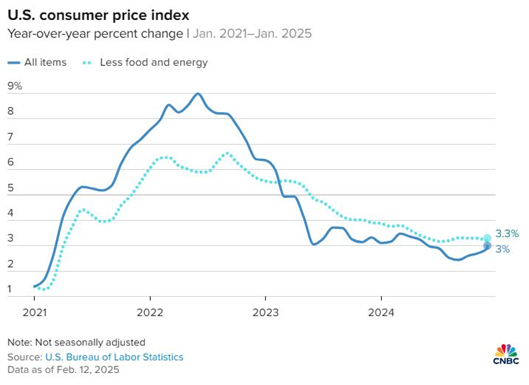
The consumer price index (CPI), which measures the cost of goods and services across the U.S. economy, increased by a seasonally adjusted 0.5% in January, pushing the annual inflation rate to 3%, up from 2.9% in the previous month, according to the Bureau of Labor Statistics (BLS). Shelter costs, which rose 0.4%, accounted for nearly 30% of the total increase. Excluding volatile food and energy prices, the core CPI rose 0.4% for the month, bringing the 12-month inflation rate to 3.3%, exceeding estimates of 0.3% and 3.1%, respectively.

On Thursday, the BLS reported that the producer price index (PPI) also rose more than expected, advancing 0.4% in January compared with consensus expectations of a 0.3% increase. However, some key components, such as healthcare items and airfares, showed signs of cooling, helping to ease inflation concerns. Bond yields saw sharp gains on Wednesday following the CPI release but later reversed course on Thursday to end the week firmer.

Also on Thursday, President Trump directed the US Trade Representative and the Department of Commerce to study on a country-by-country basis how to adjust US tariff rates on trade partners to match their existing duties and non-tariff barriers. The study is expected to be completed by 1 April, with US levies expected to follow shortly thereafter.

In Europe, the pan-European STOXX Europe 50 Index climbed 3.15%, reaching a fresh record high. Sentiment was buoyed by optimism over a potential resolution to the Ukraine-Russia conflict and strong corporate earnings. Economic data showed that the eurozone economy expanded at a quarterly pace of 0.1% in the last quarter of 2024, avoiding stagnation, with annual growth reaching 0.7% for the full year.

Meanwhile, the UK economy also posted an unexpected 0.1% expansion in the final quarter of 2024, with full-year GDP growth rising to 0.9% in 2024, up from 0.3% in 2023. The FTSE 100 ended the week 0.37% higher.

Japan’s Nikkei 225 Index gained 0.93% for the week, supported by a weaker yen and positive sentiment after President Trump decided against imposing immediate reciprocal tariffs on U.S. trading partners.

Mainland Chinese stocks also performed well, driven by hopes that U.S. tariffs on Chinese imports may be less severe than previously expected. The Shanghai Composite Index ended 1.3% higher, while the Hong Kong Hang Seng Index surged 6.88%, with strong buying interest in artificial intelligence and tech stocks. China’s consumer price index rose 0.5% year-over-year in January, marking the first pickup in inflation since August, likely fuelled by increased spending ahead of the Lunar New Year holiday.

Gold prices remained steady on Friday, trading at the close at $2,882 per ounce, posting a 0.77% weekly gain. The precious metal continued its seven-week rally, bolstered by its status as a safe- haven amid inflation and economic uncertainty.

In the energy sector, Brent crude oil prices ended the week slightly lower at $74.51 per barrel. A potential peace agreement between Russia and Ukraine raised concerns among traders that the lifting of sanctions on Moscow could increase global energy supply.

Market Moves of the Week:

Tensions between Washington and Pretoria remained elevated this week as South African President Cyril Ramaphosa called for national unity after the country’s new land-expropriation laws and foreign policy came under attack from US President Donald Trump. Trump recently froze most aid to South Africa, citing concerns over race-based discrimination policies and relations with Hamas and Iran.

The law signed by President Ramaphosa in December grants the government the authority to expropriate land for public purposes, such as infrastructure development, with compensation determined as “just and equitable.” — though some cases may involve no compensation.
 
South Africa is set to host a G20 foreign ministers’ meeting next week, with U.S. Secretary of State Marco Rubio boycotting the event in protest of South Africa’s land policies and “anti-Americanism.”

For the week, the JSE All-Share Index gained 1.42%, driven by a 3.5% rise in industrial stocks. The rand strengthened against the U.S. dollar, closing the week at R18.34/$. Concerns over a trade war lifted gold prices, providing additional support for the local currency.

Chart of the Week:

The U.S. Consumer Price index (CPI) accelerated a seasonally adjusted 0.5% for the month of January, putting the annual inflation rate at 3%, while core CPI (excluding food and fuel) ran at 0.4% and 3.3% respectively, both above forecasts.

As always, we appreciate your support and value your trust in LNKD Investment Managers. 

Weekly Insights: Stocks Lower Amid Tariff Uncertainty

Major U.S. indexes fell this week, with the S&P 500 faring best, dropping just 0.24%. Stocks dropped sharply at the start of the week following President Trump’s Friday announcement of 25% tariffs on Mexico and Canada and 10% on Chinese imports. However, by Monday’s close, Trump delayed the Mexico and Canada tariffs for 30 days, offering some relief and helping stocks recover part of their early losses.

Markets largely shrugged off the China tariffs, as Trump had previously threatened tariffs as high as 60% during his campaign. China responded with 15% tariffs on under $40 billion in U.S. imports, effective February 10, while also initiating antitrust probes into U.S. tech firms and tightening export controls on key minerals. Although no tariffs have been imposed on the European Union yet, Trump warned on Sunday that they “definitely will”.

U.S. earnings reports also played a key role in shaping sentiment as investors processed a busy week of releases. According to FactSet, 77% of S&P 500 companies that reported fourth-quarter results through Friday exceeded earnings expectations, with an average growth rate of 16.4% (compared to the 11.9% forecast). Additionally, 63% of these companies beat sales projections.

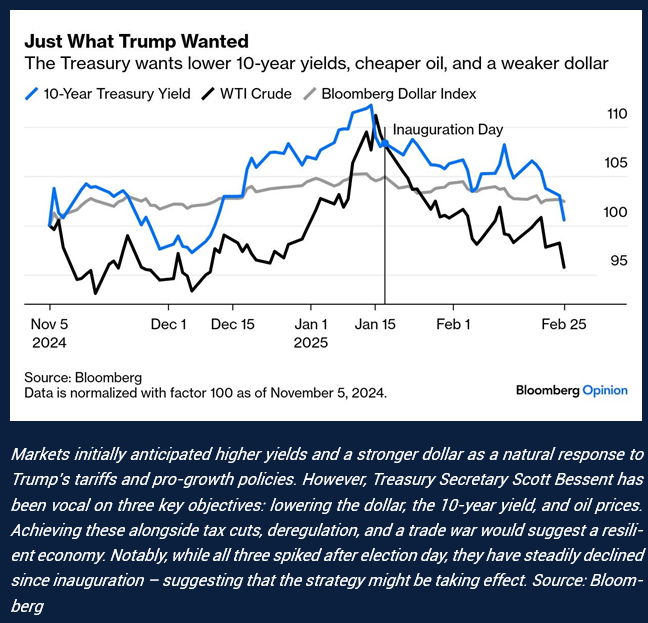
U.S. Treasury Secretary Scott Bessent said the Trump administration is focused on the 10-year Treasury yield, not the federal funds rate, and isn’t pressuring the Fed to cut rates. The administration aims to reduce energy prices, lower government size, and boost growth.

On the economic data side, the U.S. manufacturing sector expanded in January for the first time since October 2022, but services slowed. The key economic event of the week was Friday’s nonfarm payrolls report. The U.S. economy added 143,000 jobs in January, below expectations and down from December’s revised 307,000. The unemployment rate unexpectedly dropped to 4.0% from 4.1%.

The Bank of England cut its base rate by 0.25% to 4.5% in a 7-2 vote, with two members advocating for a larger cut. Governor Andrew Bailey expects further rate reductions. Inflation is expected to rise temporarily to 3.7%, while the 2025 growth forecast was halved to 0.75%. UK equities reacted positively, with the FTSE 100 reaching a record high, ending the week up 0.31%. Meanwhile, the Euro Stoxx 50 led developed markets, rising 0.73% w/w.

Mainland Chinese stock markets rose in a shortened trading week, as strong consumer spending during the Lunar New Year holiday helped offset President Trump’s decision to impose a 10% tariff on Chinese imports. The Shanghai Index climbed 1.63% from Wednesday to Friday, while in Hong Kong, the Hang Seng Index gained 4.38%, marking its best weekly performance in four months, fuelled by strong gains in tech stocks.

Market Moves of the Week:

South African manufacturers indicated a decline in business conditions for the third consecutive month in January, according to a local purchasing managers’ index (PMI) survey released on Monday. The seasonally adjusted PMI, backed by South African bank Absa, dropped to 45.3 points in January from 46.2 in December, moving further below the 50-point threshold that separates expansion from contraction.

President Cyril Ramaphosa delivered the first State of the Nation Address under the Government of National Unity on Thursday. Below, we’ve summarized the key points:

  • Medium Term Development Plan: The five-year plan, released on Friday, focuses on inclusive growth, job creation, poverty reduction, and building a capable, ethical state. Emphasis is placed on a competent public service.
  • Municipalities: Urgent focus on water and electricity, with Operation Vulindlela 2 addressing water issues. Revenue from water and electricity will be reinvested into maintenance and investment to tackle the growing municipal debt.
  • Network Industries: A “second wave of reform” will target SOEs and infrastructure, with a focus on maintaining state ownership of strategic assets while leveraging private investment and skills.
  • Electricity: Plans to implement the building blocks for a competitive electricity market in F25/26, including private investment in the transmission network.
  • Freight & Logistics: Reforms will continue, with the Freight Logistics Roadmap being implemented and private capital involved.
  • Visa Reforms: The Department of Home Affairs has cleared 90% of a 300,000 visa backlog, with digital public infrastructure and a new Electronic Travel Authorisation system streamlining visa applications.

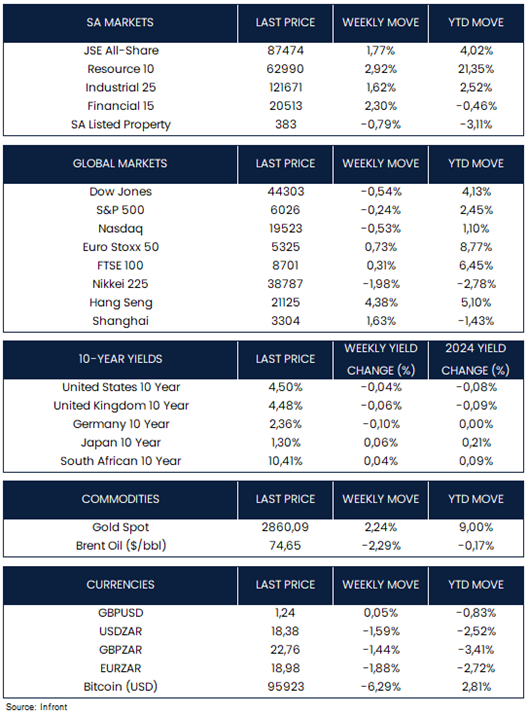
The All-Share Index rose by 1.77% this week, driven by gains in Resources (+2.92%) and Financials (+2.30%). The local currency strengthened against the U.S. dollar, moving to R18.38/$ from last week’s R18.67/$ level. SA government bonds remained relatively stable, as yields on the 10-year rose 0.04% over the week.

Chart of the Week:

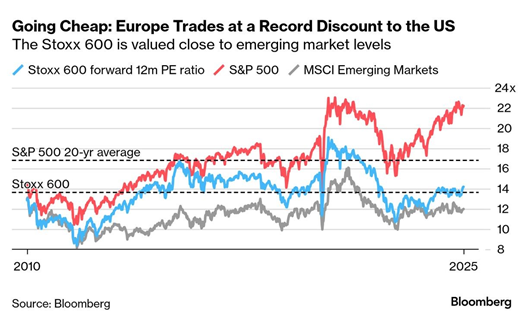
There is growing concern in Europe that its markets are broken, risking the loss of future businesses. U.S. stocks on average trade at 22 times earnings, a near 60% premium over Europe. Companies like UK chip designer Arm Holdings and Swedish fintech Klarna have chosen the US for their primary stock market listings, and New York has also caught the eye of France’s TotalEnergies and Britain’s WPP. Source: Bloomberg.

As always, we appreciate your support and value your trust in LNKD Investment Managers. 
Weekly Insights: Policy Moves and Trade Tensions

The Nasdaq Composite Index saw a sharp decline at the start of the week, largely driven by concerns over intensifying competition in the AI sector. DeepSeek, a Chinese AI developer, unveiled a new energy-efficient language model, raising investor concerns about Nvidia’s dominance. This led to a nearly 17% drop in Nvidia shares before a partial recovery, aided by strong earnings reports from Meta and Apple. Meanwhile, the U.S. government increased scrutiny on China’s AI sector, accusing DeepSeek of using illegally sourced Nvidia chips, further escalating trade tensions.

Trade policy uncertainty intensified after former U.S. President Donald Trump reaffirmed his stance on tariffs, pledging to reintroduce a 25% tariff on Mexican and Canadian goods by 1 February, alongside a 10% levy on Chinese imports. This disappointed investors who had hoped for a more moderate approach.

The Federal Reserve maintained interest rates at 4.25% to 4.50% as widely expected. Fed Chair Jerome Powell emphasised strong economic activity, a resilient labour market, and persistent inflation. He reiterated that the Fed would need more substantial evidence of inflation easing or labour market weakness before considering rate cuts. Investors remain watchful of how potential Trump-era economic policies, particularly tariffs, might influence the Fed’s future decisions.

Core PCE inflation stood at 2.8% year-on-year in December, remaining above the Fed’s 2% target. The U.S. economy grew at an annualised 2.3% in Q4, slightly below expectations but above the Fed’s long-term forecast of 1.8%. Consumer spending surged 4.2%, offsetting inventory declines. However, consumer confidence hit a four-month low in January due to job and wage concerns.

The Bank of Canada cut interest rates by 25 basis points but removed forward guidance, citing tariff uncertainties. The European Central Bank (ECB) held rates steady, maintaining its deposit rate at 2.75% as eurozone growth stagnated. ECB President Christine Lagarde noted that inflation was under control but expressed caution about further rate cuts. Meanwhile, Brazil’s central bank raised its key Selic rate by 100 basis points to 13.25% to curb inflation and stabilise the currency.

The eurozone economy stagnated in Q4, with Germany and France contracting, while overall growth for 2024 stood at just 0.7%. Inflation trends were mixed: Germany reported 2.8%, France slowed to 1.8%, and Spain rose to 2.9%. Trade policy concerns, particularly U.S. tariffs, continue to weigh on the region’s economic outlook.

The Bank of Japan (BoJ) maintained a hawkish stance following its recent rate hike. Deputy Governor Ryozo Himino indicated that further tightening would depend on inflation trends, with Tokyo’s core consumer prices rising 2.5% in January.

China’s economy began 2025 on a weak note, with manufacturing PMI falling to 49.1, signalling contraction. Non-manufacturing activity also weakened, slipping to 50.2. Large industrial firms saw a 3.3% profit decline in 2024, marking a third consecutive year of losses. Deflationary pressures and a prolonged real estate downturn continue to weigh on demand, while trade tensions with the U.S. add further uncertainty.

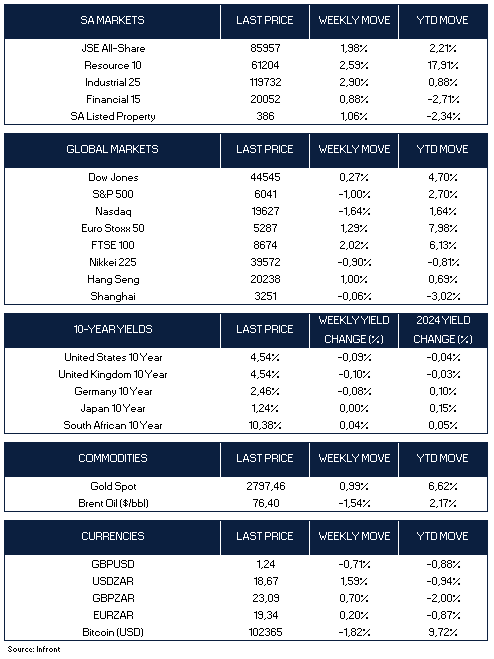
Global markets delivered mixed results this week. In the U.S., the Dow Jones edged up 0.27%, while the S&P 500 and Nasdaq declined by 1.00% and 1.64%, respectively. European markets performed better, with the Euro Stoxx 50 gaining 1.29% and the FTSE 100 rising 2.02%. In Asia, Japan’s Nikkei 225 slipped 0.90%, while Hong Kong’s Hang Seng added 1.00%, and the Shanghai Composite dipped slightly by 0.06%. Brent crude oil fell 1.54% to $76.40 per barrel, while gold surged to a record high, closing the week at $2,797.46 per ounce.

Market Moves of the Week:

South Africa’s Monetary Policy Committee (MPC) reduced interest rates by 25 basis points this week, citing a favourable near-term inflation outlook. However, they highlighted concerns over medium-term risks due to “global developments,” particularly the potential inflationary impact of Trump-era tariffs. The South African Reserve Bank (SARB) warned that in a trade war scenario, the rand could weaken to R21.00 per US dollar, with domestic inflation rising to 5.0%. In its base-case forecast, SARB expects inflation to average 3.9% in 2025, 4.6% in 2026, and 4.5% in 2027. Meanwhile, GDP growth projections were revised slightly upward to 1.8% for 2025 (from 1.7%), with forecasts of 1.8% in 2026 and 2.0% in 2027.

Following ten months of stable electricity supply, Eskom reinstated Stage 3 load shedding due to multiple breakdowns requiring extended repairs. CEO Dan Marokane described this as a temporary setback, citing ongoing structural improvements in the generation fleet. Depleted emergency reserves, will need to be replenished over the weekend.

On the JSE, the All Share Index rose by 1.98% over the week, with all three major sectors posting gains—resources up 2.59%, industrials rising 2.90%, and financials advancing 0.88%. By Friday’s close, the rand weakened to R18.67 against the US dollar.

Chart of the Week:

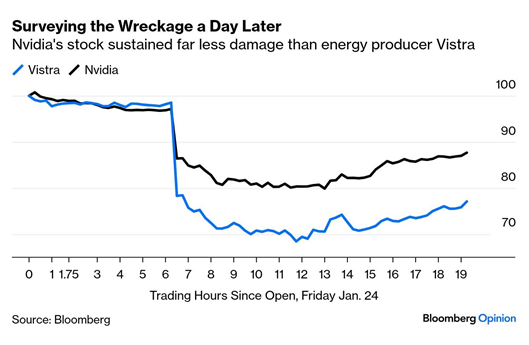
The launch of DeepSeek, China’s generative AI competitor, triggered a sharp U.S. market sell-off on Monday. While markets have since rebounded, losses remain. Nvidia regained some ground after losing $580 billion in value, but the broader impact appears more severe for utility companies expected to supply the additional power needed for AI data centres. AI’s vast computational power demands lead to high electricity consumption, particularly in data centres. The worst performer in this sector was Vistra Corp. Source: Bloomberg.

As always, we appreciate your support and value your trust in LNKD Investment Managers.
Weekly Insights: South Africa’s Inflation Eases

Political developments were a key focus this week following President Donald Trump’s inauguration on Monday. Trump ordered a review of U.S. trade policies, with plans to implement 25% tariffs on Canada and Mexico by February. His comments about preferring to avoid tariffs on China encouraged cautious optimism about a potential trade agreement, contributing to positive market sentiment.

President Trump also announced a USD 500 billion joint venture with Softbank, OpenAI, Oracle, and MGX to support AI infrastructure development in the U.S., which lifted AI-related stocks on expectations of increased investment in the sector.

In economic news, U.S. business activity expanded in January, though at the slowest pace in nine months due to rising price pressures. The S&P Global Composite PMI fell to 52.4 from 55.4 in December, its lowest since April but still indicating expansion. The U.S. manufacturing sector returned to growth after six months of contraction, with the PMI improving to 50.1 from 49.4, surpassing forecasts of 49.6. Services activity grew at a reduced pace, with the PMI easing to 52.8 from 56.8.

In the UK, wage growth excluding bonuses reached a six-month high of 6.0% in the three months to November, aligning with expectations. However, the unemployment rate unexpectedly rose to 4.4%, alongside the largest decline in payroll numbers since November 2020 and a continued drop in job openings.

In the eurozone, business activity showed slight improvement in January, with the S&P Global Composite Output Index rising to 50.2 from 49.6, indicating marginal expansion. Services activity grew modestly for the second consecutive month, while manufacturing remained in contraction. Despite current challenges, manufacturers expressed optimism about future output growth.

The Bank of Japan (BoJ) raised its policy rate for the third time, increasing it by 0.25 percentage points to approximately 0.5%, the highest level since the 2008 global financial crisis. This rate hike was widely anticipated by markets, driven by a 3.6% year-on-year rise in consumer prices, including food and energy.

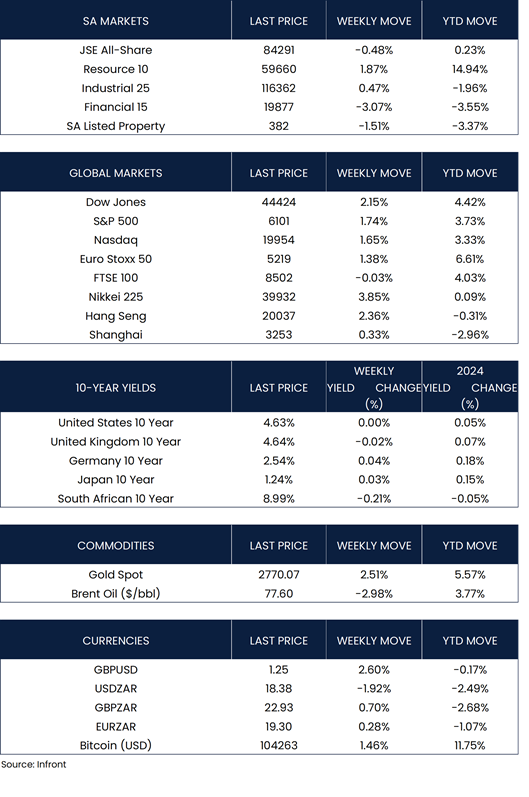
Major indexes posted gains in the holiday-shortened week, with U.S. markets closed on Monday in observance of Martin Luther King, Jr. Day. The Dow Jones advanced 2.15%, the S&P 500 rose 1.74%, and the Nasdaq Composite increased 1.65%. In Europe, the Euro Stoxx 50 Index advanced 1.38%, while the UK’s FTSE 100 posted a marginal decline of 0.03%.

Chinese equities rose, buoyed by expectations that President Trump may take a less aggressive approach on tariffs, with the Shanghai Composite up 0.33% and the Hang Seng Index in Hong Kong climbing 2.36%. Japanese markets also saw positive performance, with the Nikkei 225 rising 3.85%.

Market Moves of the Week:

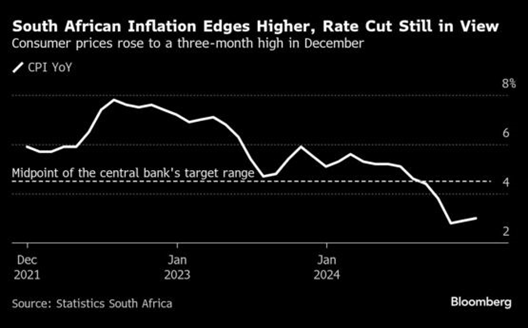
Statistics South Africa (Stats SA) reported that Consumer Price Inflation (CPI) ticked higher to 3% in December, compared to 2.9% in November, marking the second consecutive month of inflationary pressure. On a month-on-month basis, CPI increased by 0.1% in December, reflecting a modest uptick in price levels. Furthermore, Stats SA revealed that the average annual CPI for 2024 was 4.4%, a notable decline of 1.6 percentage points from the 6% average inflation rate recorded in 2023
 
Retail sales in South Africa rose by 7.7% in November, following a revised 6.2% increase in October, according to Stats SA. This marked the ninth consecutive month of growth, driven by Black Friday promotions and the “two pot” pension withdrawal scheme. The growth exceeded market expectations of 5.5%, representing the strongest increase in retail activity since July 2022 and the highest since June 2010. The uptick in sales was broad-based, with six of seven retail sectors experiencing growth.

At the World Economic Forum (WEF) in Davos, President Cyril Ramaphosa discussed South Africa’s economic recovery, focusing on attracting foreign investment, driving infrastructure growth, and addressing energy challenges. He acknowledged fiscal pressures, emphasising the need for consolidation, debt reduction, and reform, while highlighting the importance of balancing fiscal discipline with social spending to foster job creation. Ramaphosa reaffirmed South Africa’s commitment to ongoing economic reforms and global engagement.

Unlike its global counterparts, the JSE All-Share Index declined by 0.48%, primarily driven by a 3.07% drop in the financial sector. The property sector also underperformed, falling by 1.51%. In contrast, the resources sector maintained its positive momentum, rising by 1.87%, while the industrial sector posted modest gains of 0.47%. By Friday’s close, the rand appreciated by 1.92% against the U.S. dollar, trading at R18.38.

Chart of the Week:

South Africa’s consumer prices rose by 3% in December, up from 2.9% the previous month, according to Statistics South Africa. This was lower than the 3.2% forecast by economists. The modest inflation increase, coupled with a strengthening rand, supports expectations that the South African Reserve Bank could proceed with a 25 basis point cut to the repo rate, bringing it to 7.5%.

As always, we appreciate your support and value your trust in LNKD Investment Managers.