Weekly Insights: US shutdown ends

President Donald Trump on Wednesday signed legislation to end the longest government shutdown in U.S. history. The move followed a 222–209 vote in the House to restore food assistance programs, resume pay for roughly 800,000 federal workers, and revive air-traffic control operations. While Republicans largely held together with Trump’s backing, House Democrats voiced frustration that the standoff ended without securing an extension of federal health insurance subsidies.

The temporary funding deal runs through January 30, continuing the government’s projected trajectory of adding about $1.8 trillion annually to its existing $38 trillion national debt. The reopening also restores the release of crucial federal economic data—vital for investors, policymakers, and households assessing job growth, inflation, and consumer spending trends.

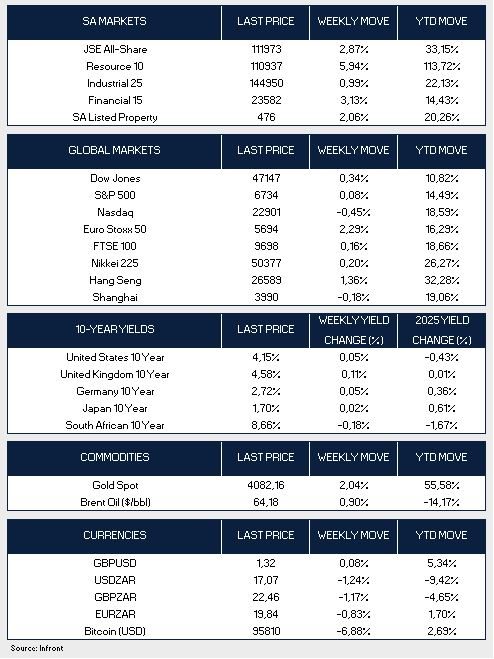
U.S. equities were mostly lower through Thursday as elevated valuations and intensifying scrutiny of artificial intelligence spending spurred a rotation out of growth-oriented stocks—many of which had driven indexes to recent record highs. A volatile session on Friday saw a rebound, with investors snapping up major technology names following the market’s worst single-day decline in more than a month. Despite the turbulence, the Nasdaq ended the week down 0.5%, while the S&P 500 and the Dow managed modest gains of 0.1% and 0.3%, respectively.

Switzerland and the United States have concluded a significant trade agreement that will materially reduce bilateral tariffs and expand cross-border investment flows. As part of the deal, the U.S. will lower tariffs on Swiss imports from 39% to 15%, providing Swiss exporters with meaningful cost relief and improving market access. In return, Switzerland has committed to invest $200 billion into the U.S. economy, reinforcing its position as a key strategic partner. Additionally, Switzerland will eliminate tariffs on a designated quota of U.S. meat exports—including beef, bison, and poultry—broadening opportunities for American producers within the Swiss market.

In Europe, the pan-European STOXX 50 Index advanced 2.29% following relief over the reopening of the U.S. federal government, while the UK’s FTSE 100 was largely unchanged. A string of weaker-than-expected UK labour and economic data weighed on sentiment, prompting a sharp increase in expectations for a Bank of England rate cut in December. Unemployment rose to 5% for the three months through September—its highest level since early 2021—while Q3 GDP growth slowed to 0.1%, missing the 0.2% consensus.

Japan’s equity markets posted minimal gains for the week, with the Nikkei 225 rising 0.20%. Investor expectations surrounding potential policy shifts under newly appointed Prime Minister Sanae Takaichi—including continued fiscal support and a cautious approach by the Bank of Japan toward tightening—put downward pressure on the yen.

Mainland Chinese markets retreated as investors took profits after recent gains pushed benchmarks to near four-year highs. The Shanghai Composite slipped 0.18%, while Hong Kong’s Hang Seng Index added 1.26%. Chinese housing market data continued to signal strain, with new home prices across 70 cities falling 0.45% in October—the sharpest monthly drop in a year.
 
Oil prices were steady on Thursday after a 4% decline the previous session, as markets weighed global oversupply concerns against new U.S. sanctions on Russia’s Lukoil. Prices rebounded on Friday, rising more than $1 after a Ukrainian drone strike halted exports from Russia’s key Black Sea port of Novorossiysk. Brent crude ended the week at $64.18 per barrel, gaining 0.9%.

Gold prices eased toward the end of the week following hawkish commentary from Federal Reserve officials; however, the metal still finished the week more than 2% higher at $4,082 per ounce, compared with last week’s close.

Market Moves of the Week:
Finance Minister Enoch Godongwana delivered an optimistic tone in his Medium-Term Budget Policy Statement (MTBPS) on Wednesday, highlighting stronger-than-expected revenue and signs of a gradually recovering economy. Tax revenue for the year is projected to come in R19.7 billion higher than expected, reflecting improved household spending and corporate tax collections. He noted progress in stabilising public debt, fostering economic growth, and removing South Africa from the Financial Action Task Force grey list, achievements he attributed to collaboration across government, law enforcement, and the private sector.
 
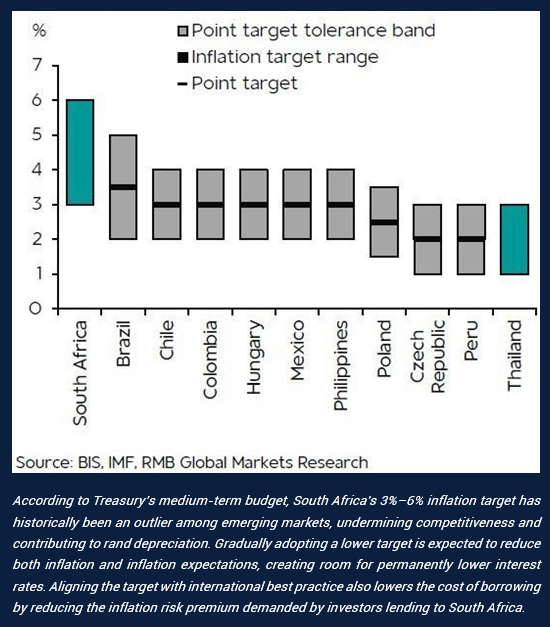
Markets reacted positively to the MTBPS, with the rand hitting its best levels in 2025 and government bond yields dipping. A key factor driving sentiment was the reduction of the inflation target to 3%, with a 1-percentage-point tolerance band, effectively narrowing the range from 3–6% to 2–4%.

Tax collections for the first half of the 2025 budget period have risen 9.3% above estimates, reaching R924.7 billion, prompting the Treasury to revise gross tax revenue upward by R19.7 billion. Despite this progress, South Africa’s slow-growth trajectory remains a concern, with GDP growth projected at 1.2% in 2025 and averaging 1.8% from 2026 to 2028. The budget deficit is forecast to narrow slightly to 4.7% of GDP in 2025/26, with government debt stabilising at 77.9% of GDP.

The government and labour unions agreed to a three-year wage deal in February 2025, with a 5.5% increase in the first year and CPI-linked adjustments thereafter. The revision of the inflation target may necessitate adjustments to this agreement.

In a further boost to investor confidence, South Africa secured its first credit rating upgrade in nearly two decades on Friday, with S&P Global raising the country’s foreign-currency long-term sovereign rating to “BB” from “BB-.” The upgrade reflected stronger growth prospects, an improving fiscal outlook, and reduced contingent liabilities following better performance at Eskom. S&P expects GDP growth to rise to 1.1% in 2025 and average 1.5% through 2026–2028.

The positive sentiment was reflected on the Johannesburg Stock Exchange, where the All Share Index rose 2.87% for the week, supported by gains in resource and financial stocks. The rand strengthened to R17.07/$ at Friday’s close, marking its strongest level against the dollar in nearly three years.

Chart of the Week:
As always, we appreciate your support and value your trust in LNKD Investment Managers.

Weekly Insights: US Markets Weaken as AI Rally Cools and Shutdown Drags On

U.S. equities lost ground this week as investors reassessed elevated valuations in the AI sector and booked profits amid a lack of fresh government data due to the ongoing federal shutdown, now stretching beyond a month.

Private sector reports provided mixed signals on the labour market. ADP data showed a modest rebound with 42,000 jobs added in October, while Challenger, Gray & Christmas reported over 150,000 job cuts—the largest October reduction in more than two decades.

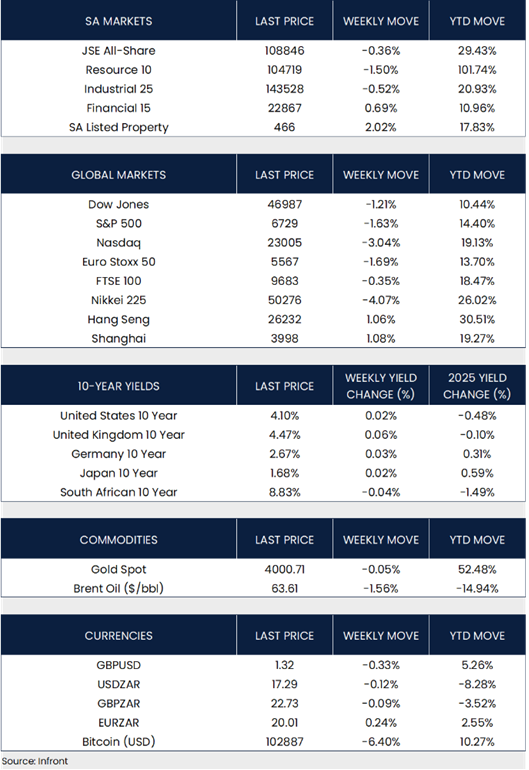
Consumer confidence also deteriorated. The University of Michigan’s Consumer Sentiment Index fell sharply to 50.3, its lowest since mid-2022, with the prolonged shutdown cited as a key concern. Meanwhile, the ISM Services PMI climbed back into expansion at 52.4, while ISM Manufacturing fell further to 48.7, marking eight straight months of contraction. All three major US indices ended the week in the red. The Nasdaq dropped around 3%, while the S&P 500 and Dow Jones each fell more than 1%, as concerns over high tech valuations and market concentration persisted.

The Bank of England kept its policy rate steady at 4.0% in a narrow 5-4 vote, hinting that market expectations for gradual rate cuts toward 3.5% over the next three years remain reasonable. UK equities held up relatively well, with the FTSE 100 easing 0.35% amid broader European weakness. Across the continent, both Sweden’s Riksbank and Norway’s Norges Bank left rates unchanged at 1.75% and 4.0%, respectively. The Euro STOXX 50 slid 1.69% as investors questioned stretched AI-linked stock valuations and digested a third consecutive monthly decline in retail sales.

After hitting record highs in late October, Japanese equities pulled back, with the Nikkei 225 losing 4.07% for the week amid renewed safe-haven demand and concerns over expensive AI shares.

In contrast, Chinese markets advanced following a one-year truce in the US-China trade dispute after the two presidents met at the APEC Summit in South Korea. The Shanghai Composite rose 1.08%, while Hong Kong’s Hang Seng Index gained 1.06%.

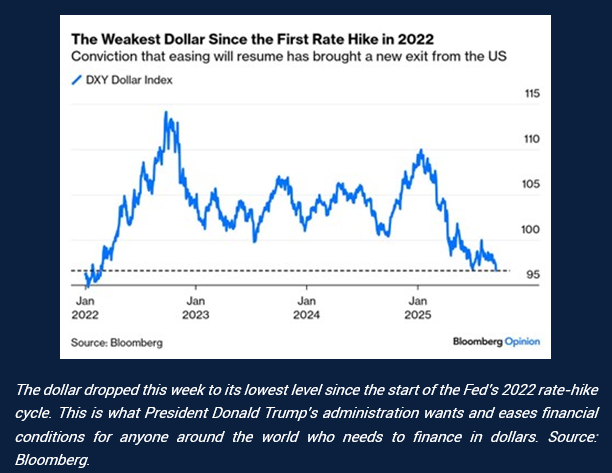
Gold prices climbed above $4,000/oz by Friday’s close, supported by a weaker US dollar and heightened demand for safety amid the ongoing US government shutdown and continued trade uncertainty. In the week ahead, markets will continue to monitor the historic US government shutdown, which has disrupted key data releases. In Europe, attention turns to UK GDP and labour market figures, while in Asia, focus will be on China’s industrial production, retail sales, property prices, and credit data for signs of economic momentum.

Market Moves of the Week:

Locally, markets will turn their focus this week to the National Treasury’s 2025 Medium-Term Budget Policy Statement (MTBPS), set to be delivered by Finance Minister Enoch Godongwana on 12 November 2025. Economists are hopeful that the delayed budget will outline progress on key structural reforms aimed at boosting growth and stabilizing public finances.

Analysts expect a slightly improved fiscal outlook, supported by better-than-expected revenue collection and ongoing efforts to rein in expenditure. South Africa has also benefited from several supportive tailwinds, including stronger gold prices—buoyed by global concerns over the US dollar’s reserve status—and increased export earnings. In addition, the country’s recent removal from the FATF grey list has lifted investor sentiment and could help attract renewed foreign capital inflows.

The rand recovered from midweek weakness, trading near R17.34/USD on Thursday and holding around R17.29 into Friday’s close, supported by steadier global risk appetite and firmer precious metal prices.

Local government bonds mirrored the improvement, with the benchmark R2035 yield easing to around 8.87%, reflecting a modest bid for duration ahead of the budget announcement. South African equities softened in line with global markets, as a tech-led pullback weighed on sentiment. The JSE All Share Index declined 0.36% for the week, with all three major sectors—financials, industrials, and resources—ending lower.

Chart of the Week:

As always, we appreciate your support and value your trust in LNKD Investment Managers. 
Weekly Insights: Markets End October Near Highs

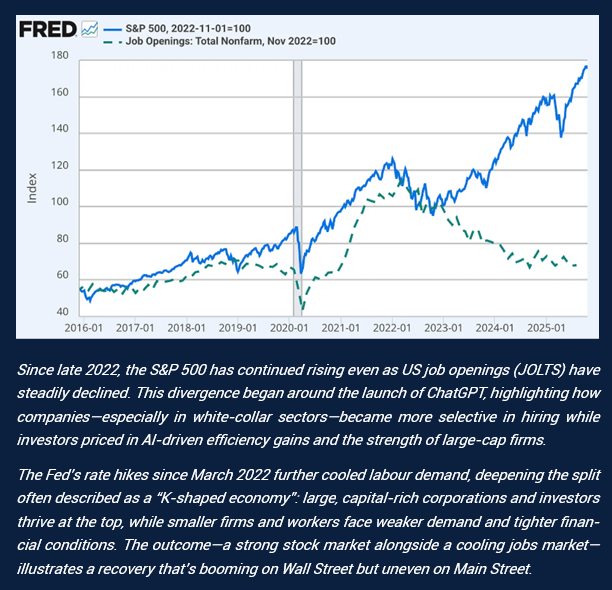
Global markets ended October near record highs, shrugging off earlier volatility as investors drew confidence from strong corporate earnings, progress in U.S.–China trade discussions, and growing expectations that interest rates have peaked. Technology shares continued to lead performance, while concerns around the U.S. government shutdown and political wrangling in Washington had limited market impact.

The U.S. Federal Reserve delivered a widely expected 25 basis-point rate cut, lowering the benchmark rate to 3.75%–4.00%. Chair Jerome Powell emphasised that another cut in December is “not a foregone conclusion,” noting divisions among policymakers and data disruptions caused by the ongoing shutdown. The Fed’s message reflected a more balanced stance – acknowledging easing inflation and softer labour conditions but avoiding premature stimulus. Meanwhile, a one-year trade truce between Presidents Trump and Xi helped ease tensions, with the U.S. scaling back select tariffs and China pledging to resume agricultural imports. Despite temporary growth drags from the shutdown, private-sector data continues to show steady consumer spending and resilient employment trends.

Corporate earnings also provided reassurance, with over 80% of S&P 500 companies beating expectations, underscoring the strength of underlying business fundamentals. While results from mega-cap technology firms were mixed, enthusiasm around artificial intelligence and improving productivity trends continued to drive market gains. The Nasdaq and S&P 500 both reached new highs, reflecting confidence that profit growth remains robust heading into year-end.

In Europe, the European Central Bank held interest rates steady at 2.15% as inflation hovered near its 2% target. President Christine Lagarde reiterated that decisions will remain data-dependent, pointing to signs of stabilisation in the eurozone economy. GDP expanded by 0.2% in the third quarter – slightly above expectations – driven by France and Spain, while the unemployment rate held firm at 6.3%. In the UK, house prices and mortgage approvals improved modestly, hinting at a stabilising housing market. In Germany, sentiment and business confidence picked up, suggesting the industrial slowdown may be bottoming out.

Across Asia, Japanese equities rallied to a record high, with the Nikkei 225 gaining 16.6% – its best monthly gain since 1994 – on steady policy support and optimism around global technology earnings. The yen weakened slightly after the Bank of Japan left rates unchanged and signalled patience on future hikes. In China, markets were more subdued as optimism over trade progress was offset by a lack of new policy stimulus. The manufacturing PMI slipped to 49.0, pointing to mild contraction, while authorities reaffirmed their goal of shifting growth toward domestic demand.

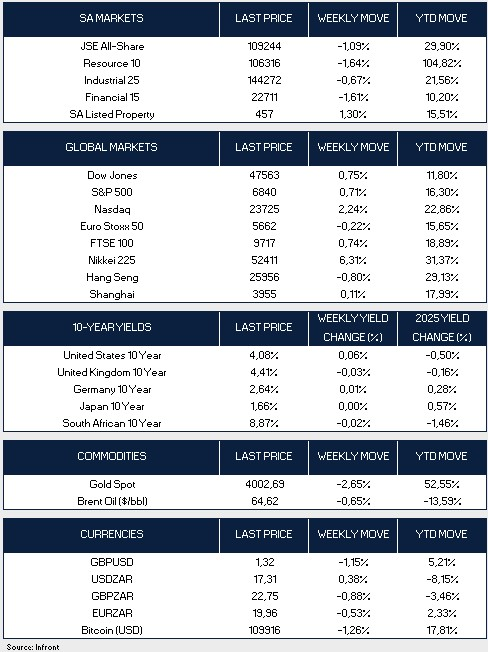
Global markets ended the week largely higher, supported by strong corporate earnings and renewed optimism around U.S. rate cuts. In the U.S., the Dow Jones gained 0.75%, the S&P 500 rose 0.71%, and the Nasdaq advanced 2.24% as technology shares outperformed. In Europe, performance was more muted, with the Euro Stoxx 50 slipping 0.22% and the FTSE 100 adding 0.74%. In Asia, Japan’s Nikkei 225 surged 6.31%, leading global gains, while Hong Kong’s Hang Seng fell 0.80% and the Shanghai Composite edged up 0.11%.Bond yields were mixed – U.S. 10-year yields rose slightly to 4.08%, while UK and German yields were marginally softer. Gold pulled back 2.65% after recent highs, Brent crude fell 0.65%, and Bitcoin retreated 1.26%, though it remains up 17.8% year-to-date.

Market Moves of the Week:

South African Reserve Bank Governor Lesetja Kganyago reaffirmed his commitment to lowering the inflation target to 3%, arguing that persistent pressures from administered prices and multi-year wage agreements should not delay the transition. He stressed that while electricity and water tariffs remain elevated, policy credibility depends on setting long-term goals aligned with international peers rather than waiting for temporary distortions to subside.

The central bank has long maintained that the current 3-6% inflation band is uncompetitive, and although Finance Minister Enoch Godongwana has not yet formally endorsed the change, the SARB has been guiding expectations toward the lower end of the range. Critics suggest the central bank is moving ahead of Treasury, but Kganyago highlighted falling government bond yields – down 80–160 basis points since April – as evidence of continued investor confidence.

He also emphasised alignment between fiscal and monetary authorities, noting close coordination with Treasury ahead of the Medium-Term Budget Policy Statement on 12 November, where a formal adoption of the new target could be confirmed. Meanwhile, National Treasury reported a R15.36 billion budget deficit for September, suggesting the current account shortfall widened modestly from 1.1% of GDP in Q2 to 1.6% in Q3, while producer inflation eased to 2.3% year-on-year, indicating softer upstream price pressures. Locally, the JSE All Share Index fell 1.09%, dragged lower by resources (-1.64%), industrials (-0.67%), and financials (-1.61%), while listed property advanced 1.30% to cap a resilient performance for the sector. The rand weakened slightly by 0.38% to R17.31/$, while the 10-year government bond yield eased marginally to 8.87%.

Chart of the Week:

As always, we appreciate your support and value your trust in LNKD Investment Managers. 

Weekly Insights: China Trade Tensions Ease

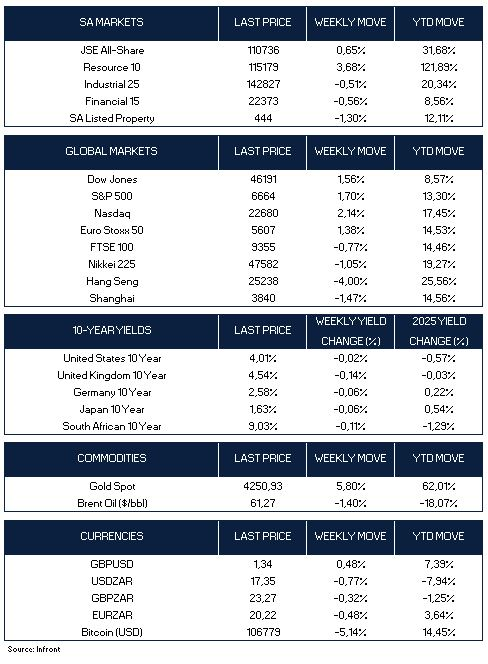
The Dow Jones Industrial Average advanced on Friday as investors reacted to a softer tone from U.S. officials regarding trade negotiations with China and looked past renewed concerns in the regional banking sector. Despite midweek volatility, all three major U.S. indices closed the week higher — the S&P 500 rose 1.7%, the Dow gained 1.6%, and the Nasdaq advanced 2.1%.

Early optimism followed signs of easing trade tensions between Washington and Beijing, supported by dovish commentary from several Federal Reserve officials and continued deal activity within the artificial intelligence (AI) sector. Treasury Secretary Scott Bessent confirmed plans to speak with his Chinese counterpart, while President Trump noted that a meeting with President Xi Jinping remained likely later this month — comments that helped ease fears of new tariffs due on November 1.

However, Thursday saw renewed volatility as the Dow fell 300 points and the S&P 500 declined 0.6%, dragged lower by regional banks. The SPDR S&P Regional Banking ETF (KRE) dropped over 6%, marking its fourth consecutive weekly loss. Investor anxiety grew following the bankruptcies of auto-industry-linked lenders Tricolor and First Brands, coupled with allegations of loan-related fraud at two regional banks. The turmoil briefly drove the Cboe Volatility Index (VIX) to its highest level since April before easing on Friday.

Fed Chair Jerome Powell reiterated that downside risks to employment have increased, reinforcing expectations of another rate cut this year. Additional dovish remarks from policymakers Christopher Waller and Stephen Miran strengthened the view that the Fed remains committed to supporting growth despite inflation remaining above target.

U.S. Treasury yields declined across the curve, with the 10-year yield falling to its lowest level since October 2024. Safe-haven demand was further supported by ongoing concerns over the federal government shutdown, now entering its third week, with little progress in negotiations between parties.

In Europe, the STOXX Europe 50 Index gained 1.38%, buoyed by Powell’s dovish tone and easing U.S.–China trade tensions. The UK’s FTSE 100 declined 0.77%, despite data showing that GDP grew 0.1% in August, following a 0.1% contraction in July. The unemployment rate edged up slightly to 4.8%, indicating a modest loosening in labour market conditions.

In Asia, Japan’s Nikkei 225 fell 1.05% as yen strength weighed on exporters and investor sentiment remained cautious amid global trade uncertainty, while in China, deflationary pressures persisted. Producer prices fell 2.3% year-on-year in September, while consumer prices declined 0.3%, deeper than expected. However, core inflation rose to a 19-month high of 1.0%, offering a glimmer of resilience in domestic demand. The Shanghai Composite Index fell 1.47% for the week, while Hong Kong’s Hang Seng Index dropped 4%, pressured by escalating trade concerns and weak property sentiment.

Gold fell over 2% on Friday to around $4,250 per ounce, retreating from record highs as easing U.S.–China trade tensions tempered safe-haven demand. Despite the pullback, the metal remains up more than 60% year to date, supported by expectations of U.S. rate cuts, geopolitical risks, and strong central bank and ETF demand. Meanwhile, Brent crude rose 0.4% on Friday to just under $61.30 per barrel, though it recorded a third straight weekly decline amid oversupply concerns. Rising U.S. inventories and an IEA forecast of a global crude surplus in 2026 continued to weigh on sentiment.

Next week, markets will focus on developments in the U.S.–China trade dialogue, the ongoing government shutdown, and a range of key economic releases — including the U.S. CPI, PMI, and existing home sales reports. In Asia, attention will turn to China’s Q3 GDP and other key data points, while in Europe, investors will watch Euro Area consumer confidence and UK inflation figures. Monetary policy decisions from the central banks of Turkey, Indonesia, and South Korea will also be closely monitored.

Market Moves of the Week:

South Africa is set to lift its long-standing moratorium on unconventional gas exploration, including shale resources, once new regulations are gazetted later this month, according to Petroleum Resources Minister Gwede Mantashe. The move is expected to reopen investment opportunities in the Karoo Basin, which the U.S. Energy Information Administration (EIA) estimates holds up to 390 trillion cubic feet of technically recoverable shale gas. The moratorium, in place since 2011, allowed for environmental and technical assessments amid concerns over hydraulic fracturing. Mantashe said the government has finalised a structured and transparent licensing framework under the Upstream Petroleum Resources Development Bill to ensure responsible exploration.

On the markets front, the rand remained under pressure for most of Friday, ending the session at R17.35/$, after a volatile week driven by global trade developments, while the benchmark JSE All Share Index gained 0.65% for the week, after a strong sell-off in resource counters on Friday.

Investors will turn their focus to next week’s September CPI release for insight into domestic inflation trends. Headline inflation eased to 3.3% year-on-year in August from 3.5% in July. A Reuters poll forecasts a modest uptick to 3.5%.

Chart of the Week:

Weekly Insights: Trade Tensions & Shutdown Weigh on Markets

U.S. equities weakened over the week as renewed trade tensions and the prolonged government shutdown weighed on sentiment. Markets were supported early on by strong gains in AI-related companies, highlighted by the AMD–OpenAI partnership, but later sold off after President Trump threatened large tariffs on Chinese goods. The shutdown entered its second week, delaying economic data and disrupting federal services, and while such events typically have only temporary effects, a longer duration could weigh more meaningfully on growth. At the same time, investors remained focused on the upcoming earnings season, with expectations for a ninth consecutive quarter of profit growth. Safe-haven demand increased, sending gold above $4,000/oz and U.S. Treasury yields lower. Fed minutes showed policymakers remained divided but still saw scope for rate cuts later this year.

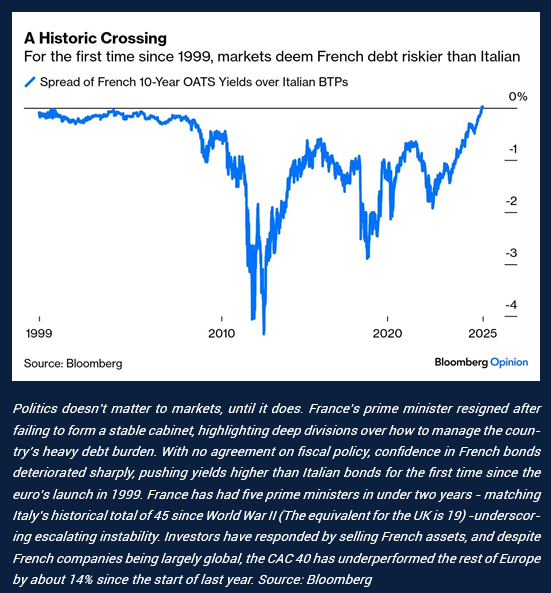
European data signalled continued weakness, led by a 4.3% drop in German industrial production in August, driven by auto sector declines and broader softness across manufacturing. Exports also fell, particularly to the U.S., prompting the German government to introduce budget cuts and electric vehicle subsidies. Political instability added pressure as the resignation of France’s prime minister triggered a selloff in French assets and higher bond yields. In the UK, house prices declined and buyer demand remained weak, although business activity stabilised slightly. The ECB noted inflation is moving closer to target and growth may recover in 2026, though sluggish exports and a stronger euro could limit near-term momentum.

Japanese equities rose early in the week after Sanae Takaichi secured leadership of the ruling LDP, increasing expectations for fiscal stimulus and continued loose monetary policy, which weakened the yen. However, optimism faded as coalition partner Komeito withdrew support, raising uncertainty over government formation and fuelling speculation of a snap election. The 10-year JGB yield climbed to its highest level since 2008 on expectations of additional stimulus. Economic data was mixed, with wage growth slowing but household spending and producer price inflation both remaining firm, pointing to underlying demand despite political uncertainty.

Mainland Chinese equities were mixed in a holiday-shortened week, with the Shanghai Composite edging higher and the CSI 300 slightly lower, while Hong Kong’s Hang Seng fell more than 3%. Early consumption data from Golden Week was weaker than expected, with retail and restaurant sales rising only 3.3% – about half the pace of the May Labor Day holiday – and passenger traffic growth also slowing. This highlighted the ongoing challenge of shifting the economy toward domestic demand and services. Attention is now turning to the upcoming fourth plenum on October 20–23, where policymakers are expected to outline priorities for the next five-year plan.

Elsewhere, global central banks continued to ease policy to support growth. The Reserve Bank of New Zealand cut interest rates by 50 basis points to 2.5%, while Poland’s central bank reduced rates by 25 basis points to 4.50% in its third cut since June, citing slowing activity and stabilising inflation.

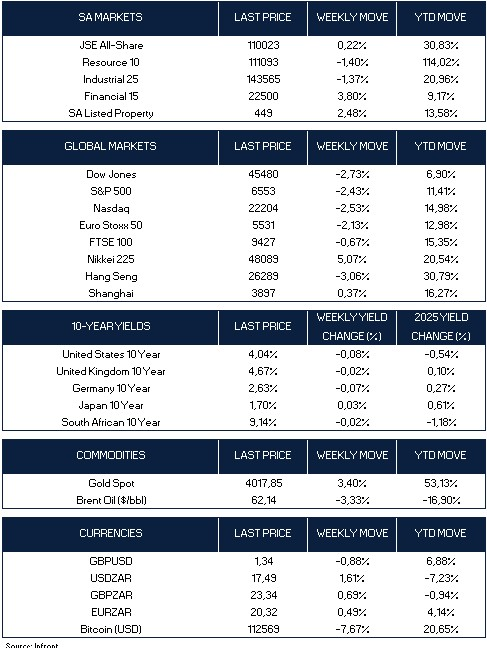
Global markets were mixed. In the U.S., the Dow fell 2.73%, the S&P 500 lost 2.43% and the Nasdaq declined 2.53%. In Europe, the Euro Stoxx 50 fell 2.13% and the FTSE 100 slipped 0.67%. In Asia, Japan’s Nikkei 225 rose 5.07%, the Shanghai Composite edged up 0.37% and Hong Kong’s Hang Seng dropped 3.06%. U.S. 10-year Treasury yields moved lower on safe-haven demand, while German and UK yields also declined slightly and Japanese yields rose. Gold strengthened and oil prices fell, while Bitcoin declined but remains higher year to date.

Market Moves of the Week:

South African policymakers moved to clarify their stance on inflation targeting after Finance Minister Enoch Godongwana criticised Reserve Bank Governor Lesetja Kganyago for a “unilateral” statement on lowering the target. The two later issued a joint statement signalling alignment, with Kganyago emphasising that the discussion is about timing rather than direction. He noted that expectations of a lower inflation target have already strengthened the rand and reduced government borrowing costs. The fiscal outlook has also improved, with revenue up more than 10% in the first five months of the 2025/26 year and spending rising only around 4%, partly due to delayed budget approval and tighter controls on social grants. After rising from 26% of GDP in 2009 to 77% in 2025, the debt ratio is expected to stabilise before gradually declining as Treasury targets a larger primary surplus. The mid-term budget will be presented on November 12. Manufacturing output rose 0.4% month on month in August, though remained 1.5% lower year on year.

South African markets were mixed over the week. The JSE All Share Index inched up 0.22%, supported by financials (+3.80%) and listed property (+2.48%). Resource stocks fell 1.40% and industrials declined 1.37%, weighing on overall gains. The rand weakened 1.61% against the U.S. dollar to R17.49 as global risk sentiment softened, while the South African 10-year government bond yield was little changed at 9.14%.

Chart of the Week:

As always, we appreciate your support and value your trust in LNKD Investment Manaers. 

Weekly Insights: Markets Remain Steady Amid U.S. Shutdown

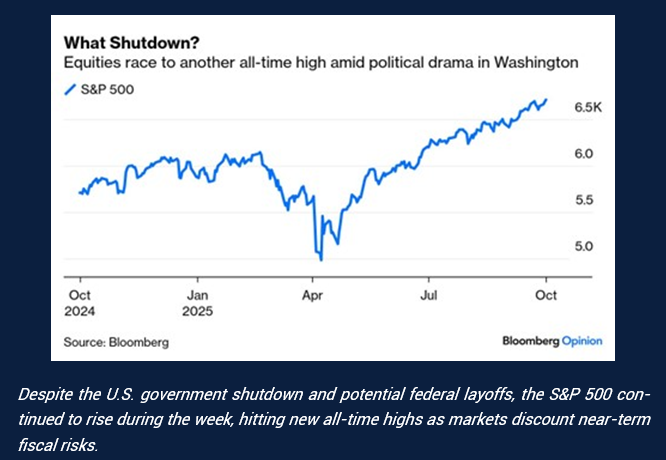
The U.S. federal government shut down on October 1 after Congress failed to pass a funding bill. The shutdown has furloughed hundreds of thousands of federal workers, halted non-essential services, and delayed key data releases. Among the most notable was the September nonfarm payrolls report from the Bureau of Labor Statistics, which did not go ahead as scheduled. If the shutdown persists, other critical releases (such as the September CPI due October 15) may also be delayed.

In the absence of the payrolls data, markets turned to alternative indicators, with ADP reporting a 32,000 job loss in September versus expectations for a 51,000 gain. While this headline weakness added to conviction around further Fed rate cuts, much of the drop reflected ADP’s benchmarking to revised government data rather than a fundamental deterioration in labour market conditions.

Euro area headline inflation ticked higher to 2.2% year-on-year in September from 2.0% in August, driven by firmer services prices and a slower decline in energy costs. Core inflation, excluding food and energy, was unchanged at 2.3%. In a keynote address at the Bank of Finland, ECB President Christine Lagarde noted that inflation risks appear broadly contained in both directions, emphasising that with policy rates at 2%, the ECB is well positioned to respond should risks evolve or new shocks emerge.

On the labour front, the unemployment rate in the bloc edged up to 6.3% in August from July’s record low of 6.2%. Spain, France, and Italy recorded the highest unemployment rates, while Germany and the Netherlands posted the lowest. On a year-over-year basis, unemployment was unchanged at 6.3%.

The Bank of Japan (BoJ) signalled that it remains on a gradual tightening path but provided limited guidance on the timing of its next rate hike. Governor Kazuo Ueda noted that rates were left unchanged at the September meeting to maintain accommodative conditions amid U.S. tariff volatility. While the tariffs have weighed on exporters’ earnings, there are no signs of spillovers to the broader economy.

China’s official manufacturing PMI edged up to 49.8 in September from 49.4 in August, while the non-manufacturing PMI, covering construction and services activity, slipped to 50.0 from 50.3. Readings above 50 signal expansion, while those below 50 indicate contraction. Despite the manufacturing PMI slightly beating the median forecast, it marked the sixth consecutive month of contraction in factory activity. Both indicators suggest that economic weakness persisted into Q3, following stronger growth in the first half of the year.

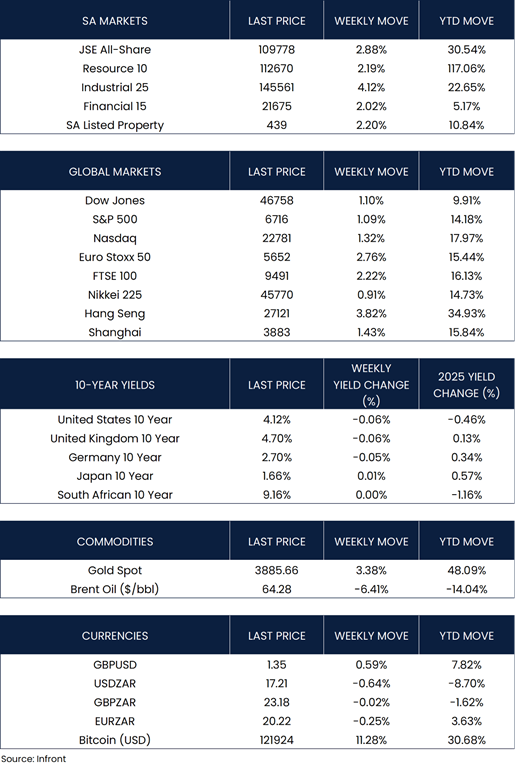
Global equities posted broad gains despite the U.S. government shutdown that began on Thursday. In the U.S., the Nasdaq Composite led the gains, rising 1.32% for the week, while the Dow Jones and S&P 500 increased 1.10% and 1.09%, respectively.

European markets also advanced, with the STOXX Europe 50 climbing 2.76% in local currency to record levels, supported by strength in technology stocks and expectations of lower U.S. borrowing costs. The UK’s FTSE 100 gained 2.22% over the week.

In Asia, Japan’s Nikkei 225 rose 0.91%. Mainland Chinese equities also advanced in a holiday-shortened week, with the Shanghai Composite up 1.43% through Tuesday, September 30, before markets closed for the Golden Week holiday from October 1 to 8. In Hong Kong, the Hang Seng Index gained 3.82%, despite the market being closed on Wednesday for National Day.

Market Moves of the Week:

South African manufacturing sentiment improved in September, supported by strong domestic demand, according to the latest PMI survey. The seasonally adjusted Absa PMI rose to 52.2 points from 49.5 in August, marking only the second time this year the index has indicated expansion. The report highlighted that gains were driven by local demand, while global trade challenges, including U.S. tariffs and port disruptions, continued to weigh on the sector.

Formal employment in South Africa came under continued pressure in Q2 2025, according to Stats SA’s Quarterly Employment Survey (QES). The survey, which tracks formal jobs in the country excluding agriculture, forestry, fishing, and private households, showed job losses across key sectors, notably community services, trade, and manufacturing. The QES differs from the broader Quarterly Labour Force Survey (QLFS), which captures informal and domestic work as well as unpaid family labour. The data highlight ongoing strain in the formal labour market.

South African markets mirrored global trends, posting gains over the week. The JSE All-Share Index rose 2.88%, supported by broad-based sector gains. Industrials led the advance with a 4.12% return, while other sectors also made meaningful contributions. The rand strengthened 0.21% against the U.S. dollar, closing at R17.21/USD.

Chart of the Week:

As always, we appreciate your support and value your trust in LNKD Investment Managers. 
Weekly Insights: US Inflation Holds Steady

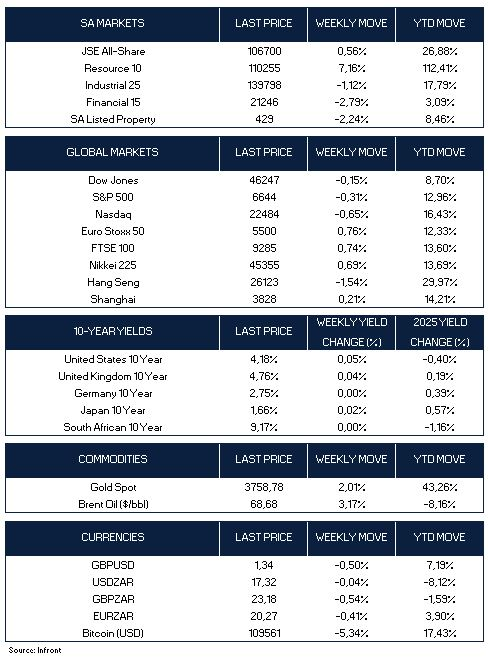
U.S. equities ended Friday higher but still closed the week in negative territory as investors digested key inflation data. The Federal Reserve’s preferred gauge, the personal consumption expenditures (PCE) price index, rose 0.3% in August, lifting the annual headline rate to 2.7% from 2.6% in July. Core PCE, which excludes food and energy, increased 0.2% for the month and held steady at 2.9% annually, in line with consensus forecasts.

The Bureau of Economic Analysis also revised second-quarter GDP growth to an annualized 3.8%, up from the prior 3.3% estimate, with consumer spending providing the largest boost.

Major U.S. indices ended the week lower, with the Nasdaq Composite and S&P 500 sliding 0.65% and 0.31% respectively, marking each index’s first losing week in four, while the Dow shed 0.15%.

Fed Chair Jerome Powell reiterated this week that while inflation expectations remain anchored near the Fed’s 2% target, downside risks to employment and elevated uncertainty leave policymakers without a “risk-free” policy path. He also noted that tariffs are likely to result in a one-time price adjustment spread over several quarters.

In Europe, the STOXX Europe 50 Index rose 0.76%, as markets weighed rate policy developments and ongoing trade tensions. Economic surveys signalled modest growth in the third quarter, with services activity expanding at the fastest pace this year, while manufacturing output lagged. Business confidence dipped to a four-month low.

In the UK, the PMI fell to 51.0, down from 53.5 in August, as both services and manufacturing slowed. Confidence also dropped to its weakest level since June, ahead of the November budget, nevertheless the FTSE 100 gained 0.74% for the week.

Japanese equities advanced, with the Nikkei 225 Index up 0.69%. Inflation in the Tokyo area rose 2.5% year-on-year in September, unchanged from August but slightly below expectations. In China, the Shanghai Composite Index gained 0.21%, while Hong Kong’s Hang Seng Index declined 1.54%.

Gold held above $3,750 per ounce, near record highs, supported by safe-haven demand despite a stronger dollar and higher Treasury yields, while oil prices advanced, set for their steepest rise since June, as Ukraine’s strikes on Russian energy infrastructure prompted supply concerns.

The week ahead brings a full slate of economic releases, led by the closely watched U.S. employment report, which will provide fresh insight into payroll growth, unemployment trends, and wage pressures—key indicators shaping the Federal Reserve’s policy outlook. In Europe, attention will centre on new inflation data for the eurozone and its member states, alongside CPI figures from Turkey and Switzerland. On the monetary policy front, interest rate decisions in Australia and India will also be in focus.

Market Moves of the Week:

In local news, South Africa’s producer inflation accelerated to 2.1% year-on-year in August, up from 1.5% in July, according to Statistics South Africa. On a monthly basis, the Producer Price Index (PPI) rose 0.3%, with the increase driven largely by higher prices in the food, beverages, and tobacco category, which climbed from 3.9% to 4.3% year-on-year as food inflation reached 4.1%.

Meanwhile, confidence indicators painted a weaker picture. The FNB/BER Consumer Confidence Index dropped sharply in the third quarter, retreating to -13, as households reported worsening financial positions and a weaker economic outlook. Retailer confidence also declined significantly, hitting its lowest level in a year.

In markets, the JSE All Share Index ended the week 0.56% higher, supported by continued strength in resource stocks. The rand firmed in late Friday trade, closing at R17.32 per U.S. dollar.

Chart of the Week:

As always, we appreciate your support and value your trust in LNDK Investment Managers. 

Weekly Insights: Federal Reserve cuts rates for first time this year

The Federal Reserve lowered rates by 25 basis points on Wednesday, as widely expected, and indicated it may cut by a further 50 basis points before year-end. Policymakers flagged rising downside risks to employment, even as inflation remains elevated. Governor Stephen Miran, newly appointed to the Board, was the lone dissenter, preferring a larger 50-basis-point reduction. Chair Jerome Powell framed the move as a risk-management measure to pre-empt further labour market softening.

In other economic news, U.S. retail sales jumped 0.6% in August, surpassing expectations, while core sales climbed 0.7%, also beating forecasts. July figures were revised higher, showing 0.6% growth instead of the initially reported 0.5%. Despite signs of a softer labour market, economic activity appears to remain resilient.

President Trump and Chinese President Xi Jinping spoke by phone on Friday. Chinese state media described the talks as “pragmatic and constructive.” Xi emphasised the importance of US-China relations, urged Washington to avoid unilateral trade actions, and expressed support for a TikTok resolution that separates its U.S. operations from its Chinese parent. Trump said on social media that the TikTok deal was approved and progress was made on trade, fentanyl, and the Russia-Ukraine conflict. The leaders are set to meet at the APEC Summit in late October, with Trump planning a visit to China in early 2026.

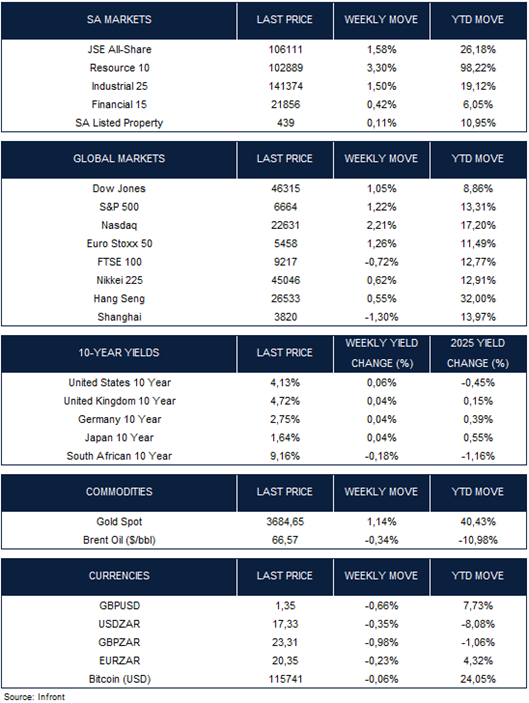
Major U.S. stock indexes hit record highs during the week. The Nasdaq Composite advanced 2.21%, while the S&P 500 and Dow Jones Industrial Average gained 1.22% and 1.05%, respectively. Meanwhile, the yield on the U.S. 10-year Treasury note rose 6 basis points to 4.13%.

The Bank of England this week held its key rate at 4% in a 7–2 vote and slowed bond sales to ease gilt market pressures amid rising long-term yields. Governor Andrew Bailey said that while inflation is expected to return to the 2% target, any future rate cuts will need to be gradual and cautious. Economic data showed headline inflation steady at 3.8% in August, overall wage growth rising to 4.7% and unemployment holding at 4.7%. On the market front, the FTSE 100 fell 0.72% week-on-week, while Europe’s Euro Stoxx 50 gained 1.26%.

Japan’s stock market edged higher this week, with the Nikkei 225 rising 0.62%. The Bank of Japan surprised markets by announcing it would start selling its ETF and REIT holdings sooner than expected, signalling a shift toward policy normalisation. As widely expected, interest rates were kept at 0.50%, though two policymakers broke from consensus, favouring a hike amid ongoing political and trade uncertainties.

Mainland Chinese stocks fell as investors booked profits amid signs of slowing growth. The Shanghai Composite fell 1.3%, while Hong Kong’s Hang Seng rose 0.55%. August data showed retail sales and industrial output posting their weakest monthly growth this year, with fixed asset investment slowing to just 0.5% for the first eight months, the lowest non-pandemic reading on record.

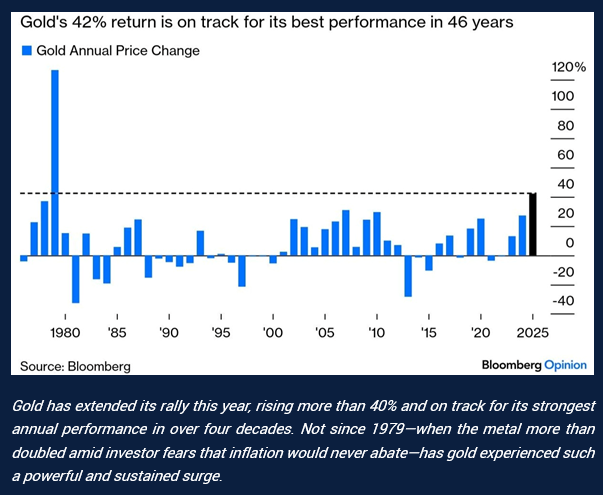
In commodities, Brent oil dipped 0.34% on the week, while gold advanced 1.14% as investors reacted to the Federal Reserve’s first rate cut of the year and monitored signals on future policy.

Market Moves of the Week:

The South African Reserve Bank paused its rate-cutting cycle on Thursday, leaving the benchmark repo rate unchanged at 7%, following a split 4-2 vote, with two dissenting members in favour of a 25-basis point cut. This decision aligned with market expectations. The bank’s updated forecasts were slightly more hawkish, revising the 2026 inflation projection from 3.3% to 3.6%, driven by supply-side factors such as food and fuel prices, as well as higher electricity tariffs. The Monetary Policy Committee (MPC) highlighted that it is closely monitoring the effects of the 125 basis points of rate cuts implemented over the past year, along with shifts in inflation expectations and associated risks, before considering any further easing.

South African (SA) inflation slowed more than expected in August, driven by lower fuel and food costs. Headline consumer inflation fell to 3.3% y/y from 3.5% in July, lower than the 3.6% forecast of economists polled by Reuters. The annual core inflation rate, which excludes food, non-alcoholic beverages, fuel, and energy, rose to 3.1% in August 2025, the highest since March, from 3% in the prior month.

SA’s manufacturing sector slipped back into contraction in August, with the Absa PMI falling 1.4 points to 49.5 after briefly entering expansion in July. Compiled by the Bureau for Economic Research (BER), the index highlights weak domestic and export demand, as new sales orders dropped sharply to 47.4, with respondents citing the adverse effects of U.S. tariffs on exports.

The All-Share Index rose 1.58% this week, boosted by Resources and Industrials. The local currency strengthened against the U.S. dollar, moving to R17.33/$ from last week’s R17.39/$ level. The 10-year SA government bond extended its year-to-date rally, with yields falling 18 basis points over the week.

Chart of the Week:

As always, we appreciate your support and value your trust in LNKD Investment Managers.
Weekly Insights: Softer Jobs keep Fed on Rate-Cut Path

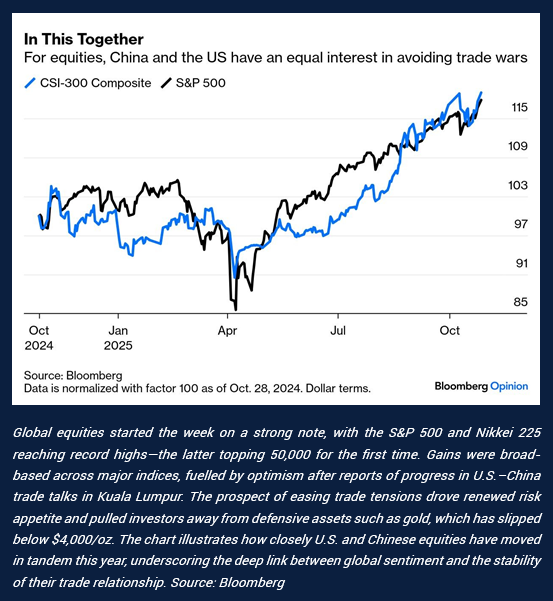
U.S. equities closed higher, with the Dow, S&P 500, and Nasdaq all hitting fresh record highs before easing modestly into Friday. The Russell 2000 extended its winning streak to six weeks, supported by optimism around artificial intelligence and expectations that the Federal Reserve will cut rates at its September 16–17 meeting. Futures markets continue to price in a faster pace of U.S. interest rate cuts than the Fed’s own projections.

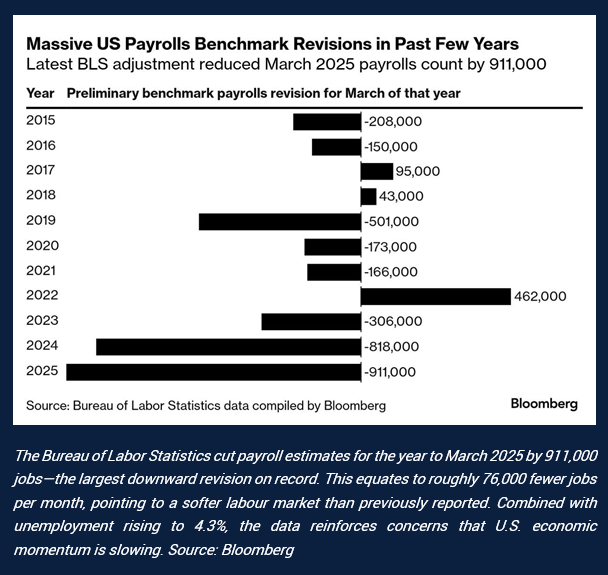
Economic data kept focus on inflation and the labour market. August CPI rose 2.9% year-on-year, with core CPI steady at 3.1%. Treasury yields dipped as investors priced in Fed action, with the 10-year briefly touching 4.0%. Jobless claims rose to their highest since 2021 and payrolls were revised down by 911,000 – the largest downward revision on record – pointing to a softer jobs backdrop. Consumer sentiment also slipped, with households worried about business conditions and employment, while long-term inflation expectations edged up.

In Europe, the ECB left rates unchanged at 2% but lifted its 2025 inflation and growth forecasts, prompting markets to assume that interest rate cuts are over in the region. German data was mixed, with exports down and factory orders weaker, though output improved. In the UK, GDP was flat in July, retail sales were firmer, but the housing market softened further. Political uncertainty persisted in France after President Macron appointed Sebastien Lecornu as prime minister following the collapse of François Bayrou’s government.

Japan was a standout, with the Nikkei jumping 4.1% to a record high on AI-driven gains led by SoftBank. GDP was revised sharply higher, showing 2.2% annualised growth in Q2, supported by consumption. Prime Minister Shigeru Ishiba announced his resignation, with a new leader to be chosen in October. Inflation pressures remain, with widespread consumer price hikes, though PPI eased slightly. The Bank of Japan is expected to hold steady this month, but another hike remains possible.

China’s deflation persisted, with CPI falling 0.4% year-on-year and PPI down 2.9%. Core CPI, however, rose to an 18-month high of 0.9%, suggesting some policy traction. Equities rallied strongly, driven by liquidity and optimism over Beijing’s push for homegrown technology, with the CSI 300 seeing its best daily gain since March. This divergence between weak price data and buoyant markets highlights the challenge for policymakers.

Geopolitics stayed in focus. Donald Trump threatened tariffs of up to 100% on China and India unless the EU joined in, while the U.S. was shaken by the assassination of conservative activist Charlie Kirk. In Europe, Poland shot down Russian drones that crossed its airspace, the first direct NATO engagement of the war. Germany pledged more air policing, while Trump suggested the incursion may have been a “mistake,” exposing divisions among allies.

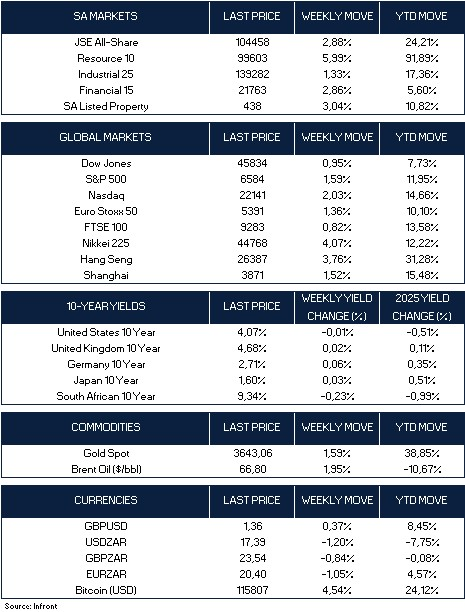
Global markets ended the week broadly higher. The Dow gained 0.95%, the S&P 500 rose 1.59%, and the Nasdaq climbed 2.03%. In Europe, the Euro Stoxx 50 advanced 1.36% and the FTSE 100 gained 0.82%. In Asia, Japan’s Nikkei jumped 4.07%, Hong Kong’s Hang Seng rose 3.76%, and the Shanghai Composite added 1.52%. Bond markets were stable overall, with U.S. 10-year yields easing slightly, while German and Japanese yields edged up. Commodities were firmer, as gold rose 1.6% and Brent crude 2.0% to $66.80. Bitcoin gained 4.5% for the week.

Market Moves of the Week:

South Africa’s economy showed signs of recovery in Q2 2025, with real GDP expanding 0.8% quarter-on-quarter, up from just 0.1% in Q1 and above expectations. Growth was broad-based, with manufacturing, mining, and trade contributing, while stronger household consumption added support. Year-on-year, GDP rose 0.6%, but the current account deficit widened to R82.8bn (1.1% of GDP) as the trade surplus narrowed on softer exports.

Momentum in manufacturing slipped in July, with output down 0.5% month-on-month and 0.7% year-on-year, while the BER Building Confidence Index eased to 35 in Q3. Weaker sentiment among architects, surveyors and material producers outweighed modest gains for contractors, highlighting the uneven nature of the recovery.

Retail trends were mixed, but online sales are expected to exceed R130bn in 2025, or around 10% of total turnover, after surging 35% in 2024. Growth remains strongest in on-demand grocery platforms such as Shoprite, Pick n Pay and Woolworths, while digital investment is reshaping fashion retail.

In trade, South Africa secured continued access to the U.S. for fisheries exports beyond January 2026, after regulators recognised local marine mammal protections as comparable to U.S. standards. The ruling safeguards jobs, sustains a vital export channel, and underscores the country’s role as a responsible fishing nation.

South African equities advanced, with the JSE All Share Index rising 2.88%. Resource stocks were the standout performers, surging 5.99%, while financials gained 2.86% and industrials added 1.33%. Listed property also firmed, up 3.04%. The rand strengthened against the U.S. dollar, appreciating 1.20% to close at R17.39, supported by improved risk sentiment.

Chart of the Week:

As always, we appreciate your support and value your trust in LNKD Investment Managers. 

Weekly Insights: Soft US Jobs Data Boosts Fed Cut Bets

US stocks closed lower on Friday as weaker-than-expected August jobs data fuelled concerns about a slowing economy, despite growing expectations for Federal Reserve rate cuts. The S&P 500, which had gained earlier in the session, finished 0.3% lower, retreating from Thursday’s record close. The Dow Jones Industrial Average dropped 220 points, while the Nasdaq 100 remained essentially flat. Sectors such as banks, energy, and industrials led the decline, while real estate showed resilience, buoyed by optimism surrounding potential rate cuts.

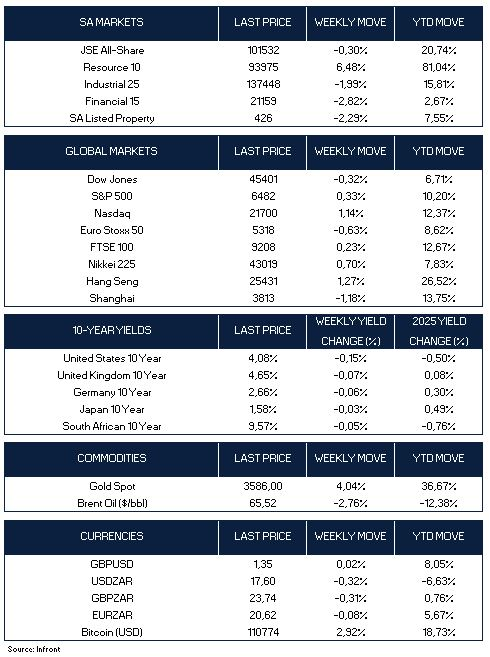
Despite Friday’s losses, both the S&P 500 and the tech-heavy Nasdaq posted gains for the week, up 0.33% and 1.14%, respectively. The Dow, however, finished the week down 0.32%.

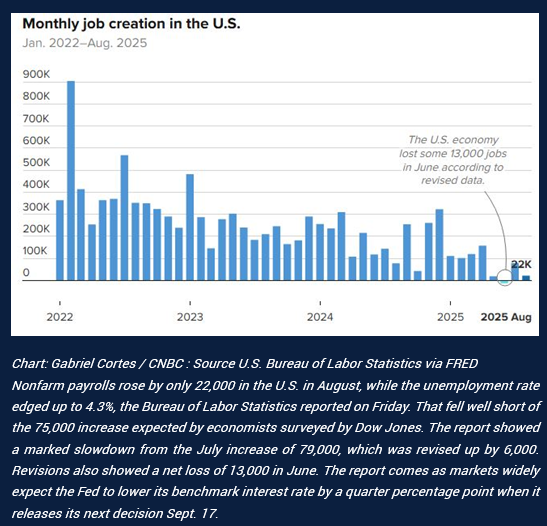
The catalyst for the sell-off was the release of the Labor Department’s nonfarm payrolls report, which showed US employers added just 22,000 jobs in August. This was a sharp decline from July’s revised figure of 79,000 and well below market expectations of approximately 77,000. Additionally, June’s payroll number was revised downward from a gain of 14,000 to a loss of 13,000, marking the first negative monthly reading since December 2020. The unemployment rate for August also ticked up to 4.3%, the highest level since 2021.

In response to the jobs report, futures markets tracked by the CME FedWatch tool now reflect a 100% probability of at least a 25-basis-point (0.25 percentage point) rate cut at the Fed’s next meeting. The likelihood of a 50-basis-point cut increased from 0% to roughly 10% following the data. Meanwhile, the yield on the 10-year US Treasury note fell sharply to 4.07%, its lowest level in five months, as investors sought the relative safety of government bonds amid concerns over a weakening labour market.

In Europe, the STOXX Europe 50 Index ended the week 0.63% lower, weighed down by worries about slowing global growth and a strengthening euro. Inflation in the Eurozone rose slightly in August to 2.1%, remaining close to the European Central Bank’s (ECB) 2% medium-term target. Unemployment in the bloc fell marginally to 6.2% in July, down from 6.3%. Meanwhile, in contrast the UK’s FTSE 100 Index posted a modest gain of 0.23%.

Japanese stock markets saw positive momentum for the week, with the Nikkei 225 Index gaining 0.70%. Japanese auto stocks were particularly strong, as the US formally implemented a trade deal with Japan, capping tariffs on most Japanese goods, including automobiles, at 15%.

Mainland Chinese markets, however, experienced a pullback, with the Shanghai Composite Index falling 1.18% as investors took profits following a recent rally. In Hong Kong, the Hang Seng Index fared better, rising 1.27%.

On the commodities front, oil prices continued their decline for a third consecutive session on Friday, heading for a weekly loss—the first in three weeks. Concerns over OPEC+ supply expectations and a surprise increase in US crude stockpiles contributed to the bearish sentiment. Gold, on the other hand, was on track for its best week in three months, gaining over 4% on the week, as expectations for a potential US interest rate cut supported the precious metal’s appeal.

Looking to the week ahead, key economic releases will include the US inflation data for August, with headline consumer inflation expected to rise to 2.9%, the highest level since January. The core inflation rate is expected to remain above 3%, signalling ongoing price pressures. In Europe, all eyes will be on the European Central Bank’s upcoming monetary policy decision. The ECB is widely expected to keep borrowing costs unchanged for a second consecutive meeting, with the deposit rate remaining at 2%, as inflation remains near target and economic growth shows signs of steadying.

Market Moves of the Week:

South Africa’s net foreign reserves rose to $65.899 billion at the end of August, up from $65.143 billion in July, surpassing expectations. This positive data, coupled with a weaker dollar, provided a lift to the South African rand, stocks, and government bonds on Friday. As the US dollar weakened against a basket of major currencies, investor sentiment towards emerging markets, including South Africa, was notably improved.

In corporate news, South African freight rail and ports company Transnet reported a smaller loss for the last financial year, signalling progress in its ongoing turnaround program. Transnet’s revenue grew by 7.8% to 82.7 billion rand, while net operating expenses fell by 4.9% to 52.1 billion rand. The company emphasized that increasing private-sector involvement in the country’s ports and rail network remains a central element of its long-term strategy. However, Transnet’s auditor reiterated concerns about the company’s financial viability, cautioning that challenges remain.

On the Johannesburg Stock Exchange, the JSE All Share Index ended the week 0.3% softer, the resource sector continued its positive performance, buoyed by increases in the gold price, while the other major sectors were down on the week. Meanwhile, South Africa’s benchmark 2035 government bond saw a gain in early trading, with the yield falling by 8 basis points to end the week at 9.565%.

Chart of the Week:

As always, we appreciate your support and value your trust in STRATEGIQ Capital.