Weekly Insights: Weak U.S. Economic Data Weighs on Sentiment

The S&P 500 Index experienced its steepest weekly decline in 18 months, driven by growing concerns over an economic slowdown. The information technology sector led the downturn, with Nvidia shares particularly hard hit. Energy stocks also suffered as oil prices fell, further weighing on the index.

The week’s economic data releases largely fell short of expectations, intensifying fears that the Federal Reserve may have delayed too long in easing monetary policy. This combination of disappointing data and uncertainty around future Fed actions contributed to the broader market’s negative sentiment.

Investors closely monitored the U.S. jobs report, expecting nonfarm payrolls to rise by 165,000 and the unemployment rate to improve slightly to 4.2%. However, August’s payrolls increased by only 142,000, missing expectations and highlighting job losses in key sectors. This weaker-than-expected report may increase calls for a more aggressive monetary response, including a potential 50-basis point rate cut by the Federal Reserve later this month.

The slowdown in hiring suggests that the U.S. economy may be experiencing a soft landing—where economic growth slows but avoids a full-blown recession—so long as the deterioration in the labour market does not accelerate.

The U.S. trade deficit expanded to a two-year high in July, driven by a significant increase in goods imports. According to data released by the Commerce Department on Wednesday, the trade gap in goods and services grew by 7.9% from the previous month, reaching $78.8 billion. This figure aligned with the median forecast from a Bloomberg survey of economists.

In corporate news, Nvidia’s share price plummeted by 9.5%, erasing $278.9 billion in market value, marking the largest single-day loss in value for a U.S. stock. The decline extended to 14% over three sessions following earnings that failed to meet investor expectations. Adding to the company’s challenges, the U.S. Department of Justice issued subpoenas to Nvidia’s management as part of an investigation into potential antitrust violations.

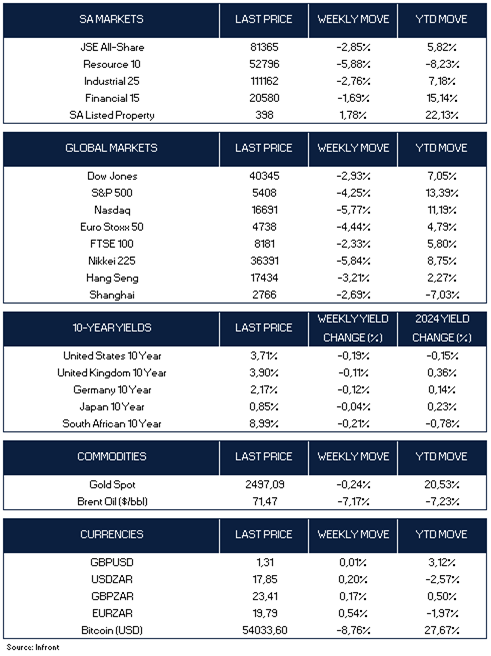
All the major US equity indexes ended the week lower, the S&P 500 -4.25%, Dow Jones -2.93%, while the tech heavy NASDAQ composite was the worst performer, closing the week down -5.77%.

The International Monetary Fund (IMF) has projected that Saudi Arabia’s current account balance is poised to shift into deficit due to declining oil prices and increasing imports tied to large-scale projects aimed at transforming the economy. The IMF’s latest Article IV review of Saudi Arabia’s economy forecasts a current account deficit of 0.1% of gross domestic product (GDP) for this year, expanding to 1.1% in 2025. The deficit is expected to average 2.9% from 2026 to 2029. This marks a stark reversal from 2022, when a surge in crude prices to nearly $130 a barrel, following Russia’s invasion of Ukraine, propelled Saudi Arabia’s current account surplus to nearly 14% of GDP.

Meanwhile, oil prices have recently hovered near a nine-month low as OPEC+ members deliberated on whether to increase supply amid ongoing concerns about global demand. This context adds pressure to Saudi Arabia’s fiscal outlook, given the nation’s heavy reliance on oil revenue.

In the Eurozone, European Central Bank (ECB) Governing Council member Gediminas Šimkus indicated in an interview that he sees a “clear case” for an interest rate cut in September. However, he expressed that the likelihood of an additional cut in October is “quite unlikely.” This statement suggests that while the ECB may continue easing monetary policy but will remain data dependent over the medium-term. The Euro Stoxx 50 closed lower, down -4.44%.

No major news out of the UK this week, however the FTSE 100 followed global peers ending the week lower, -2.33% on renewed fears about a deterioration in the outlook for the global economy.

The Japanese yen appreciated to the mid-142 range against the USD, strengthening from around JPY 145 at the end of the previous week. This movement is driven by expectations of a narrowing interest rate differential between Japan and the U.S. Market participants are increasingly anticipating that the Bank of Japan (BoJ) will raise interest rates further this year, while the U.S. Federal Reserve appears likely to cut rates in September. This shift in monetary policy outlooks has bolstered the yen against the dollar.

Japanese stocks experienced a decline over the week, with the Nikkei 225 Index down -5.84% and the broader TOPIX Index registering a 4.2% loss, yen strength posing a headwind for Japan’s export-oriented companies.

China is reportedly considering a significant interest rate cut on up to $5.3 trillion in mortgages, aiming to lower borrowing costs for millions of families while also managing the impact on the banking sector’s profitability. Financial regulators have proposed reducing rates on outstanding mortgages nationwide by approximately 80 basis points. This initiative is part of a broader package that includes speeding up the timeline for when mortgages become eligible for refinancing, according to sources familiar with the matter.

China’s official Manufacturing Purchasing Managers’ Index (PMI) fell to 49.1 in August, down from 49.4 in July, according to the National Bureau of Statistics. This decline was lower than expected and highlights deepening contractions in production and new orders, signalling ongoing challenges in the manufacturing sector as the economic slowdown continues to weigh on activity.

The Shanghai Composite index and Hong Kong’s benchmark Hang Seng Index both closed in negative territory, down -2.69% and -3.21% respectively. 

Market Moves of the Week:
In South Africa, business sentiment has risen to its highest level in nearly two years, buoyed by the resumption of stable power supply, economic optimism, and political certainty following the May 29 elections. The Rand Merchant Bank and Stellenbosch University’s Bureau for Economic Research’s quarterly business confidence index increased to 38 in the three months ending September, up from 35 in the previous quarter. This improvement was primarily driven by retailers and new vehicle dealers who are anticipating a boost from expected interest rate cuts later this month.

The country’s headline GDP grew by a modest 0.4% in the second quarter of 2024, following a stagnant first quarter. The trade and finance sectors showed solid growth, rising by 1.2% and 1.3%, respectively. However, the primary sector disappointed with declines in both agriculture and mining, reflecting an economy still facing significant challenges.

On a positive note, South Africa’s current account deficit narrowed more than expected in the second quarter. The deficit reduced to an annualized 0.9% of GDP, or R64.6 billion, from a revised 1.5% in the previous quarter, driven by an increase in the rand price of exported goods and services.

Additionally, September 1st marked the beginning of a new era for the retirement savings industry with the introduction of the Two Pot system. This reform allows retirement fund members to access a portion of their assets before retirement age, providing liquidity for emergency funding needs, particularly in the wake of the pandemic. While similar reforms have been implemented in other countries, the impact on South Africa’s collective investment market and economic stimulus will be closely monitored by all market participants.

The JSE ALSI also ended the week lower tracking the risk off sentiment from global peers, down -2.85%. All the major sectors were lower this week, led by Resources down -5.88%, followed by Industrials down -2.76%, while Financials fared best, but still closed in negative territory down -1.69%.  The SA Listed Property sector was the outlier this week closing in the green, up 1.78%. The Rand closed slightly weaker against the Dollar, ending the week at R17.85/$. 

Chart of the Week:
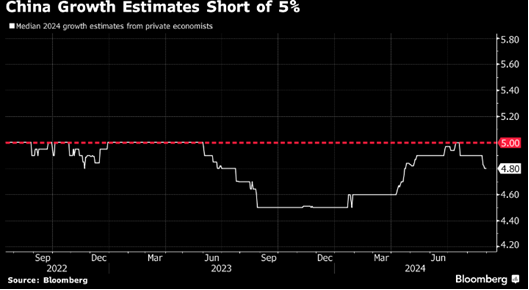
Analysts are increasingly doubtful that China will achieve its 5% economic growth target for 2024. The median forecast for full-year GDP growth among economists surveyed by Bloomberg has declined to 4.8%, down from 4.9% in mid-August. This shift in sentiment follows weaker-than-expected second-quarter growth of 4.7% reported in July, which prompted several leading financial institutions to lower their growth projections. Goldman Sachs, Citi, and Barclays all adjusted their forecasts in July, reducing their targets from 5% to 4.9%, 4.8%, and 4.8% respectively. JPMorgan is even more cautious, anticipating growth of just 4.6% for the year. Source: Bloomberg and Financial Times.

As always, we appreciate your support and value your trust in LNKD Investment Managers.

Weekly Insights: Markets Stage a Strong August Recovery

Markets rebounded strongly in August, recovering from an early-month dip of nearly ten percent, supported by resilient economic data, positive earnings, and the Federal Reserve’s willingness to ease monetary policy. With inflation approaching the Fed’s target, the focus is now shifting to growth. As we approach the US November election, investors should also be prepared for potential market volatility. Despite this, markets ended the month on a high note, with most indices near record levels after recovering from the earlier correction.

NVIDIA’s earnings release and US economic data were the main drivers of sentiment this week, particularly the Labour Department’s core PCE price index, the Fed’s preferred inflation measure, which showed inflation rising modestly by 0.2% in July. Investors were reassured by inflation’s alignment with the Fed’s target. Meanwhile, consumer spending remained strong, with personal incomes and spending both exceeding expectations. The GDP growth rate for the second quarter was also revised upwards to 3%, driven by stronger consumer spending.

US consumer confidence reached a six-month high in August, despite concerns over the labour market, reflecting optimism about the economy and inflation. The Fed is expected to begin cutting interest rates in September, which may ease some economic pressures. However, growth is likely to moderate due to ongoing high borrowing costs affecting sectors like housing and manufacturing.

NVIDIA’s latest earnings report showed significant revenue growth, though its forecast fell short of some expectations, raising concerns about the sustainability of its AI-driven expansion. The company’s shares fell after the announcement, leading to questions about its future growth trajectory.

Inflation in the eurozone slowed to 2.2% in August, its lowest in three years, while core inflation saw a slight decline. However, services inflation, closely monitored by the ECB, increased. Germany faced further economic challenges, with a small GDP contraction in the second quarter and continued struggles in its industrial sector.

The UK saw an increase in net mortgage approvals in July, reaching the highest level since September 2022. House prices continued to climb, with the Nationwide Building Society reporting a 2.4% annual increase in August.

In Japan, inflation rose to 2.6% in August, reflecting ongoing price pressures, while industrial production rebounded. However, retail sales growth slowed, missing market expectations. In China, economic growth concerns are mounting, with rising protests linked to labour and housing issues. The People’s Bank of China injected liquidity into the banking system, though monetary policy remained largely unchanged.

Global stock markets delivered mixed results this week. In the US, the Dow Jones gained 0.94%, the S&P 500 edged up by 0.24%, while the Nasdaq slipped by 0.92%. European markets saw the Euro Stoxx 50 rise by 1.11%, and the FTSE 100 increased by 0.59%. Asian markets were generally stronger, with Japan’s Nikkei 225 advancing by 0.74%, the Hang Seng Index strengthening by 2.29%, and the Shanghai Composite dipping by 0.43%. Brent oil prices dropped 2.61%, and gold prices edged down 0.36%.

Market Moves of the Week:

In July, South Africa’s Producer Price Index recorded a slight decline of 0.2% month-on-month, with a 4.2% year-on-year increase, down from 4.6% in the previous month.

During a speech at Business Unity South Africa’s AGM, President Cyril Ramaphosa emphasised the importance of strengthening the relationship between government and business to support economic growth, describing it as “far too important to fail.”

Meanwhile, the health department is preparing to release draft regulations for the NHI Act within the next month, which will address key issues such as the appointment of the NHI fund’s board.

After strong performance in recent months, the JSE All Share Index closed the week down by 0.71%, with the Resource sector facing significant pressure, dropping 4.82%. The Industrial sector also edged lower by 0.30%. However, the Financial sector rose by 1.45%, and SA Listed Property continued its strong performance, gaining 2.56%. The yield on the South African 10-Year Bond increased by 0.13%, while the rand settled at R17.82/$.

Chart of the Week:

This chart illustrates the market’s excitement with NVIDIA. Since ChatGPT’s launch in November 2022, Nvidia’s market cap has surged by over $3 trillion, making it a dominant force in the S&P 500, where it now accounts for more than 6% of the index. This unprecedented rise has introduced significant volatility, establishing Nvidia as a key market driver. Source: Bloomberg.

As always, we appreciate your support and value your trust in LNKD Investment Managers. 

Weekly Insights: A Volatile Week for Markets

Global financial markets experienced renewed volatility this week, driven by concerns over a potential U.S. recession, which many consider premature. The week began with a sharp drop in global equity markets, sparking headlines about a potential crash. Despite significant fluctuations, the stock market ultimately saw only modest changes. While recent volatility is noteworthy, it’s crucial to remain calm and avoid panic-driven decisions.

Market swings were influenced by technical factors and automated trading. A modest increase in Japanese short-term interest rates led to a partial unwinding of the “carry trade,” where investors borrow in Japan at low rates to invest in higher-yielding U.S. assets. A sharp rise in the yen made this trade unprofitable, prompting many investors to exit their positions.

Economic concerns also played a role, particularly after last week’s negative unemployment and manufacturing data. However, this week brought some relief. S&P Global data showed that the services sector remained in expansion territory, despite a slight decline to 55.5. The Institute for Supply Management’s gauge rebounded to 51.4 from 48.8, indicating improved conditions. A better-than-expected jobs report on Thursday also boosted the market, with weekly jobless claims dropping to 233,000 and alleviating some labour market concerns. Experts, including Goldman Sachs economists, argue that recession fears are exaggerated, noting the economy’s stability and the Federal Reserve’s focus on systemic risks over market volatility.

Market volatility was somewhat eased by dovish comments from BoJ Deputy Governor Shinichi Uchida, who indicated that interest rates are unlikely to rise soon amidst market instability. This led to a weakening of the yen, which ended the week in the lower JPY 147 range against the USD.

In Europe, June retail sales volumes unexpectedly fell by 0.3%, reflecting weaker demand and a slower recovery from inflation. German industrial output and orders exceeded expectations, but manufacturing sector conditions worsened in July.

In the UK, July retail sales rose by 0.3%, reversing the previous month’s decline. The Services PMI increased to 52.50, and the Construction PMI beat expectations, rising to 55.30. Halifax reported a 0.8% rise in house prices, with housing sentiment improving due to lower interest rates and government plans for residential development.

Global stocks ended the week with modest declines. In the U.S., the Dow Jones fell by 0.60%, the Nasdaq dipped by 0.18%, and the S&P 500 edged down by 0.04%. In Europe, the Euro Stoxx 50 rose by 0.79%, while the FTSE 100 saw a slight decrease of 0.08%. Asian markets were mixed, with Japan’s Nikkei 225 dropping by 2.46%, the Hang Seng Index gaining 1.18%, and the Shanghai Composite declining by 1.49%. Brent oil prices increased by 3.00%, while gold prices slipped by 0.46%.

Market Moves of the Week:

President Cyril Ramaphosa has signed the National Health Insurance (NHI) bill into law, moving forward despite significant opposition. Democratic Alliance leader John Steenhuisen has voiced concerns, highlighting that the NHI remains a divisive issue within the coalition government. The bill will be implemented gradually, with the government working to address concerns and make necessary legal adjustments.

South African private sector activity remained sluggish in July, with the S&P Global South Africa PMI inching up to 49.3 – still below the growth threshold of 50 for the second consecutive month. Supply-side pressures, including severe weather disruptions at key ports, contributed to the weak performance. Nevertheless, businesses remain optimistic about improved conditions in the coming year.

Despite market volatility, the JSE All Share Index ended the week slightly up by 0.25%, bolstered by gains in the Industrial sector (+1.61%), while the Resource (-1.14%) and Financial (-0.21%) sectors lagged. The yield on the South African 10-Year Bond fell by 0.14%, and the rand settled at R18.31/$.

Chart of the Week:

Last week’s disappointing U.S. jobs data sparked significant volatility in global financial markets, leading to a sharp sell-off on Monday. However, new employment figures released this week, showing the largest drop in U.S. unemployment benefits in nearly a year, reassured markets that the U.S. labour market workforce isn’t disintegrating so much as reverting to its pre-pandemic trend. The S&P 500 responded with a 2.3% surge on Thursday, marking its best performance in 18 months and fully recovering from the earlier losses. While other markets have also regained ground, they have yet to return to the levels seen before last week’s unsettling jobs report. Source: Bloomberg.

As always, we appreciate your support and value your trust in LNKD Investment Managers 

Weekly Insights: Divergence in Central Bank policy

Global equity markets fell this week amid growing concerns about a slowing US economy. The Institute for Supply Management’s (ISM) manufacturing index slumped, and weekly jobless claims rose, intensifying fears of a potentially harder-than-expected economic landing in the US. Following the data release, the equity market, which has already factored in a 25-basis point rate cut from the Federal Reserve, extended their decline.

During the week, companies accounting for nearly 40% of the S&P 500’s market capitalisation reported their second-quarter earnings, including four of the “Magnificent Seven”—Microsoft, Meta Platforms (Facebook), Apple, and Amazon.com. While the results were mixed compared to consensus expectations, a recurring theme was the anticipation of significant capital expenditures to develop artificial intelligence (AI) capabilities.

The Federal Reserve kept rates steady on Wednesday but noted that recent Q2 inflation readings provided added confidence in inflation control. However, they cautioned that delaying rate reductions could overly weaken the economy. The Fed emphasized that no decision has been made regarding a potential rate cut in September, and future actions will depend on incoming data. Fed funds futures are now pricing in a rate cut in September 2024 as a certainty, with nearly three full cuts expected by the end of the year, up from two cuts anticipated earlier in July.

On Thursday, the US 10-Year yield dropped below 4% for the first time in six months, while the 2-Year yield reached its lowest point in 15 months. The ISM Manufacturing index fell to 46.8 in July, below the consensus estimate of 48.8, marking the seventh consecutive quarter of depressed manufacturing data. Economists do not anticipate significant changes until the Fed begins cutting rates. Attention shifted to Friday’s US jobs report, which has implications for growth and interest rate expectations. The report showed the weakest growth in nonfarm payrolls since April, with unemployment rising to 4.3%, the highest since October 2021.

All the major US equity indexes ended the week lower, the S&P 500 -2.06%, Dow Jones -2.10%, while the tech heavy NASDAQ composite bore the brunt of the tech selloff, closing the week down -3.35%. The NASDAQ composite has pulled back over 10% from its July highs.  

In the UK, the Bank of England (BoE) cut lending rates by 25 basis points to 5%, marking the first-rate reduction since the pandemic’s onset. The Monetary Policy Committee (MPC) vote was narrowly divided, with a 5:4 split between cutting and holding rates, signalling the start of an easing cycle for the UK. At the next MPC meeting, a vote will be held to determine the pace of Quantitative Tightening (QT) policy over the next twelve months. The current expectation is for a gradual easing path, with an additional 25 basis point cut anticipated later this year and four more cuts projected for 2025.

In the Eurozone, the economy grew more than expected in the second quarter, with resilient expansion in key countries countering Germany’s unexpected contraction. Gross domestic product (GDP) rose by 0.3% in the three months through June, maintaining the same growth rate as the first quarter. This exceeded the 0.2% median forecast of economists, with both France and Spain surpassing estimates and Italy continuing to grow, thereby offsetting a 0.1% decline in Germany. Meanwhile, German inflation accelerated in July, with consumer prices rising 2.6% year-over-year, up from 2.5% in June. This uptick in inflation could influence the European Central Bank’s approach to future interest rate cuts. Unemployment ticked up to 6.5% in June from an all-time low of 6.4% in May.

Both the FTSE 100 Index and the Euro Stoxx 50 closed lower, down 1.34% and 4.60% respectively.

The Bank of Japan (BoJ) raised its benchmark interest rate and announced plans to reduce bond purchases, signalling a commitment to normalising its monetary policy. The policy rate was increased to approximately 0.25% from a previous range of 0% to 0.1%, as stated on Wednesday. Additionally, the BoJ plans to decrease its monthly bond-buying pace to around ¥3 trillion ($19.6 billion) starting in the first quarter of 2026. Governor Kazuo Ueda’s actions reflect a shift from the ultra-easy monetary policy that included the world’s last negative interest rate, which persisted until March.

In response, Japanese stocks experienced a significant decline, with the Topix index suffering its largest drop since April 2020. The Yen’s sharp appreciation adversely impacted exporters, while the BoJ’s tightening measures increased rates and negatively affected real estate shares.

Off the back of a stronger Yen, the Nikkei 225 index declined 4.67% for the week as export-heavy industries detracted from overall market performance.

Chinese equity markets were mixed this week as investors digested weaker than expected manufacturing data. China’s factory activity continued to decline for the third consecutive month in July, underscoring the economy’s ongoing challenges despite efforts to boost growth. The official manufacturing purchasing managers’ index (PMI) fell to 49.4, as reported by the National Bureau of Statistics on Wednesday, indicating a contraction in the sector. The Chinese economy has largely been driven by investment, but recent developments suggest a shift in focus. At a Communist Party meeting on Tuesday, leaders emphasized the importance of bolstering domestic demand and called for accelerated fiscal and monetary accommodation to support the economy.

The Shanghai Composite index recorded a positive return this week, up 0.50%, while Hong Kong’s benchmark Hang Seng Index slid -0.66% for the week.

Market Moves of the Week:

In South Africa, the South African Reserve Bank (SARB) is set to complete the transfer of $5.5 billion in profits from the nation’s gold and foreign-exchange reserves to the Treasury by mid-August. Governor Lesetja Kganyago announced that as of 1 July, R100 billion had already been transferred to the SARB, with approximately three-quarters of the amount due to the National Treasury for the year already paid out. The final transfers are expected to be completed by mid-August.
 
Trade data for June, released by the South African Revenue Service (SARS), indicate a modestly rising trade surplus in the second quarter. This is likely to result in a narrowing of the current account deficit from 1.2% of GDP in the first quarter to an estimated 0.7% of GDP in the second quarter.
 
Additionally, ABSA’s Purchasing Managers’ Index (PMI), compiled by the Bureau for Economic Research (BER), showed an increase to 52.4 in July, up from 45.7 in June. This beat the consensus expectation of a rise to 48.0. Key components of the index also showed improvement: business activity rose to 50.8 from 36.3 in June, new orders increased to 55.4 from 37.9, and inventories slightly declined to 48.5 from 51.9. The data suggests a strong start to the third quarter, following weaker months in May and June.
 
The JSE ALSI also ended the week lower tracking the risk off sentiment from global peers, down -0.72%. All the major sectors were lower this week, led by Resources down -1.91%, followed by Industrials down -0.45%, while Financials fared best, but still closed in negative territory down -0.15%. The SA Listed Property sector was the outlier this week closing in the green, up 1.72%. The Rand closed relatively flat against the Dollar, ending the week at R18.29/$.

Chart of the Week:

The benchmark 10-year Treasury yield fell below 4% for the first time in six months. This decline came as traders began to price in the possibility of a rate cut at each of the next four meetings of the Federal Open Market Committee (FOMC). The move below 4% signals growing concerns about an impending economic slowdown. This development raises questions about whether the Fed is waiting too long to start its easing cycle, which is expected to begin in September. The market is acutely aware that the Fed may have delayed its rate hikes previously, and now there is speculation that the central bank might be similarly behind the curve in transitioning to a more accommodative monetary policy stance. Source: Bloomberg..

As always, we appreciate your support and value your trust in LNKD Investment Managers. 

Weekly Insights: Bullish US inflation data lifts investor sentiment

Data released Friday morning showed the Personal Consumption Expenditures price index, the US Federal Reserve’s preferred measure of underlying US inflation, slowing to 2.5% from a year ago in June, matching estimates from economists polled by Dow Jones. Core inflation, which excludes food and energy, gained 0.2% for the month and 2.6% on the year, also in line with expectations.

Friday’s report offers some encouraging evidence that inflation is continuing to ease from its four-decade high.  Investors will get more clues about the Fed’s next moves at its policy meeting next week, where the central bank is expected to hold rates steady.

US Gross Domestic Product (GDP) expanded at an annual rate of 2.8% in the second quarter, much more than expected. This reading followed the 1.4% growth recorded in the first quarter and came in above the market expectation of 2%. Consumer spending helped propel the growth number higher, as did contributions from private inventory investment and non-residential fixed investment, according to the first of three estimates the department will provide.

In election news, US Vice President Kamala Harris became the presumptive Democratic presidential nominee this week after President Joe Biden dropped out of the race under pressure on Sunday.

For the week, the S&P 500 declined 0.8%, while the Nasdaq lost 2.1%, led by weakness in the Magnificent Seven stocks amid concerns that massive levels of AI-related capex won’t be accretive to the bottom line anytime soon. Investors continued their pivot into cyclical areas of the market with small-cap and value shares continuing to outpace the large-cap growth stocks that have led the market over much of the year. In contrast, the Dow outperformed, adding 0.8%, and notching its fourth consecutive positive week for the first time since May.

In US earnings news, 41% of the companies in the S&P 500 have reported actual results for Q2 2024 to date. Of these companies, 78% have reported actual EPS above estimates, which is above the 5-year average of 77% and above the 10-year average of 74%, according to data from FactSet. During the upcoming week, 171 S&P 500 companies (including ten Dow 30 components) are scheduled to report results for the second quarter.

In Europe, the pan-European STOXX Europe 50 Index ended 0.73% higher, while the UK’s FTSE 100 Index rose 1.59%. The gains contrasted with midweek losses as earnings in the technology and luxury goods sectors weighed on returns.

In Asia, the benchmark Nikkei was sharply down on the week, falling by 6.0%. The market weakness was partially driven by a third successive week of yen strength (negative for the profit outlook for Japanese exporters) as well as other weak economic data points.

Chinese equities were also weaker on the week, after unexpected rate cuts by the central bank failed to instil confidence in the economic outlook. The People’s Bank of China said it cut the lending rate for one-year medium term policy loans by 20 basis points to 2.3%, its biggest rate cut since China’s economy was slammed by the COVID-19 pandemic in 2020. The move comes in the wake of weak GDP data earlier in the month and after markets were disappointed by the lack of major reforms announced following last week’s Third Plenum of the Communist Party’s central committee.

For the week, the Shanghai Composite Index declined 3.07%, while in Hong Kong, the benchmark Hang Seng Index retreated 2.28%, according to FactSet.

Market Moves of the Week:

South African inflation slowed in June, statistics agency data showed on Wednesday, clearing the path for the central bank to cut rates at its next meeting, economists said. Headline consumer inflation stood at 5.1% year-on-year in June, compared to 5.2% in May, in line with the prediction made by economists polled by Reuters.

Inflation has remained above 5% for 10 consecutive months Statistics South Africa data showed, while the South African Reserve Bank (SARB) prefers it to be at the midpoint of its 3%-6% target band. The slow rate of disinflation has meant the central bank has kept its main lending rate unchanged at 8.25% for more than a year.

The Gauteng Division of the High Court in Pretoria on Wednesday ruled that provisions of the National Health Act that force doctors to register for a “certificate of need” are unconstitutional. The legal teams for the applicants argued that the sections of the National Health Act (a different piece of legislation from the National Health Insurance Act) setting out a scheme that would require healthcare practitioners to obtain a certificate of need (CON) violated several constitutional rights, including the right to human dignity; the right to freedom of movement and residence; the right to choose a trade, occupation and profession; the right not to be arbitrarily deprived of property; and the right of access to healthcare. The ruling is seen as a major blow to government’s plans to implement the NHI.

The JSE all share index gained 1.5% for the week with only the resource sector ending the week in the red. South Africa’s 10Y government bond yield continues to strengthen since the outcome of the May 29 vote, with foreign investors being net buyers of the nation’s debt to the tune of R23.4 billion ($1.3 billion) this year — on track for the largest annual inflow since 2019, based on data reported by exchange operator JSE. Inflation and monetary policy are also seen to be moving in the right direction, with this week’s inflation print reinforcing bets for a policy easing cycle to begin in September. These developments coupled with more than 100 days without power cuts has been improving investor sentiment.

On the currency front, the rand gained against the dollar on Friday, trading at 18.29 against the greenback, at the close.

Chart of the Week:

The personal consumption expenditures price index increased 0.1% on the month and was up 2.5% from a year ago, in line with Dow Jones estimates, the Commerce Department reported Friday. The positive inflation report lifted investor hopes for more rate cuts this year, with the fed funds futures market now pricing in cuts in September, November and December.

As always, we appreciate your support and value your trust in LNKD Investment Managers. 

Weekly Insights: Investors Hopeful as Inflation Expectations Dial Back

In June, US consumer prices fell for the first time in four years due to lower gasoline prices and moderating rents, signaling disinflationary pressures. This supports the case for the Federal Reserve to proceed with interest rate cuts in September. The Consumer Price Index (CPI), a key economic indicator, decreased by 0.1% from May, with an annual rate of 3%, approaching its lowest level in over three years. Excluding volatile food and energy prices, core CPI rose by 0.1% monthly and 3.3% year-over-year, marking the smallest annual increase since April 2021.

Meanwhile, U.S. producer prices saw a modest uptick in June, as reported by the Bureau of Labor Statistics. The Producer Price Index (PPI) for final demand increased by 0.2% last month. Over the twelve months ending in June, the PPI rose by 2.6%, marking a slight acceleration from the 2.4% increase observed in May. The PPI serves as a key indicator of the prices that producers receive for their goods and services in the marketplace. This unexpected rise in the PPI contrasts with recent data suggesting a moderation in inflationary pressure.

During his Capitol Hill testimony this week, Fed Chair Jerome Powell acknowledged the return of the US labor market to pre-pandemic conditions, which is increasingly influencing Fed decisions. Powell indicated that positive data received on Thursday morning would bolster the Fed’s confidence that inflation is approaching its 2% target. 

The U.K. economy grew by 0.4% in May, according to flash figures released by the Office for National Statistics on Thursday. Following the announcement, the British pound surged to a four-month high against the U.S. dollar. After exiting a shallow recession in the first quarter, the British economy flatlined in April but saw a notable improvement in May. Annual GDP growth increased to 1.4%, driven primarily by growth in the services and construction sectors, particularly in infrastructure and homebuilding.

Meanwhile, France faces a hung parliament after Sunday’s legislative elections, with no party winning a majority. The left-wing New Popular Front (NFP) made unexpected gains, limiting advances by the far-right National Rally. While the NFP won the most seats, it fell short of a majority. President Macron’s Ensemble party placed second, followed by the National Rally. Macron proposed forming a national unity government to oppose NFP’s fiscal policies. Meanwhile, he asked the current government to act as caretaker during negotiations.

In June, wage growth in the eurozone saw a modest increase as salaries adjusted to ongoing inflationary pressures. According to Indeed’s Wage Tracker, year-over-year salary increases for job openings across the euro area rose to 4.20% in June from 3.47% in May. This data, often cited by ECB chief economist Philip Lane, aligns closely with the ECB’s economic projections and is unlikely to change expectations for further interest rate cuts this year.

China’s U.S. dollar-denominated imports fell by 2.3% year-on-year, missing expectations for slight growth. Conversely, exports from China rose by 8.6% compared to last year, surpassing forecasts. In the first half of 2024, China’s trade with the U.S. saw imports decline, while exports grew in dollar terms. Trade with the EU also decreased in both imports and exports. However, China’s trade with ASEAN countries surged by 7.1% in the first half of the year, establishing ASEAN as China’s top regional trading partner. Overall, these dynamics resulted in a 2% increase in year-to-date imports and a 3.6% rise in exports compared to the same period last year.

In June, China’s consumer prices rose for the fifth consecutive month but missed expectations. The Consumer Price Index (CPI) increased by 0.2% year-over-year, slower than the 0.3% growth in May, marking the weakest growth in three months. Excluding food and energy, core CPI remained unchanged from May, rising by 0.6%. Meanwhile, the Producer Price Index (PPI) improved slightly, declining by 0.8% year-over-year compared to a 1.4% drop in the previous month.

Stocks across major global indices saw significant gains this week, marking a notably broad advance since mid-April. In the U.S., the Dow Jones Industrial Average, S&P 500 Index, and Nasdaq Composite all posted gains of 1.59%, 0.87%, and 0.25%, respectively. In Europe, the STOXX Europe 50 Index rose 1.28% in local currency terms as investors responded positively to lower-than-expected U.S. inflation data. The UK’s FTSE 100 Index also saw an increase of 0.60% for the week.

In Asia, Chinese stocks benefitted from strong export figures, outweighing concerns about deflationary pressures. The Shanghai Composite Index climbed 0.72%, while Hong Kong’s Hang Seng Index surged 2.54%. Japanese stocks, however, pulled back from record highs reached earlier in the week amid speculation of government intervention to support the Japanese yen in forex markets. Despite this, the Nikkei still managed to end the week with a gain of 0.68%.

Market Moves of the Week:

South Africa’s economic growth in the second quarter faced challenges, with key sectors including manufacturing and mining showing no growth in May despite a stable electricity supply. Data from Statistics South Africa (Stats SA) indicated that manufacturing output contracted by 0.6% year-over-year in May, following a downwardly revised 4.9% increase in April. 

Foreign investment in South African equities surged after the formation of a Government of National Unity (GNU) and a market-friendly cabinet following the May elections. Recent Johannesburg Stock Exchange (JSE) data shows R9.1 billion flowed into South African stocks in the past two weeks. Coupled with 100 days without power cuts, foreign investors are optimistic about South Africa’s medium-term economic prospects. Bank of America projects sustained power stability could drive over 2% annual GDP growth in the years ahead.

The JSE All-Share index benefited from the positive global market trends, posting a weekly gain of 1.10%. Most sectors contributed positively to the market’s overall performance, with Industrials leading the advance with a 1.96% return. The Resources sector was the sole detractor, experiencing a slight decline of -0.10%. Meanwhile, the South African rand continued to strengthen, buoyed by unexpectedly soft U.S. inflation data that increased expectations of a Federal Reserve interest rate cut in September. The rand appreciated by 1.57% against the Dollar, closing the week at R17.95/$

Chart of the Week:

Investors are highly confident in a Fed rate cut for September, contingent on sustained trends in employment and inflation data. Powell’s concerns about labour market tightness potentially driving inflation make a September easing almost inevitable if upcoming employment reports reflect ongoing challenges. The current jobless rate of 4.1% is the highest since late 2021. Source: Bloomberg.

As always, we appreciate your support and value your trust in LNKD Investment Managers. 

Weekly Insights: UK’s Labour wins big

Sir Keir Starmer’s Labour Party won a resounding victory in the UK’s general election, ending 14-years of turbulent Conservative rule. Results show that the opposition Labour Party has won 412 parliamentary seats of the total 650, the most since Tony Blair’s 1997 triumph. This translates as roughly 63% of the total seats. Voter turnout was just 60% for this election. The new British Prime Minister promised a government of “stability and moderation”. The UK’s FTSE 100 Index added 0.49% for the week.

In Europe, the pan-European STOXX Europe 50 Index ended the week 1.74% higher. Political jitters eased as the far right in France failed to win an outright majority in the first round of legislative elections on June 30. Though Marine Le Pen’s National Rally (RN) party took the largest share of the vote in the first round of parliamentary elections last Sunday, political blocs on the left and in the centre are working together ahead of Sunday’s final round of voting to keep RN from achieving an absolute majority in the National Assembly, the lower house of the French parliament.

Speaking at the European Central Bank’s (ECB’s) annual retreat in Portugal, ECB President Christine Lagarde appeared to strike a slightly more hawkish tone. She said that Europe is “still facing several uncertainties regarding future inflation” and that the Central Bank does not have sufficient evidence that inflation threats have passed. Latest data points showed inflation in the eurozone edging down to 2.5% in June from 2.6% while the unemployment rate was unchanged at 6.4% in May.

Iran elected 69-year-old Masoud Pezeshkian to its presidency, in an unexpected victory for the country’s reformist camp amid deep social discontent, economic hardship, and regional war.

Pezeshkian won 16.3 million votes, according to reports, with the election seeing a 49.8% turnout. His rival Saeed Jalili, a hard-line right-wing former nuclear negotiator, finished the race with 13.5 million votes. But power and critical decision-making in Iran ultimately lies with the supreme leader, Ayatollah Khamenei, and unelected institutions like the Revolutionary Guards.

In the US, President Joe Biden remained defiant on Friday that he is staying in the presidential race and denounced efforts to push him out after more than a week of sustained media frenzy focused on his poor debate performance.

Widely monitored labour data released Friday morning reflected a 206,000 increase in nonfarm payrolls in June, and a slight uptick in the unemployment rate, which rose to 4.1%. The jobless rate rose to the highest since late 2021, the latest in data as well as downward revisions to prior months raises the odds of rate cuts in the coming months ahead. Economists had expected the jobless rate to remain steady at 4%.

The S&P 500 rose to a new high on Friday, although the market’s gains remained notably narrow. All three major indexes finished the week in the green. The Nasdaq Composite advanced 3.5%, and the S&P 500 climbed 1.95%. The Dow underperformed, adding close to 0.7%. Markets were closed Thursday for Independence Day.

In Asia, Japan’s stock markets gained ground, with the benchmark Nikkei 225 Index climbing 3.36%. The yield on Japan’s 10-year sovereign bonds climbed to 1.1%—its highest level since 2011—before easing later in the week.

Chinese equities fell as underwhelming manufacturing data reinforced concerns about the slowing economy. The Shanghai Composite Index registered a modest loss for the week. In Hong Kong, the benchmark Hang Seng Index gained 0.46% during a holiday-shortened week, according to FactSet.

On the commodities market, gold was up 2.8% for the week at $2,391, its highest level in a month, while Brent crude ended the week firmer at $86.83 a barrel.

Market Moves of the Week:

Following the announcement of President Cyril Ramaphosa’s government of national unity cabinet earlier in the week, investors particularly welcomed the reappointment of Enoch Godongwana as finance minister and David Masondo as his deputy, viewing it as a clear commitment to fiscal prudence and economic structural reforms. Under the new unity government, the ANC retained the majority with 20 out of 32 Cabinet minister seats, while the DA secured six seats.

In a major milestone, South Africa enjoyed a hundred (100) days of no load-shedding, Eskom said in a statement on Friday. The breakthrough is the result of a recovery plan initiated in March 2023 and “aggressive” maintenance of the company’s power plants, the company said. The improved electricity performance is raising investor confidence. The South African Reserve Bank projects the SA economy to grow 1.2% this year.

For the week, the all-share index was up 1.37% and is just over 5% higher year to date. South Africa’s 10-year government bond yield was also stronger, as yields fell below 10%. On the currency front, at the close, the rand had strengthened to R18.23, having touched an intraday best of R18.15/$.

Chart of the Week:

US hiring and wage growth stepped down in June while the jobless rate rose to the highest since late 2021, bolstering prospects that the Federal Reserve will begin cutting interest rates in coming months. Nonfarm payrolls rose by 206,000 and job growth in the prior two months was revised down by 111,000, the Bureau of Labor Statistics said Friday.

As always, we appreciate your support and value your trust in LNKD Investment Managers. 

Weekly Insights: GNU – The Wildebeest of SA Politics

The wildebeest, also known as the gnu (pronounced “NOO”), is often referred to in the South African wildlife community as a “spare parts animal.” This nickname is attributed to its unique combination of features: the tail of a horse, the horns of a juvenile buffalo, the sloped back of a hyena, the stripes of a zebra, the rump of a donkey, and the beard of a billy goat. The formation of the Government of National Unity (GNU) has led to significant contention between the ANC and DA over ministerial positions, with both parties jostling for certain key portfolios, particularly the trade and industry ministry. Like the diverse anatomy of the wildebeest, assembling a functional government from parties (ANC, DA, IFP, PA etc.) with differing ideologies is proving to be more complex than anticipated.

Investors faced a week of uncertainty in both equity and currency markets as they awaited the President’s cabinet announcement. The DA threatened to walk away from the agreement unless Ramaphosa stuck to his original offer. Volatility increased across the board, leading to diminished investor sentiment. The Rand rallied strongly on Friday after ANC Secretary-General Fikile Mbalula posted on X saying “Almost done with GNU discussions, in the best interests of all South Africans. It will be done as promised.”

At the time of writing, GNU talks are back on track however no formal announcement has been made at this point. There is hope that we will have some clarity by the end of the weekend, however this could be pushed out again if further negotiations are required.

The JSE ALSI ended the week marginally lower, down -0.08%, lead lower by the financial sector down -0,85%. Industrials also ended lower, -0,52%, while resources bucked the trend ending the week up 2.67%. The SA Listed Property sector also ended the week in negative territory, down 0.39%. The Rand appreciated against the Dollar this week, largely driven by Friday’s performance closing the week 1.19% stronger at R18.18/$.

Market Moves of the Week:

The US presidential debates began this week with President Joe Biden and former President Donald Trump facing off in their first engagement leading up to the elections later this year. Post-debate commentary was largely unfavourable for President Biden and the Democrats. Many political analysts labelled the debate a “disaster” for the party. Former White House Staffer Barbara Heineback remarked that Democrats are “in trouble” and are well aware of it following Biden’s performance.

U.S. real GDP growth was revised up by 0.1 percentage points to an annualized rate of +1.4% in the first quarter, in line with consensus expectations. However, the composition was weak as consumption growth was revised down by half a point to +1.5%. Additionally, gross domestic income (GDI) growth was revised down to +1.3%. The average of real GDP and real GDI increased by 1.4% in Q1, adding to the evidence that activity growth has moderated. The core personal consumption expenditure price index rose by just 0.1% from the previous month. On a year-on-year basis the index rose 2.6%, down from April’s 2.8% rate.

New-home sales in the US slumped in May as elevated prices and mortgage rates continued to challenge the housing market. New single-family home sales decreased by 11.3% to an annual pace of 619,000, the slowest since November, according to government data released Wednesday. The figure was below almost all estimates in a Bloomberg survey of economists and reflected declines in all four major US regions.

US small caps are on track for their worst start to the year in history compared to their larger peers. The Russell 2000 index is underperforming the S&P 500 by nearly 15% so far into 2024, setting the small-cap gauge on pace for its worst first six months of a year ever. If this negative spread holds through year-end, it would mark a fourth consecutive year of underperformance by small caps.

Most major US stock indexes ended the week mixed in a light news week during what seems to be a lull in market activity ahead of second-quarter earnings season. The S&P 500 and Dow Jones ended marginally lower, both posting a return of -0,08%, while the tech heavy NASDAQ composite posted positive performance, closing the week up 0.24%.  

In the UK, elections are set for 4th July. Amidst Rishi Sunak’s early departure from D-Day celebrations and an ongoing betting scandal, the Conservative Party continues to poll at historically low levels. The rise of Nigel Farage as leader of Reform UK has further threatened some of the safest Conservative seats. Current polls indicate a substantial Labour victory. GDP in the UK grew 0.7% for the first quarter of the year, beating expectations of 0.6% growth, this is the fastest Q1 growth of any G7 country.

In Europe, the first round of French elections is scheduled for Sunday, 30 June, with the second round on 7 July. There is a significant risk that President Macron’s decision to call a snap election may backfire, with polls suggesting the Assembly could be dominated by the hard-right Front Notional (FN) and the left leaning New Popular Front (NFP), making political cohabitation between an FN government and a centrist party challenging.

Additionally, the ECB Forum on Central Banking begins in Sintra, Portugal, on Monday. Policymakers from around the world, including ECB President Christine Lagarde and Fed Chair Jerome Powell, will be speaking at the event. The European Commission’s economic sentiment indicator ticked lower to 95.9, below estimates of 96.2, driven by weaker demand from industrial companies, retailers and construction businesses.

Both the FTSE 100 Index and the Euro Stoxx 50 closed lower, down 0.89% and 0.27% respectively.

In Japan, the Yen slumped to its weakest level on record against the Euro, highlighting its persistent depreciation. The Yen fell by as much as 0.3% to 171.60 against the Euro on Wednesday, though it strengthened in early Thursday trading. The minutes of the June Bank of Japan meeting suggested a rate hike could come as soon as the next meeting on 31 July. Industrial production rebounded in May with a +2.8% month-on-month increase, following a -0.9% decline in April, surpassing market forecasts of +2.0%. Additionally, Tokyo’s core CPI accelerated by +0.2 percentage points from May, reaching +2.1% year-on-year, in line with market expectations. May retail sales beat expectations rising 3% year-on-year led by demand for autos.

Off the back of a weaker Yen, the Nikkei 225 index gained 2.56% for the week as export-heavy industries contributed to positive market performance.

Chinese equity markets weakened this week as concerns around the slowing economy tapered risk appetite. Foreign selling also contributed to the week’s decline, as global funds sold about RMB 49.4 billion worth of assets, putting China’s market on track for its first monthly outflow since January. The National Bureau of Statistics reported a marginal increase in industrial profits of 0.7% in May, down from April’s 4% gain. An improvement in commodity prices, helped boost profits for mining companies. Looking ahead, investors will keep a close eye on China’s official purchasing managers’ index to be released on Sunday.

The Shanghai Composite index recorded a decline this week, down 1.03%, while Hong Kong’s benchmark Hang Seng Index slid 1.85% for the week.  

Chart of the Week:

South Africa achieved its first primary budget surplus in 15 years. Revenue exceeded non-interest expenditure by R31.6 billion, or 0.4% of GDP, in the year through March 2024. This achievement reflects Finance Minister Enoch Godongwana’s firm stance on funding for debt-stricken state companies such as Transnet, providing financial support only if strict conditions were met, including the implementation of recovery plans and the sale of non-core assets. Source: South African Reserve Bank & Bloomberg.

As always, we appreciate your support and value your trust in LNKD Investment Managers. 

Weekly Insight: Markets Hold Strong Amid Mixed Data

U.S. markets recorded modest gains last week despite a shortened trading session due to the Juneteenth holiday closure. The S&P 500 Index hit new all-time highs, driven by strong performances from value stocks over growth shares. Most major benchmarks outperformed the Nasdaq Composite, which is heavily weighted towards technology stocks.

Economic data from the U.S. presented a mixed outlook. Retail sales in May edged up by just 0.1%, following a revised 0.2% decline in April, indicating cautious consumer spending. In contrast, industrial production surged by 0.9% in May, its fastest growth in nearly a year, with factories operating at peak capacity since November. S&P Global’s composite index of business activity climbed to 54.6 in June, its strongest level in over two years, pointing to a robust economy despite subdued retail figures.

In the UK, the Bank of England kept its key interest rate steady at 5.25%, aligning with expectations. Headline inflation eased to 2% in May, but services inflation spiked to 5.7%, leading to scaled-back expectations for immediate rate cuts. Meanwhile, polls indicated a significant electoral challenge for Rishi Sunak’s Conservatives, with projections suggesting Labour could secure a historic 425 parliamentary seats.

In the eurozone, economic sentiment exceeded forecasts, reaching 51.30 in June from 47.00 in May. However, consumer price inflation slowed to a modest 0.2% increase in May from 0.6% in April. France and Italy faced EU criticism for their substantial deficits ahead of pivotal legislative elections, raising potential implications for both nations.

The Swiss National Bank lowered its policy rate to 1.25% in response to easing inflationary pressures. Conversely, the Bank of Japan discussed accelerating policy normalisation due to concerns over inflation linked to the weakened yen. In China, despite injections of RMB 182 billion into the banking system, new home prices fell by 0.7% in May, marking the sharpest monthly decline in almost ten years, underscoring persistent challenges in the property sector.

Global stocks generally performed well this week. In the U.S., the Dow Jones rose by +1.45% and the S&P 500 gained +0.61%, while the Nasdaq remained unchanged. European shares also showed strength, with the Euro Stoxx 50 up by +1.41% and the FTSE 100 by +1.12%. In contrast, Asian markets were mostly weaker; Japan’s Nikkei 225 declined by -0.56% and the Shanghai Composite fell by -1.14%, while the Hang Seng Index increased by +0.51%. Brent oil prices rose by +2.97%, whereas gold prices decreased by -0.47%.

Market Moves of the Week:

In South Africa, investors continued to pay close attention to developments within the newly formed Government of National Unity (GNU), post the election outcome. The UDM became the latest party to join the ANC-led GNU, alongside the DA, IFP, Good, PA, and PAC. Negotiators from the GNU parties convened on Friday, 21 June, to finalise agreements on the Cabinet and other executive roles, with announcements expected by Sunday or early next week. While President Cyril Ramaphosa could take as long as needed to form the government, an ANC official emphasised the importance of avoiding a power vacuum and providing direction to capital markets.

South Africa’s consumer price index (CPI) remained steady at 5.2% in May on a year-on-year basis, aligning with market expectations. Retail sales in South Africa unexpectedly grew by 0.6% year-over-year in April, compared to a 2.3% increase in the prior month.

The South African market continued its upward trend following a positive election outcome, with the JSE rising by +3.52%. All three major sectors experienced solid gains: Resources increased by +3.61%, Industrials by +1.37%, and Financials by +6.11%. Additionally, the yield on the South African 10-Year Bond improved by 0.46%. The rand also strengthened significantly, closing at R17.96/$.

Chart of the Week:

Inflation and politics intertwine with irony as Rishi Sunak assumed office in October 2022 with the daunting task of curbing inflation from over 10% to the long-term target of 2%. Surprisingly, recent data suggests this goal has been achieved. However, this economic success hasn’t bolstered Sunak’s electoral prospects. Recent UK polling indicates he may lose his parliamentary seat. Despite these developments, the Bank of England opted against rate cuts, citing concerns over inflation in the services sector, mirroring trends in the United States. Source: Bloomberg.

As always, we appreciate your support and value your trust in LNKD Investment Managers.. 

Weekly Insights: ANC, DA & IFP sign agreement to form national government

Throughout Friday, the ANC/DA/IFP Government of National Unity (GNU) secured control of the country’s key legislatures. In parliament, Thoko Didiza of the ANC was elected Speaker with 284 votes, defeating the EFF’s Veronica Mente, while the DA’s Annelie Lotriet was elected as Deputy Speaker. President Ramaphosa was also comfortably re-elected for a second term late Friday night. These outcomes were made possible by the signing of a broad GNU agreement between the ANC and DA on Friday (which includes the IFP), following intense negotiations that lasted from Thursday night into early Friday morning.

The agreement includes clauses that will guide the composition of Cabinet and key provincial positions. It details the executive decision-making process, a conflict-breaking mechanism and provides guidelines for policymaking and the finalisation of the national budget.

The GNU also secured victories in KZN and Gauteng. In KZN, the ANC’s Nontembeko Boyce was re-elected as speaker, the DA’s Mmabatho Tembe was elected as deputy speaker, and the IFP’s Thami Ntuli will be the new premier, all winning with 41 votes to 39. In Gauteng, the ANC’s Panyaza Lesufi was re-elected as premier with DA support, and Morakane Mosupyoe, also from the ANC, was elected as speaker.

The National Council of Provinces (NCOP) held its first sitting on Saturday, June 15, where 54 permanent delegates from nine provinces were sworn in. Refilwe Mtshweni-Tsipane was elected Chairperson and Kenneth Mmoiemang was elected Chief Whip for the seventh term of Parliament, both unopposed. The House will elect the Deputy Chairpersons and House Chairpersons of the NCOP at a later date. The NCOP ensures provincial interests are considered in national legislation and promotes a cooperative government. This first sitting, along with the National Assembly’s session, marks the establishment of the seventh term of Parliament.

The new president will be inaugurated on 19 June, leading to the dissolution of the current cabinet, with a new cabinet expected to be announced on 21 June. The next phase will involve a strategy session to outline government policy priorities. Despite policy differences between the ANC and DA, DA leader John Steenhuisen stressed that the GNU’s success will require sustained hard work and pragmatic negotiation, while navigating opposition from the EFF, MKP, and dissenting ANC members.

On the economic data front, manufacturing production in South Africa (SA) surpassed consensus expectations, growing by 5.3% y/y in April after a 6.5% contraction in March, according to StatsSA’s recent Manufacturing: Production and Sales preliminary update for April 2024. Additionally, the Bureau for Economic Research (BER) Business Confidence survey reported that business confidence among manufacturers, while still subdued, increased by 7 points to 28%, the highest level in two years.

The JSE gained +0.26% over the week, with SA Inc. stocks (companies whose earnings are predominantly linked to the SA economy) rallying on Friday after news of the GNU spread. Financials (+8.27%) benefited the most, while Industrials (-1.46%) lagged following the decline of major stocks such as Naspers, Prosus and Richemont. The local currency strengthened against the U.S. dollar, benefiting from the “market-friendly” political outcome, falling to R18.34/$ from last week’s R18.86/$ level. SA government bonds also rallied, as yields on the 10-year fell -0.44% over the week.

Market Moves of the Week:

Shortly before the U.S. Federal Open Market Committee met on Wednesday to set interest rates, consumer inflation data was released. Headline consumer price index (CPI) inflation remained unchanged in May for the first time in nearly two years. Core prices, excluding food and energy, increased by 0.2%, slightly below expectations and marking a seven-month low. Year-over-year, core inflation dropped to 3.4%, the lowest since April 2021. Soft producer price data on Thursday also eased market concerns that the disinflationary trend had stalled.

Despite benign inflation data, the Federal Reserve (the Fed) concluded its scheduled policy meeting on Wednesday with little change in its stance. Following the meeting, the Fed released its quarterly summary of economic projections. It showed unchanged median growth expectations but a rise in expectations for core personal consumption expenditure (PCE) inflation in 2024 from 2.6% to 2.8%.

While the Fed kept rates unchanged, officials increased their median expectation for the federal funds rate at the end of 2024 from 4.6% to 5.1%, implying only one cut later in the year. In their post-meeting statement, Fed officials acknowledged “modest further progress” on inflation, a shift from the previous statement’s indication of “a lack of further progress” on May 1. Despite the Fed’s more cautious view, markets are nearly pricing in two full rate cuts before the end of the year.

In last week’s European Parliament elections, right-wing populist parties made minor gains, while in France, Marine Le Pen’s National Rally Party scored over 30% of the vote, outperforming French President Emmanuel Macron’s Renaissance Party. This prompted Macron to call for snap legislative elections on June 30 and July 7. The situation worsened for Macron as left-wing parties formed a unity pact, raising market concerns. If the unified left gains ground, Macron’s centrist party could fall to third place, risking loss of parliamentary control. Despite remaining president until 2027, Macron could lose control over the domestic agenda. Markets fear Le Pen’s party could lead to budget issues akin to the UK’s during Prime Minister Liz Truss’s tenure.

Britain’s economic recovery stalled before the general election, a blow to Prime Minister Rishi Sunak’s campaign claims of economic improvement. GDP was flat in April, down from 0.4% growth in March, according to the Office for National Statistics. UK unemployment rose to a 2.5-year high of 4.4% through April, with easing pay pressures suggesting the Bank of England might cut interest rates later this year. 

The Bank of Japan (BOJ) maintained its current monetary policy and decided to reduce its purchases of Japanese Government Bonds this week. Traders were caught off guard by the BOJ’s announcement of a potential reduction in debt purchases, despite the absence of specific figures or a timeline. This delay in policy normalization led to renewed weakness in the yen.

Certain markets looked past a cautious Fed this week. The S&P 500 index and the Nasdaq composite touched new highs, rising by +1.58% and +3.24% respectively over the week, while the Dow Jones dipped -0.54%. Downside inflation data helped push the yield on the benchmark 10-year U.S. Treasury note sharply lower for the week, from 4.43% to 4.21%. 

In Europe, the Euro Stoxx 50 index fell by -4.20%, fuelled by political uncertainty, whilst the UK’s FTSE 100 index dropped -1.19%. Japan’s Nikkei 225 index rose +0.34%, while Hong Kong’s Hang Seng index fell -2.10% as deflationary pressures continued to weigh on China’s economy. Oil prices (Brent) rose +3.89% while Gold gained +1.70%. 

Chart of the Week:

Core services continued to rise last month, albeit more slowly, but a drop in energy prices offset this, bringing the overall month-on-month figure to nearly zero. Core goods (excluding food and energy), which drove the inflation spike in 2021 and 2022, saw their biggest year-on-year deflation in two decades, indicating inflation is hurting far less. Source: Bloomberg

As always, we appreciate your support and value your trust in LNKD Investment Managers.