Weekly Insights: AI Pressure Tests Risk Appetite

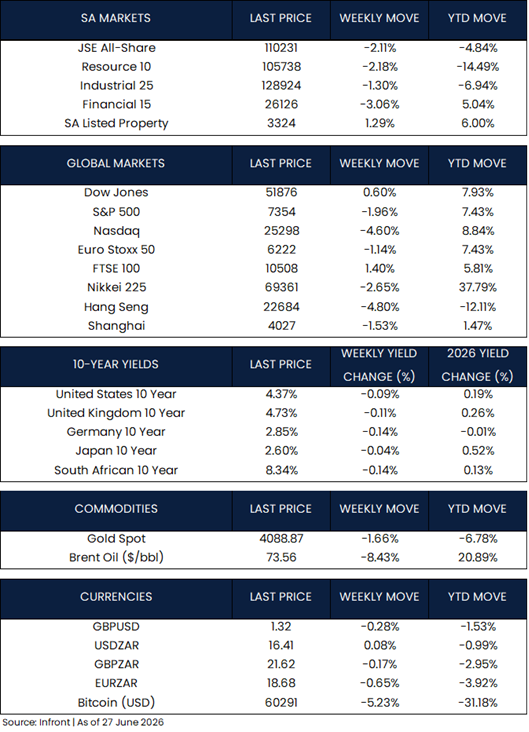
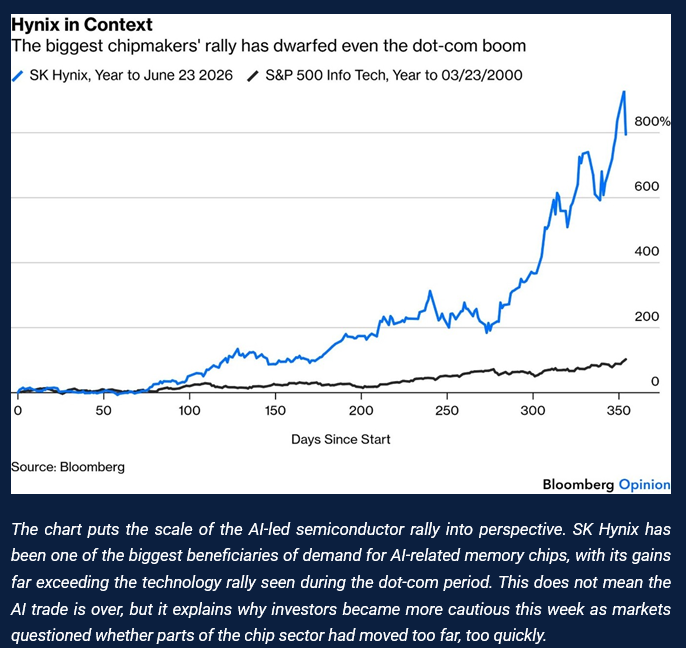
Global markets were volatile over the week as attention shifted from oil relief to renewed pressure in technology and AI-linked shares. The sell-off began in U.S. megacap technology before spreading into semiconductors, with Korea’s KOSPI falling sharply and the SOX chip index declining around 8% as investors questioned how far the AI trade had already run.

Micron Technology’s strong earnings update briefly steadied sentiment, but the rebound faded quickly. That left investors debating whether the pullback was normal quarter-end volatility or a sign that positioning in AI-linked shares had become stretched.

Monetary policy uncertainty added to the pressure. U.S. PCE inflation rose to 4.1% year-on-year in May, while core PCE increased to 3.4%, keeping attention on whether the Federal Reserve may need to keep policy restrictive for longer.

U.S. equities were mixed over the week. The Nasdaq fell 4.60% and the S&P 500 declined 1.96%, weighed down by renewed pressure in large-cap technology and AI-linked shares. The Dow Jones, however, gained 0.60%, showing that the sell-off was concentrated in large-cap growth and technology shares. On the data front, first-quarter U.S. GDP was revised higher to an annualised 2.1% from 1.6%, helped by lower imports, while consumer spending was revised down. Business activity also improved in June, with the composite PMI rising to 52.2, its highest level in five months, while manufacturing activity reached its strongest level since May 2022.

In Europe, inflation expectations eased, with the ECB’s latest consumer survey showing that 12-month inflation expectations declined to 3.5% in May, the lowest level in three months. With oil prices also moving back toward pre-conflict levels, this helped ease some of the inflation pressure facing the ECB. In the UK, Prime Minister Keir Starmer announced his resignation on 22 June 2026. Domestic data was weaker, with retail sales volumes falling sharply in June and the CBI balance declining to -54 from -46 in May, while manufacturing order books fell to -45, their weakest level since 2020.

In Japan, inflation and Bank of Japan policy remained in focus. Tokyo core CPI rose to 1.6% year-on-year in June from 1.3% in May, the first pickup in eight months, keeping investors focused on whether the BoJ may need to tighten policy further.

Japanese equities weakened over the week, with the Nikkei 225 falling 2.65%. Local AI and semiconductor-linked names remained sensitive to the broader global technology sell-off, which weighed on the index into the end of the week.

In China, investor sentiment remained weak, with technology shares under pressure. Investors had favoured other Asian technology markets earlier in the week, but the broader semiconductor sell-off later weighed on the sector. The softer tone was reinforced by weaker recent activity data, with Goldman Sachs lowering its second-quarter GDP forecast to 3.5% quarter-on-quarter annualised from 4.0%, although it kept its full-year growth forecast unchanged at 4.7%.

Market Moves of the Week:
In South Africa, producer inflation was the main local data point, accelerating to 7.8% year-on-year in May from 4.8% in April. The increase pointed to renewed pipeline cost pressure in the economy, reinforcing the risk that higher input costs could still feed through into consumer inflation.

The growth backdrop also remained under pressure, with S&P lowering its South African growth forecasts for 2026 and 2027 to 1.3% and 1.5%, respectively, while raising its 2026 inflation forecast to 4.3%. This points to a less comfortable mix of softer growth and higher inflation.

South African markets ended the week weaker, with the JSE All Share Index lower. Financials were the weakest major sector, falling 3.06%, while Resources declined 2.18% and Industrials lost 1.30%. Listed property was the standout performer, rising 1.29%. The rand was broadly stable against the U.S. dollar at R16.41, while the South African 10-year government bond yield moved lower to 8.34%.

Chart of the Week:
As always, we appreciate your support and value your trust in LNKD Investment Managers.

Important Information

The information included above as well as individual companies and/or securities mentioned should not be construed as investment advice, a recommendation to buy or sell or an indication of trading intent on behalf of any LNKD Investment Managers product. This material is provided for informational purposes only and is not intended to be investment advice or a recommendation to take any particular investment action. Information contained herein is based upon sources we consider to be reliable; we do not, however, guarantee its accuracy. All charts and tables are shown for illustrative purposes only.

LNKD Investment Managers is an authorised financial services provider (FSP 51257).

Weekly Insights: Blast Off

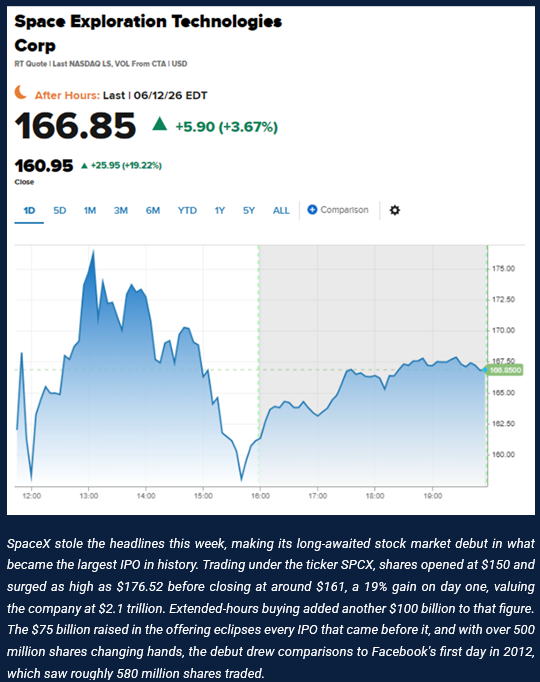
The defining story of the week was SpaceX making its long-awaited stock market debut in what became the largest IPO in history. Trading under the ticker SPCX on the Nasdaq, the stock surged 19% on its debut, closing at around $161 and briefly trading as high as $176.52 before extended-hours buying pushed the implied market cap above $2.2 trillion. The $75 billion raised in the IPO is the largest in history by a considerable margin. Elon Musk, who flagged on a pre-IPO JPMorgan livestream that SpaceX has been cash-flow positive since roughly 2015, framed the listing as capital-raising for a “significant growth phase” one that includes putting over 100,000 satellites in orbit and building AI data centres in space. It’s worth noting that Starlink remains the only profitable segment of the business today. The IPO also made Musk the world’s first trillionaire, based on his combined stakes in SpaceX and Tesla.

Beyond the blockbuster debut, broader equity markets managed to close the week in positive territory despite a turbulent ride. Small-caps led the charge, while the S&P 500, Dow, and Nasdaq each added over 0.65%. The week’s dominant macro theme remained the US-Iran conflict. Markets swung between risk-off and risk-on as missile exchanges, threatened US strikes, and then Trump’s last-minute cancellation of those strikes all played out in rapid succession. By Friday, cautious optimism around a potential peace deal was the prevailing mood.

The US inflation picture this week was a study in contradictions. Headline CPI came in at 4.2% year on year in May, the highest since April 2023, driven largely by the energy shock from the Strait of Hormuz closure. On a month-on-month basis, however, CPI rose just 0.2%, below expectations and the second consecutive month of decelerating price growth. Core CPI similarly moderated, rising 0.2% versus 0.4% the prior month.

Producer prices told a different story. PPI jumped 1.1% month on month, well above the 0.7% consensus, with energy goods up 10.7%. Year on year, PPI hit 6.5%, the highest since November 2022. The components that feed into core PCE, the Fed’s preferred gauge, are now pointing to a 0.4% print when that data lands later this month. That figure, if realised, keeps a rate hike firmly on the table before year-end.

Consumer sentiment edged up to 48.9 in June (a 4.1-point improvement from May), with some relief from early-month easing in petrol prices. But the mood remains cautious as inflation expectations for the year ahead sit at 4.6%.

In Europe, the European Central Bank delivered its first rate hike since September 2023 on Thursday, raising three key rates and flagging an “uncertain” outlook with upside inflation risks and downside growth risks. Updated forecasts now put eurozone inflation at 3.0% in 2026, moderating to 2.0% by 2028, while GDP growth was revised down to 0.8% for 2026. European equity markets were mixed on the week, though sentiment improved sharply on Friday as peace deal optimism took hold.

In the UK, April GDP contracted 0.1% month on month, a reversal from March’s 0.3% growth with services the main drag. The data reinforces expectations that the Bank of England will hold rates at its 18 June meeting. The FTSE 100 added 1.0% for the week.

In Asia, Japan’s Nikkei fell 0.85% over a volatile week, recovering sharply on Friday alongside the broader geopolitical de-escalation. The BoJ is widely expected to raise rates by 25bp to 1.0% at its 15–16 June meeting, its first hike since December 2025. The yen remained pinned around JPY 160 to the dollar. In China, the picture was mixed: the Shanghai Composite was flat on the week (+0.09%), while Hong Kong’s Hang Seng fell 0.98% amid weaker offshore sentiment.

Gold held around $4,200/oz but is on track for a second consecutive weekly decline as rate-hike expectations weigh on the metal. Brent crude fell 3.4% to $87.3/barrel on Strait of Hormuz reopening hopes, leaving oil down roughly 6% on the week, though prices remain over 20% higher since the initial US-Israel strikes on Iran in late February.

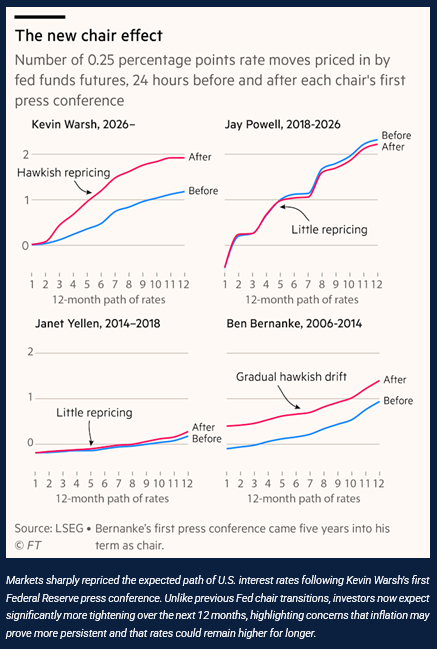
Next week’s key event is the Fed’s first policy meeting under new Chair Kevin Warsh. A hold is fully priced in, but the forward guidance matters enormously, specifically whether Warsh signals openness to hiking later this year. With core PCE likely to print at 0.4% and PPI-driven pipeline pressures building, the tone of the press conference will set the market’s direction into month-end. Simultaneously, the BoE, BoJ, RBA, Riksbank, SNB, Norges Bank, and the Brazilian central bank all meet on rates. Progress, or the absence of it, on the US-Iran deal is expected to continue to drive oil prices and broader risk sentiment throughout the week

Market Moves of the Week:

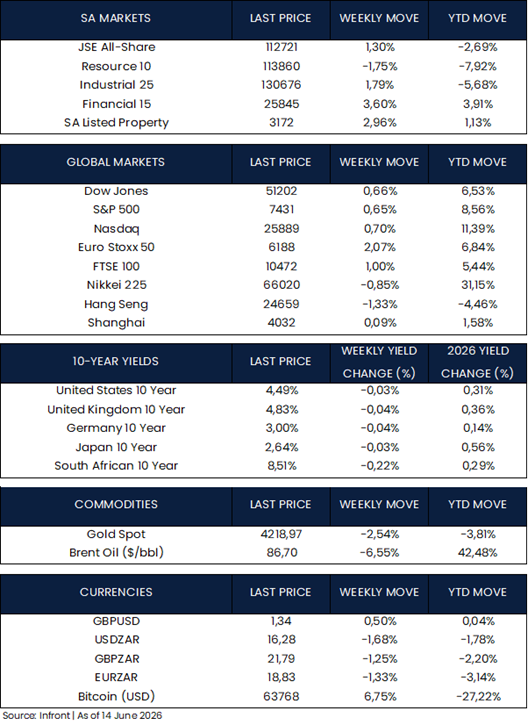
The domestic highlight of the week was the Q1 2026 GDP print, which came in ahead of expectations. South Africa’s economy expanded 0.5% quarter on quarter, up from 0.4% in Q4 2025 and the sixth consecutive quarter of growth, beating the Bloomberg consensus of 0.3%. On an annual basis, growth accelerated to 1.9%, also ahead of the 1.8% forecast. Finance, real estate, agriculture, trade, and transport were the primary drivers, with agriculture posting its sixth straight quarter of expansion at 3.9%. The trade sector similarly extended a six-quarter winning streak, supported by stronger wholesale trade, motor trade, and food and beverage activity.

The numbers are encouraging on the surface, but the detail warrants some caution. Fixed investment declined despite the broader expansion, and domestic demand remains soft, a combination that raises legitimate questions about the durability of the growth trajectory.

On the ratings front, Fitch upgraded South Africa to BB on 5 June, moving it in line with Moody’s and S&P, both of which also carry positive outlooks. National Treasury welcomed the move as an endorsement of fiscal policy and a signal that investment-grade status is within reach if the reform momentum holds. The upgrade is notable given the dimming global growth backdrop and the inflation pressures stemming from the Iran conflict. South African assets have also benefited from the country’s removal from the FATF grey list and the Reserve Bank’s adoption of a 3% inflation target last year, a policy shift that delivered a meaningful decline in government bond yields. The benchmark 10-year yield is now roughly 150 basis points lower than a year ago, and the rand, despite modest weakness since the Middle East conflict escalated in late February, remains about 9% stronger against the dollar year on year, trading at R16.28 this week versus R16.55 last week.

The JSE All Share closed the week up 1.3%, with financials, industrials, and listed property all firmly in the green. Resources underperformed on the week, weighed down by the commodity price volatility tied to Middle East uncertainty.

Chart of the Week:

As always, we appreciate your support and value your trust in LNKD Investment Managers.

Important Information

The information included above as well as individual companies and/or securities mentioned should not be construed as investment advice, a recommendation to buy or sell or an indication of trading intent on behalf of any LNKD Investment Managers product. This material is provided for informational purposes only and is not intended to be investment advice or a recommendation to take any particular investment action. Information contained herein is based upon sources we consider to be reliable; we do not, however, guarantee its accuracy. All charts and tables are shown for illustrative purposes only.

LNKD Investment Managers is an authorised financial services provider (FSP 51257).
Weekly Insights: Markets Rally as Central Banks Stay Cautious

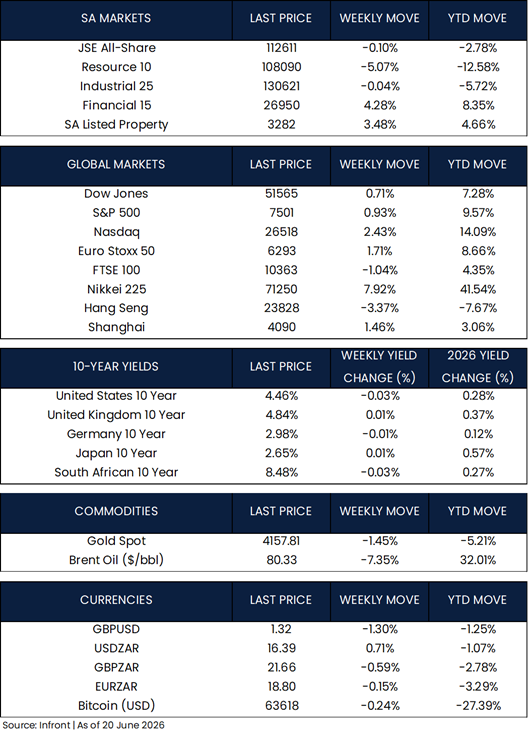
Global markets were broadly positive this week as investors welcomed signs of easing tensions in the Middle East. A temporary peace agreement between the United States and Iran helped reduce fears of a prolonged oil supply shock, with Brent crude falling 7.35% for the week. Lower oil prices supported investor sentiment, although central banks remain alert to inflation risks.

U.S. markets ended the week higher, led by technology shares. The Nasdaq rose 2.43%, the S&P 500 gained 0.93% and the Dow Jones added 0.71%. Investor appetite for technology and artificial intelligence-related companies remained strong, while lower oil prices also helped improve market confidence.

The Federal Reserve left interest rates unchanged, but its message remained cautious. Policymakers are still concerned that inflation could stay higher for longer, especially after the recent jump in energy prices. This means investors should not assume that interest rate cuts are around the corner. Economic data showed that the U.S. consumer remains resilient, with retail sales rising more than expected. However, the housing market remains under pressure as high borrowing costs continue to weigh on affordability. Overall, the U.S. economy still looks solid, but markets remain sensitive to any signs that inflation is not cooling quickly enough.

European markets also moved higher, supported by the improved geopolitical backdrop and lower energy prices. The Euro Stoxx 50 gained 1.71% for the week, while the FTSE 100 declined 1.04%.

The Bank of England kept interest rates unchanged as it continues to balance inflation risks against a slower growth environment. Inflation has moderated, but policymakers remain cautious because energy prices can quickly feed through to household costs and business expenses.

In Europe, investor sentiment improved as confidence indicators in Germany recovered. However, economic data remains mixed, with parts of the region still facing weak growth. For now, lower oil prices are a welcome relief, especially for consumers and businesses that are sensitive to fuel and energy costs.

Asian markets were mixed this week. Japan was the clear standout, with the Nikkei 225 rising 7.92% and taking its year-to-date gain to 41.54%. Japanese shares were supported by continued enthusiasm around technology companies and the country’s exposure to global artificial intelligence investment.

At the same time, Japan remains an important market to watch from a global interest rate perspective. The Bank of Japan raised rates to their highest level since 1995 and continues to reduce bond purchases. This does not necessarily mean Japan is enjoying a simple growth boom. Rather, it reflects pressure from inflation risks, higher energy costs and a weak yen.

This shift matters because Japan has spent decades with extremely low interest rates. As Japanese yields rise, local investors may have more reason to keep money at home instead of investing overseas. Over time, this could have important implications for global bond markets, especially given Japan’s large role in funding international debt markets. China’s market performance was more uneven. The Shanghai Composite gained 1.46%, while Hong Kong’s Hang Seng fell 3.37%. China’s industrial and export sectors remain relatively resilient, but consumer spending and property remain weak. Investors are still waiting for stronger evidence that policy support is feeding through into the broader economy.

Market Moves of the Week:

South African markets were mixed. The JSE All Share Index slipped 0.10%, dragged lower by weakness in resources, which fell 5.07%. Financials were the strongest part of the local market, rising 4.28%, while listed property gained 3.48%.

The biggest local development was the potential change in the interest rate outlook following the temporary peace agreement between the United States and Iran. Brent crude fell sharply this week, which could ease pressure on South African fuel prices if the decline is sustained.

This matters because higher fuel prices had recently pushed inflation higher, rising from 3.1% in March to 4.5% in May. That increase contributed to the South African Reserve Bank raising interest rates at its May meeting. Deputy Governor Rashad Cassim indicated that if oil prices continue to fall and inflation pressure eases, it could make future policy decisions easier for the SARB. However, South Africa is not completely out of the woods. Food prices remain a risk, especially if higher fertiliser costs or drought conditions place further pressure on the cost of living. The rand also remains important, as currency weakness can make imports more expensive and keep inflation elevated.

Chart of the Week:

As always, we appreciate your support and value your trust in LNKD Investment Managers.

Important Information

The information included above as well as individual companies and/or securities mentioned should not be construed as investment advice, a recommendation to buy or sell or an indication of trading intent on behalf of any LNKD Investment Managers product. This material is provided for informational purposes only and is not intended to be investment advice or a recommendation to take any particular investment action. Information contained herein is based upon sources we consider to be reliable; we do not, however, guarantee its accuracy. All charts and tables are shown for illustrative purposes only.

LNKD Investment Managers is an authorised financial services provider (FSP 51257).
Weekly Insights: Oil Relief Lifts Markets, But Inflation Risks Linger

In the U.S., lower oil prices helped set a more positive tone for markets. Brent crude fell sharply as hopes of a U.S.–Iran agreement raised expectations that energy flows through the Strait of Hormuz could improve. The move helped ease near-term inflation concerns and supported risk appetite across equity and bond markets.

Inflation remained the key macro focus. The April PCE price index rose 0.4% month-on-month and 3.8% year-on-year, while core PCE increased 3.3% year-on-year. The Federal Reserve also maintained a cautious tone, with several policymakers still focused on the risk that the recent energy shock and supply disruptions could keep inflation elevated.

Growth data was more mixed. First-quarter GDP was revised down to 1.6% from an initial estimate of 2.0%, reflecting softer investment and consumer spending. Durable goods orders rose 7.9% in April, driven mainly by transportation equipment, but the underlying detail was weaker, with core capital goods orders, a proxy for business investment, falling 1.1% after a strong March gain.

The consumer picture was also uneven, as personal spending rose 0.5%, while personal income was broadly flat.

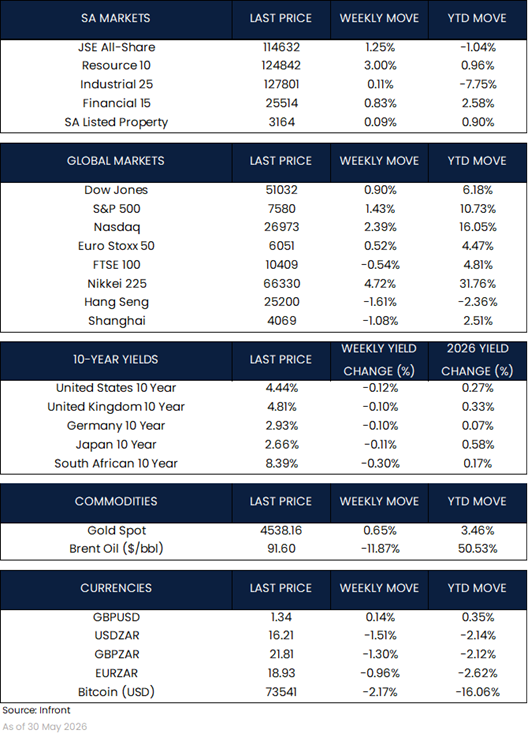
Despite the mixed data, U.S. equities ended higher. The S&P 500 rose 1.43%, while the Nasdaq gained 2.39%. Treasury yields moved lower, with the 10-year yield ending at 4.44%, as lower oil prices and reported progress in U.S.–Iran negotiations helped ease inflation concerns.

In Europe, the week was steadier, but not especially strong. The Euro Stoxx 50 gained 0.52%, with Germany’s DAX and France’s CAC 40 also ending higher, while the FTSE 100 declined 0.54%. Lower oil prices helped improve the tone, particularly given Europe’s exposure to energy costs, but the region still faced a difficult mix of soft growth and uncertain inflation dynamics.

The European Central Bank’s April minutes showed that some policymakers were still open to raising rates, with officials concerned that the recent energy shock could prove more persistent than initially expected. Germany’s labour market data was slightly more encouraging, with unemployment unexpectedly easing to 6.3%, although the outlook remains cautious.

In the UK, shop price inflation rose more than expected to 1.2% year-on-year in May, reflecting higher shipping and raw material costs linked to the Middle East conflict. Food inflation eased, but the data still pointed to pressure on household spending.

In Asia, Japan was the clear outperformer. The Nikkei 225 rose 4.72%, supported by lower oil prices and renewed demand for technology and semiconductor shares. Softer inflation data also reduced some near-term pressure on the Bank of Japan to raise rates quickly, although officials continued to signal that policy may still need to adjust over time.

China’s industrial profit data was more encouraging, with profits rising 24.7% year-on-year in April and pointing to improved conditions in parts of the industrial economy. However, markets remained cautious, as investors continued to look for clearer evidence that policy support is feeding through into broader demand.

Chinese policymakers are expected to introduce new financing tools to support infrastructure investment. At the same time, concerns around coal supply resurfaced after a mine accident in Shanxi pushed coking coal prices higher. Despite stronger industrial profit data, Chinese equities ended weaker, with the Shanghai Composite and Hang Seng both declining over the week.

Market Moves of the Week:

In South Africa, the SARB raised rates by 25 basis points to 7.00%, its first hike in three years. The decision was driven by concern that the recent energy shock and global supply risks could keep inflation elevated. Producer inflation also surprised to the upside, rising 4.8% year-on-year in April, reinforcing the central bank’s cautious stance.

Moody’s revised South Africa’s outlook to positive, citing an improving fiscal position and continued reform efforts. Transnet bulk export data was also encouraging, with April bulk exports remaining firm year-on-year and year-to-date performance supported by stronger flows through Saldanha and Richards Bay. These developments remain important for mining exports, tax revenue and broader confidence in the reform story.

Local markets ended higher, supported by the improved global backdrop and stronger resource shares. The JSE All Share Index rose 1.25%, while the Resource 10 Index gained 3.00%. South African bonds also strengthened, with the 10-year yield ending at 8.39%. The rand firmed to R16.21 against the U.S. dollar, helped by lower oil prices, a softer dollar and improved sentiment toward emerging markets.

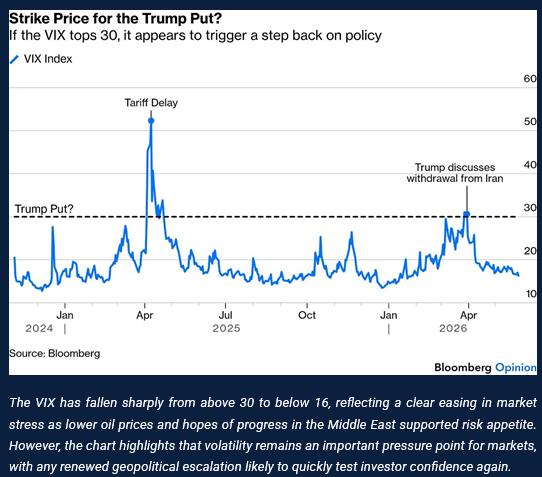
Overall, the week was defined by a clear easing in market stress. Hopes of progress in the Middle East, lower oil prices and continued AI momentum supported equities, while volatility eased sharply, with the VIX moving from above 30 to below 16. However, the broader macro picture remains less settled: U.S. inflation is still persistent, consumer momentum remains mixed, China’s recovery is uneven, and South Africa has shifted back into tightening mode.

Chart of the Week:

As always, we appreciate your support and value your trust in LNKD Investment Manager..

Important Information

The information included above as well as individual companies and/or securities mentioned should not be construed as investment advice, a recommendation to buy or sell or an indication of trading intent on behalf of any LNKD Investment Managers product. This material is provided for informational purposes only and is not intended to be investment advice or a recommendation to take any particular investment action. Information contained herein is based upon sources we consider to be reliable; we do not, however, guarantee its accuracy. All charts and tables are shown for illustrative purposes only.

LNKD Investment Managers is an authorised financial services provider (FSP 51257).