Weekly Insights: Markets Reassess Risk

Global markets experienced another volatile week as investors weighed renewed concerns over artificial intelligence (AI) investment, rising energy prices and the outlook for interest rates. Technology shares came under pressure, while defensive sectors and government bonds benefited from a shift in investor sentiment. Meanwhile, escalating tensions in the Middle East pushed oil prices higher, adding to inflation concerns ahead of several important central bank meetings.

In the US, technology shares led the declines as investors increasingly questioned the scale and sustainability of AI-related investment. Semiconductor stocks were particularly hard hit, with the Philadelphia Semiconductor Index falling approximately 4% over the week. Concerns around elevated capital expenditure, rising debt levels and whether future earnings can justify current valuations weighed on sentiment. However, the weakness did not extend across the broader market, with investors rotating towards more defensive sectors, including utilities, consumer staples and healthcare.

US economic data continued to reflect a resilient economy, although signs of pressure are emerging. October’s preliminary Composite PMI eased to 57.6 from 58.4, still indicating robust business activity, but businesses reported their sharpest increase in selling prices since August 2022. Meanwhile, the housing market remained under pressure, with pending home sales falling 7.3% in September to a record low. Initial jobless claims declined to 194,000, suggesting labour market conditions remain relatively stable.

Bond markets benefited from the cautious sentiment, with the US 10-year Treasury yield retreating to around 5.0% from a recent peak of 5.3%. Attention now turns to the Federal Reserve’s meeting on 27–28 October, where policymakers are widely expected to leave interest rates unchanged following September’s increase. However, persistent inflation pressures, particularly from energy prices, could complicate the outlook for further policy tightening.

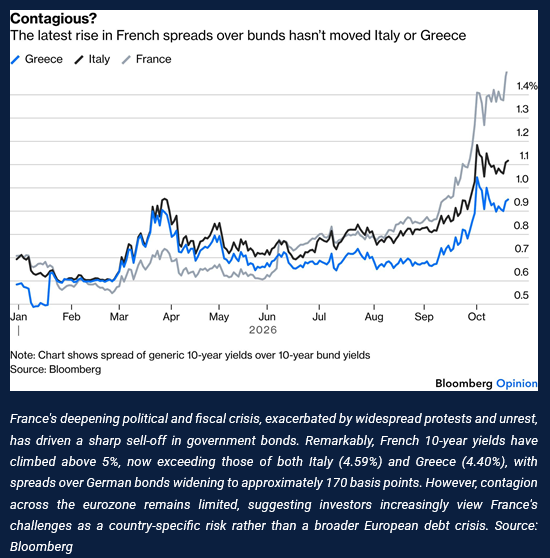
In Europe, France’s deepening political and fiscal challenges dominated headlines. Widespread protests and civil unrest added to concerns over the country’s deteriorating finances, pushing government borrowing costs sharply higher. However, Moody’s unexpectedly maintained France’s Aa3 credit rating on Friday, providing some relief, although its negative outlook highlights the challenges that remain. Elsewhere, eurozone business activity slowed, with the October Composite PMI declining to 51.9 from 53.1, reinforcing concerns about the strength of the region’s economic recovery.

In the UK, inflation rose to 3.5% year on year in September, ahead of expectations, driven largely by higher fuel prices. While unemployment declined to 4.7%, consumer confidence deteriorated sharply, with the GfK index falling to -24 from -13. The combination of persistent inflation and weakening household sentiment presents a difficult environment for the Bank of England, with markets increasingly anticipating a further interest rate increase in November.

Japanese equities experienced a difficult week, reflecting the broader global sell-off in technology shares and concerns around AI-related investment. Inflation also remained in focus, with core consumer prices rising 2.1% year on year in September, up from 1.7% in August and moving back above the Bank of Japan’s 2% target. While further monetary tightening remains possible, the central bank is expected to hold rates steady at its upcoming meeting.

Chinese markets also came under pressure, particularly in Hong Kong, where technology and internet-related shares led the declines. Economic data provided a more encouraging headline, with third-quarter GDP growth accelerating to 4.5% year on year from 4.3%, ahead of expectations. However, underlying activity remains uneven, with September retail sales increasing just 1.1% and fixed-asset investment declining 7.2% over the first nine months of the year. Weak domestic demand and investment continue to weigh on the broader recovery.

Geopolitical tensions remained another important driver of market sentiment. Renewed attacks on Saudi Arabian infrastructure by Houthi forces raised concerns about potential disruptions to energy supplies, pushing Brent crude oil above $116 per barrel. Higher energy prices continue to complicate the inflation outlook, reinforcing expectations that central banks may need to maintain restrictive monetary policy for longer.

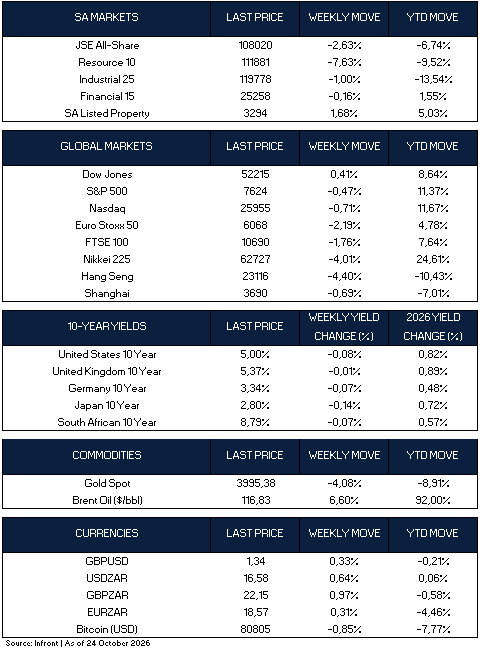
Overall, global equity markets ended the week weaker. The S&P 500 declined 0.47% and the Nasdaq fell 0.71%, while the Dow Jones gained 0.41%. European markets also retreated, with the Euro Stoxx 50 down 2.19% and the FTSE 100 losing 1.76%. Asian markets experienced sharper declines, led by Hong Kong’s Hang Seng, which fell 4.40%, and Japan’s Nikkei 225, down 4.01%. Brent crude oil gained 6.60%, extending its year-to-date increase to 92.00%. In contrast, gold declined 4.08%, its sharpest weekly fall since June, briefly slipping below $4,000 an ounce. Bitcoin also weakened, declining 0.85%.

Market Moves of the Week:
Turning to South Africa, the week was dominated by the government’s Medium-Term Budget Policy Statement. National Treasury lowered its 2026 economic growth forecast to 1.2% from 1.6%, highlighting the challenges facing the domestic economy. However, stronger tax collections have helped improve the government’s financial position, allowing it to reduce planned bond issuance and introduce a programme to repurchase some existing debt. These developments were welcomed by bond investors. Government also outlined additional infrastructure investment plans, although weak economic growth and elevated debt levels remain important challenges.

Inflation provided some encouraging news, despite rising slightly to 4.5% in September from 4.4% in August. The increase was smaller than expected, while underlying price pressures showed signs of easing. Importantly, government announced temporary fuel levy reductions from November to provide relief to households and businesses facing higher petrol and diesel prices. This should help cushion the impact of rising global oil prices and supports expectations that the South African Reserve Bank will leave interest rates unchanged at its November meeting.

Elsewhere, economic data continued to reflect a mixed picture. Retail sales increased 3.3% year on year in August, slightly below July’s 3.4% but ahead of expectations, suggesting consumer spending remains relatively resilient. However, business confidence softened and building activity weakened, highlighting the uneven nature of the economic recovery. While consumers continue to show some resilience, stronger business investment and confidence will be important to support a more sustained improvement in economic growth.

Against this backdrop, South African financial markets experienced a difficult week. The JSE All Share Index declined 2.63%, driven by a sharp 7.63% fall in resource shares, while industrials and financials retreated 1.00% and 0.16% respectively. Listed property was a relative bright spot, gaining 1.68%. The rand weakened against the US dollar to R16.58, while the South African 10-year government bond yield declined to 8.79%, supported by a more favourable government borrowing outlook following the budget announcement.

Chart of the Week:
As always, we appreciate your support and value your trust in LNKD Investment Managers.

The information included above as well as individual companies and/or securities mentioned should not be construed as investment advice, a recommendation to buy or sell or an indication of trading intent on behalf of any LNKD Investment Managers product. This material is provided for informational purposes only and is not intended to be investment advice or a recommendation to take any particular investment action. Information contained herein is based upon sources we consider to be reliable; we do not, however, guarantee its accuracy. All charts and tables are shown for illustrative purposes only.

LNKD Investment Managers is an authorised financial services provider (FSP 51257).

Weekly Insights: Counting the Costs: Oil, Inflation and AI Debt

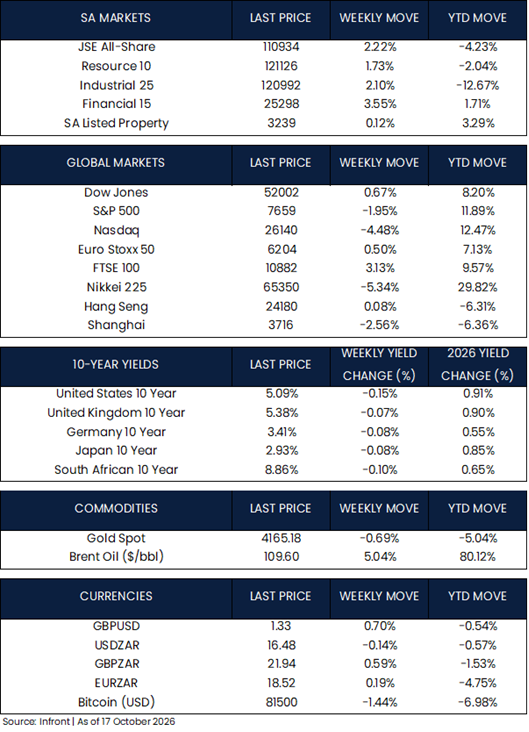
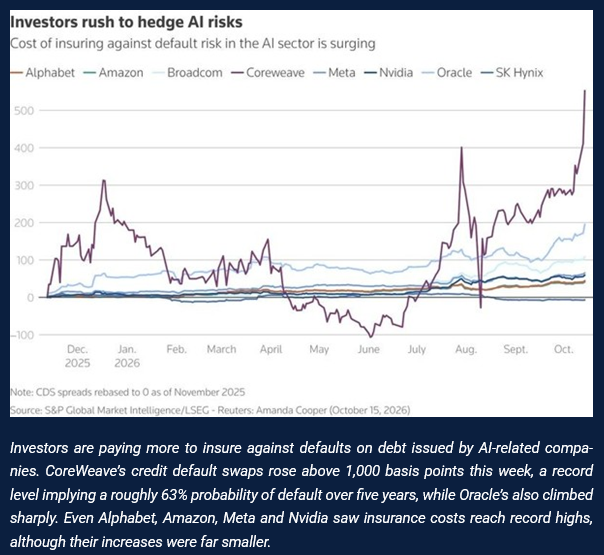
The AI trade ran into a harder question this week: not whether the technology will deliver, but who is financing the build-out and at what price. Investors turned their attention to the scale of borrowing behind the expansion, and the scrutiny quickly spilled into credit markets, where the cost of insuring debt issued by several AI-linked companies rose sharply. The Nasdaq fell 4.48% and the S&P 500 gave up 1.95%, while the more value-orientated Dow managed a 0.67% gain. The rotation out of technology found a home in government bonds, pulling the US ten-year yield down 15 basis points to 5.09%.

The IMF raised its global growth forecast for 2026 to 3.1%, from 3.0% in July, supported by AI investment and resilient trade, while leaving its 2027 forecast unchanged at 3.4%. However, the outlook remains cautious. Although the global economy has so far weathered the energy shock, a prolonged supply disruption and a potential reassessment of AI expectations remain key downside risks.

On the energy front, supply fears intensified after an attack on Saudi Aramco’s headquarters and threats of further strikes on Saudi oil facilities. Hopes of relief from the Russia–Ukraine conflict also faded as the energy ceasefire brokered by Trump collapsed, with Ukraine resuming strikes on Russian energy infrastructure in response to continued Russian attacks on its own facilities. Brent crude closed the week 5.04% higher at $109.60 a barrel, despite US efforts to bring additional Russian diesel onto global markets.

Higher energy costs remained central to the US inflation picture. Consumer prices rose 0.6% in September, lifting annual inflation to 3.7%. Core prices rose a more modest 0.3% over the month and 2.6% over the year. The bigger warning came from producer prices, which jumped 1.3% as increases spread beyond energy into other goods and services. That pipeline pressure keeps the prospect of a further Federal Reserve hike firmly on the table.

Economic data presented a mixed picture, with headline figures masking underlying weakness. Retail sales increased by 0.8%, although underlying sales grew by just 0.1%. Industrial production was more encouraging, rising 0.7%, while manufacturing output increased by 0.3%.

Earnings season opened with a mixed showing from the major US banks. Loan growth held up and consumers kept spending, but softer investment-banking and fixed-income trading activity weighed on parts of the sector. JPMorgan reported its first earnings miss since late 2023 and Bank of America also disappointed, while Goldman Sachs and Citigroup beat expectations.

European markets finished higher, with the Euro Stoxx 50 gaining 0.50% and the FTSE 100 advancing 3.13%. The economic backdrop was less encouraging, with higher energy prices lifting inflation and industrial activity weakening.

Final figures put eurozone inflation at 3.8% in September, up from 3.2% in August, while core inflation edged up to 2.5%. Industrial production fell 0.5% in August, its third consecutive monthly decline.

In the UK, the economy grew 0.1% in August, confounding expectations of a modest contraction. Manufacturing, led by pharmaceuticals, did the heavy lifting while services were flat. Bank of England chief economist Huw Pill pushed back against market pricing of four rate increases over the coming year, though he cautioned that inflation could prove stubborn.

In Japan, wholesale prices rose 6.8% from a year earlier in September, slowing from 7.6% in August. Even so, Bank of Japan Governor Kazuo Ueda said the central bank would keep raising interest rates, warning that underlying inflation could overshoot its 2% target. Core machinery orders, a leading indicator of business investment, rebounded 5.2% in August after falling 3.7% in July. That did little to shield equities, with the Nikkei 225 falling 5.34%.

The retreat from the AI trade hit Asian technology names hardest. South Korea’s Kospi suffered its worst week since October 2008, falling 14.46%, with an 8% slide on Thursday triggering a 20-minute trading halt.

China’s data told a two-sided story. September exports surged 36.3% year on year in dollar terms and imports rose 31.0%, pushing the monthly trade surplus to a record $133.5 billion. Higher energy and commodity costs drove producer price inflation up to 5.0% from 3.8% in August, yet consumer inflation crept up to only 0.9%, held back by weak domestic demand. The Shanghai Composite lost 2.56%, while Hong Kong’s Hang Seng was broadly flat, edging up 0.08%.

Market Moves of the Week:

In South Africa, attention turned to next week’s Medium-Term Budget Policy Statement, as stronger mining tax receipts raised expectations of improved government finances. Bank of America estimates that 2026/27 revenue could exceed February’s budget projections by R70 billion, driven largely by gold and precious-metals producers. The bank nevertheless expects much of the extra revenue to be spent, so the deficit would narrow only slightly, to 3.5% of GDP against Treasury’s 3.7% target. Morgan Stanley anticipates three months of renewed fuel-tax relief in the budget, which it estimates would reduce its inflation forecast by half a percentage point.

Mining activity remained under pressure, with output falling 12.7% year-on-year in August. The decline was led by a sharp 22.5% contraction in platinum-group metals, while coal and iron ore production also recorded significant declines.

Local markets ended the week on a positive note, with the JSE All-Share rising 2.22%, led by a 3.55% gain in financial shares. The rand strengthened 0.14% to R16.48 against the US dollar, while the 10-year government bond yield declined by 10 basis points to 8.86%, reflecting improved sentiment across local asset classes.

Chart of the Week:

As always, we appreciate your support and value your trust in LNKD Investment Managers.

Important Information

The information included above as well as individual companies and/or securities mentioned should not be construed as investment advice, a recommendation to buy or sell or an indication of trading intent on behalf of any LNKD Investment Managers product. This material is provided for informational purposes only and is not intended to be investment advice or a recommendation to take any particular investment action. Information contained herein is based upon sources we consider to be reliable; we do not, however, guarantee its accuracy. All charts and tables are shown for illustrative purposes only.

LNKD Investment Managers is an authorised financial services provider (FSP 51257).
Weekly Insights: Markets Rise, Consumers Remain Cautious

Markets experienced another unsettled week as investors weighed rising oil prices, developments in the Middle East and the possibility of further interest-rate increases. US shares finished higher, while European and Asian markets were mixed, and South African shares managed a modest gain despite difficult economic news.

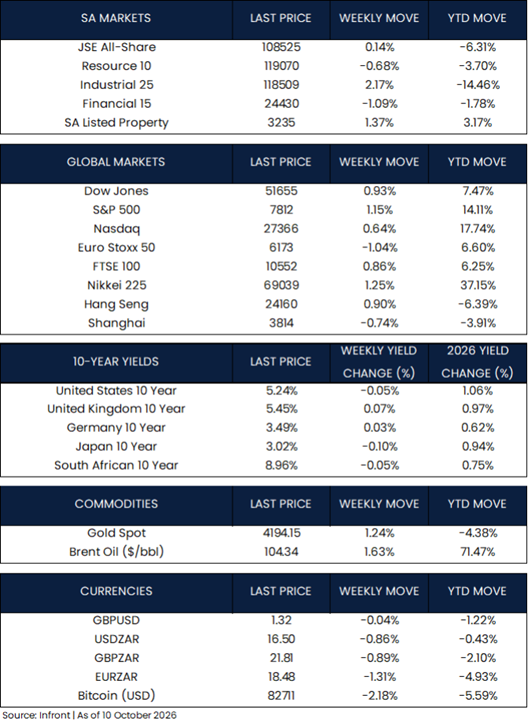
US shares advanced, with the S&P 500 gaining 1.15%, the Dow Jones rising 0.93% and the Nasdaq adding 0.64%. Consumer staples, utilities and energy stocks performed well, while technology shares experienced another volatile week as investors questioned whether expectations for AI-related companies had become too optimistic.

Oil prices remained sensitive to developments in the Middle East. News of a planned release of oil reserves initially eased supply concerns, but reports of further attacks on tankers in the Strait of Hormuz pushed prices higher again. Brent ended the week up 1.63% at $104.34 a barrel, keeping pressure on fuel costs and the inflation outlook.

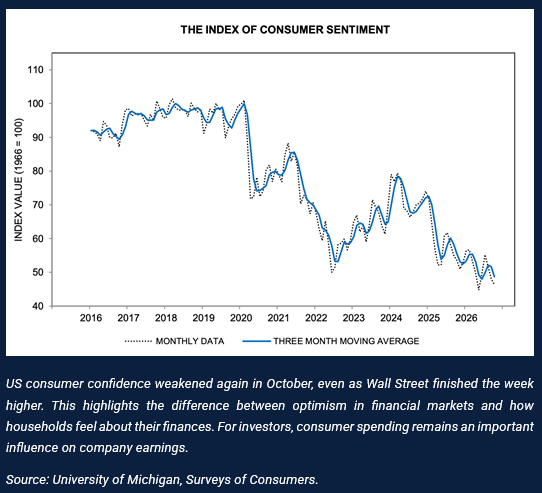
Minutes from the Federal Reserve’s September meeting suggested that another interest-rate increase remained likely before year-end, although policymakers offered little guidance on timing. Economic data showed that services businesses continued to expand, but rising costs and higher household inflation expectations remained concerns. Consumer confidence also weakened, highlighting the pressure on households. US government bond yields eased after strong demand at bond auctions, with the ten-year Treasury yield ending at 5.24%. This provided some relief after yields had reached their highest levels since 2002 earlier in the week. Investors now look to the next inflation release for clues about whether the Fed will need to raise rates again soon.

European shares were mixed, with the Euro Stoxx 50 falling 1.04% while the UK’s FTSE 100 gained 0.86%. Higher energy prices and uncertainty over interest rates remained central to investor sentiment, alongside economic releases that showed uneven growth across the region.

Minutes from the European Central Bank’s September meeting showed that policymakers unanimously supported raising interest rates. Officials warned that the full effect of higher energy prices had yet to feed through to inflation, but stressed that further increases would depend on how the outlook developed. This left investors weighing the risk of more expensive borrowing against already subdued economic activity. German exports and factory orders declined in August, although industrial production recovered from its July fall. French industrial output also weakened, partly because of lower electricity production. In the UK, business activity continued to expand at a slower pace, while house prices were unchanged, suggesting that households and businesses remained cautious.

Asian markets delivered mixed results, with Japan’s Nikkei 225 gaining 1.25% and Hong Kong’s Hang Seng rising 0.90%, while the Shanghai Composite declined 0.74%. Technology shares played an important role in market movements, supporting Japanese equities early in the week but weighing on mainland Chinese shares after exchanges reopened following the Golden Week holiday.

Chinese technology companies faced pressure from higher global borrowing costs and concerns about possible US restrictions on advanced communications products. A recovery in Hong Kong internet and technology shares helped the Hang Seng finish higher. However, concerns about the wider Chinese economy remained.

Golden Week travel figures showed that more people were taking holidays, but spending increased more slowly than visitor numbers. Together with weaker cinema ticket sales, this suggested that consumers remained careful with their money. Investors now await China’s next growth figures and policy announcements for signs of stronger support for the economy. In Japan, the government sought to reassure investors that its plans to support households would remain consistent with responsible public finances. Proposed measures included a temporary reduction in the consumption tax on food and financial assistance for lower-income households. Wages continued to improve, but household spending remained weak, while the ten-year government bond yield eased to 3.02%.

Market Moves of the Week:

The JSE All-Share gained 0.14%, with industrials and listed property helping offset declines in resources and financial shares. Industrials advanced 2.17% and listed property gained 1.37%, while resources fell 0.68% and financials declined 1.09%. The overall market held up despite growing concerns about fuel costs, inflation and weak economic activity.

The SARB’s October Monetary Policy Review warned that higher fuel prices could spread into wages and other costs, making inflation more difficult to bring under control. Sharp increases in petrol and diesel prices added pressure to household budgets and businesses during the week. This kept the possibility of further interest-rate increases in focus, even as the economy struggled to gain momentum.

Manufacturing output fell 4.3% compared with a year earlier, reversing July’s improvement and highlighting continued weakness in the industrial sector. Government bonds nevertheless attracted strong demand at the weekly auction, and the ten-year bond yield declined to 8.96%. The rand also strengthened, with USD/ZAR falling 0.86% to R16.50 per dollar. Attention now turns to US inflation data on 14 October, followed by South Africa’s September inflation release and the Medium-Term Budget Policy Statement on 21 October. These will help investors assess the outlook for interest rates, household costs and government finances.

Chart of the Week:

As always, we appreciate your support and value your trust in LNKD Investment Managers.

Important Information

The information included above as well as individual companies and/or securities mentioned should not be construed as investment advice, a recommendation to buy or sell or an indication of trading intent on behalf of any LNKD Investment Managers product. This material is provided for informational purposes only and is not intended to be investment advice or a recommendation to take any particular investment action. Information contained herein is based upon sources we consider to be reliable; we do not, however, guarantee its accuracy. All charts and tables are shown for illustrative purposes only. LNKD Investment Managers is an authorised financial services provider (FSP 51257).
Weekly Insights: U.S. Hiring Stalls as Bond Rout Pauses

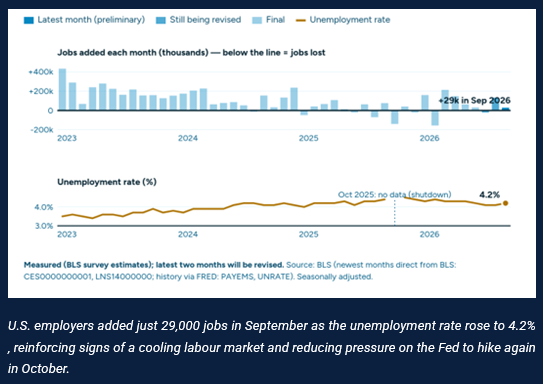
The Bureau of Labor Statistics (BLS) reported that nonfarm payrolls rose by just 29,000 in September, well below consensus expectations of around 90,000, while downward revisions cut a combined 60,000 jobs from July and August, leaving July with a net loss of 10,000.

The unemployment rate edged up to 4.2% from 4.1%, partly reflecting a rise in the labour force participation rate to 61.8%, while wage growth was sluggish. BLS data also showed job openings falling to 7.08 million in August.

Inflation data also provided some relief, with headline PCE inflation rising 0.3% in August and holding at 3.4% year on year, while core PCE inflation, which excludes food and energy prices, increased 0.2% and remained at 3.0% year on year. Both annual inflation measures were unchanged from July’s revised readings.

Second-quarter GDP growth was revised higher to an annualised 2.2%, from 1.5%, primarily reflecting stronger investment, consumer spending and government spending. Expectations for an October rate hike fell from around 70% earlier in the week, following softer payrolls data and comments from Fed officials indicating that there was no urgency for a further increase following September’s hike.

Manufacturing activity remained in expansion territory in September, with the ISM Manufacturing PMI registering 54.5, marking a ninth consecutive month of expansion. New orders and employment strengthened, although the prices paid index rose sharply by 6.8 points to 77.9, its highest reading since May, pointing to renewed input cost pressures.

Eurozone inflation surprised to the upside in September, accelerating to 3.8% from 3.2% in August and exceeding expectations of 3.6%. The broader rise in inflation across the region reinforced expectations that the ECB may need to maintain a restrictive policy stance.

In the UK, revised data showed the economy expanded 0.5% in the second quarter, slightly above the previous estimate of 0.4%, with services remaining the principal driver of growth. Elevated gilt yields continued to create a challenging backdrop for rate-sensitive sectors, keeping attention focused on borrowing costs and the outlook for fiscal policy. Manufacturing activity also remained in expansion territory, with the S&P Global UK Manufacturing PMI rising to 51.9 in September, from 51.7 in August.

In Japan, rising inflation kept expectations of further BoJ tightening in focus, with Tokyo-area core CPI accelerating to 2.7% year on year in September, from 1.8% in August. However, underlying activity remained mixed, with industrial production falling 1.7% month on month in August, while sentiment among large manufacturers improved modestly.

In China, economic activity showed signs of improvement, with the official Manufacturing PMI returning to expansion at 50.1 in September, from 49.8 in August, alongside a pickup in services activity. Authorities also announced the country’s largest stimulus package since 2024, including mortgage interest subsidies for qualified first-time homebuyers. However, the measures received a muted response from investors, with some market participants viewing the measures as insufficient to address ongoing structural challenges.

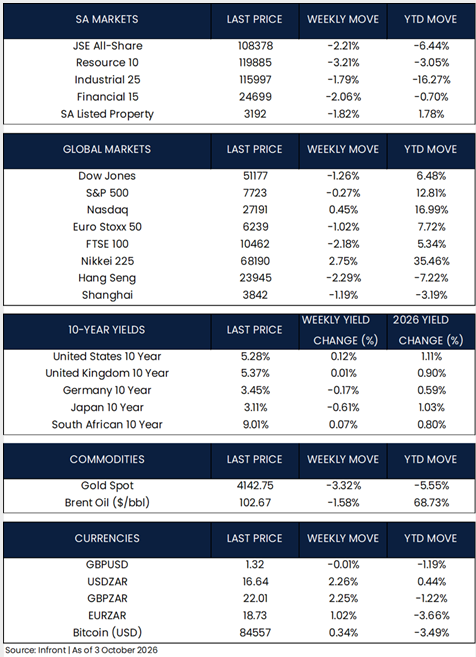
US equities finished the week mixed as investors weighed softer US jobs data against elevated Treasury yields and volatile oil prices. The Dow Jones Industrial Average fell 1.26% and the S&P 500 declined 0.27%, while the tech-heavy Nasdaq Composite gained 0.45%.

The cautious tone extended into Europe, where higher-than-expected eurozone inflation, elevated oil prices and rising sovereign yields weighed on sentiment. The pan-European STOXX Europe 50 fell 1.02%, while the UK’s FTSE 100 declined 2.18%.

Asian markets were more mixed. In Japan, the Nikkei 225 rose 2.93%, supported by gains in AI- and semiconductor-related shares. In China, mainland markets were closed on Thursday and Friday for the Golden Week holiday. Over the three trading days through Wednesday, the Shanghai Composite fell 1.19%, while Hang Seng also fell 2.29%, with financial and technology stocks among the biggest laggards.

Against this backdrop, global sovereign bond markets remained under pressure, with the US 10-year Treasury yield reaching 5.33% and the 30-year yield 5.69% on Thursday, their highest levels since 2002. Softer US economic data subsequently prompted a partial bond rally, with the US 10-year yield ending the week at 5.28%, up 12 bps. In Japan, the 10-year JGB yield also rose above 3%, reaching a 30-year high.

Market Moves of the Week:

South African economic data remained mixed, with some improvement in manufacturing activity but continued weakness in employment. The Absa Purchasing Managers’ Index (PMI), compiled by the Bureau for Economic Research (BER), rose 4.9 points to 50.7 in September, returning to expansion territory after three consecutive months of contraction, as new sales orders rebounded sharply.

Producer price inflation eased to 5.0% year on year in August, from 5.7% in July, while South Africa recorded a preliminary trade surplus of R20.5 billion in August, supported by exports of R181.8 billion against imports of R161.3 billion.

The labour market remained under pressure. Stats SA’s latest Quarterly Employment Statistics showed formal non-agricultural employment declining by 14,000 quarter-on-quarter and by 95,000 year-on-year in the second quarter. Full-time employment fell by 96,000 year-on-year, pointing to continued weakness in formal job creation. The broader Quarterly Labour Force Survey also showed the unemployment rate rising to 33.6% in the second quarter.

Local equity markets weakened over the week, with the JSE All Share Index falling 2.21%, with all sectors declining and resources leading the losses at 3.21%. The rand depreciated 2.26% against the US dollar to R16.64/$, as a stronger greenback and rising global bond yields weighed on emerging market assets and outweighed supportive domestic data.

Chart of the Week:

As always, we appreciate your support and value your trust in LNKD Investment Managers.

Important Information

The information included above as well as individual companies and/or securities mentioned should not be construed as investment advice, a recommendation to buy or sell or an indication of trading intent on behalf of any LNKD Investment Managers product. This material is provided for informational purposes only and is not intended to be investment advice or a recommendation to take any particular investment action. Information contained herein is based upon sources we consider to be reliable; we do not, however, guarantee its accuracy. All charts and tables are shown for illustrative purposes only.

LNKD Investment Managers is an authorised financial services provider (FSP 51257).