

Markets experienced another unsettled week as investors weighed rising oil prices, developments in the Middle East and the possibility of further interest-rate increases. US shares finished higher, while European and Asian markets were mixed, and South African shares managed a modest gain despite difficult economic news.
US shares advanced, with the S&P 500 gaining 1.15%, the Dow Jones rising 0.93% and the Nasdaq adding 0.64%. Consumer staples, utilities and energy stocks performed well, while technology shares experienced another volatile week as investors questioned whether expectations for AI-related companies had become too optimistic.
Oil prices remained sensitive to developments in the Middle East. News of a planned release of oil reserves initially eased supply concerns, but reports of further attacks on tankers in the Strait of Hormuz pushed prices higher again. Brent ended the week up 1.63% at $104.34 a barrel, keeping pressure on fuel costs and the inflation outlook.
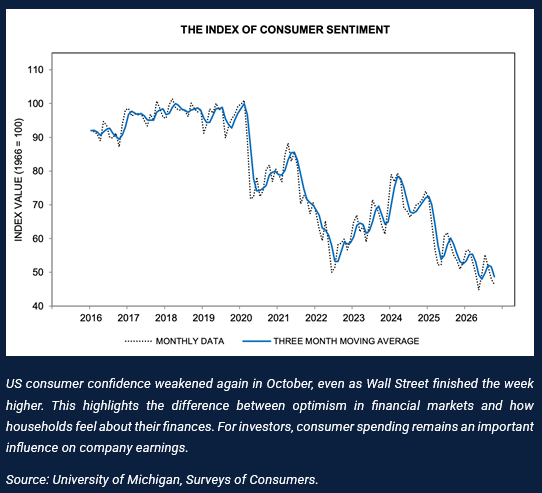
Minutes from the Federal Reserve’s September meeting suggested that another interest-rate increase remained likely before year-end, although policymakers offered little guidance on timing. Economic data showed that services businesses continued to expand, but rising costs and higher household inflation expectations remained concerns. Consumer confidence also weakened, highlighting the pressure on households. US government bond yields eased after strong demand at bond auctions, with the ten-year Treasury yield ending at 5.24%. This provided some relief after yields had reached their highest levels since 2002 earlier in the week. Investors now look to the next inflation release for clues about whether the Fed will need to raise rates again soon.
European shares were mixed, with the Euro Stoxx 50 falling 1.04% while the UK’s FTSE 100 gained 0.86%. Higher energy prices and uncertainty over interest rates remained central to investor sentiment, alongside economic releases that showed uneven growth across the region.
Minutes from the European Central Bank’s September meeting showed that policymakers unanimously supported raising interest rates. Officials warned that the full effect of higher energy prices had yet to feed through to inflation, but stressed that further increases would depend on how the outlook developed. This left investors weighing the risk of more expensive borrowing against already subdued economic activity. German exports and factory orders declined in August, although industrial production recovered from its July fall. French industrial output also weakened, partly because of lower electricity production. In the UK, business activity continued to expand at a slower pace, while house prices were unchanged, suggesting that households and businesses remained cautious.
Asian markets delivered mixed results, with Japan’s Nikkei 225 gaining 1.25% and Hong Kong’s Hang Seng rising 0.90%, while the Shanghai Composite declined 0.74%. Technology shares played an important role in market movements, supporting Japanese equities early in the week but weighing on mainland Chinese shares after exchanges reopened following the Golden Week holiday.
Chinese technology companies faced pressure from higher global borrowing costs and concerns about possible US restrictions on advanced communications products. A recovery in Hong Kong internet and technology shares helped the Hang Seng finish higher. However, concerns about the wider Chinese economy remained.
Golden Week travel figures showed that more people were taking holidays, but spending increased more slowly than visitor numbers. Together with weaker cinema ticket sales, this suggested that consumers remained careful with their money. Investors now await China’s next growth figures and policy announcements for signs of stronger support for the economy. In Japan, the government sought to reassure investors that its plans to support households would remain consistent with responsible public finances. Proposed measures included a temporary reduction in the consumption tax on food and financial assistance for lower-income households. Wages continued to improve, but household spending remained weak, while the ten-year government bond yield eased to 3.02%.
Market Moves of the Week:
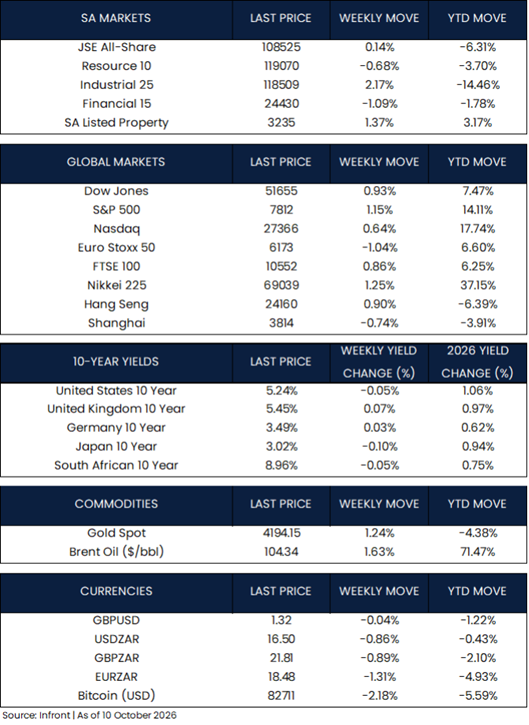
The JSE All-Share gained 0.14%, with industrials and listed property helping offset declines in resources and financial shares. Industrials advanced 2.17% and listed property gained 1.37%, while resources fell 0.68% and financials declined 1.09%. The overall market held up despite growing concerns about fuel costs, inflation and weak economic activity.
The SARB’s October Monetary Policy Review warned that higher fuel prices could spread into wages and other costs, making inflation more difficult to bring under control. Sharp increases in petrol and diesel prices added pressure to household budgets and businesses during the week. This kept the possibility of further interest-rate increases in focus, even as the economy struggled to gain momentum.
Manufacturing output fell 4.3% compared with a year earlier, reversing July’s improvement and highlighting continued weakness in the industrial sector. Government bonds nevertheless attracted strong demand at the weekly auction, and the ten-year bond yield declined to 8.96%. The rand also strengthened, with USD/ZAR falling 0.86% to R16.50 per dollar. Attention now turns to US inflation data on 14 October, followed by South Africa’s September inflation release and the Medium-Term Budget Policy Statement on 21 October. These will help investors assess the outlook for interest rates, household costs and government finances.
Chart of the Week:
As always, we appreciate your support and value your trust in LNKD Investment Managers.
Important Information
The information included above as well as individual companies and/or securities mentioned should not be construed as investment advice, a recommendation to buy or sell or an indication of trading intent on behalf of any LNKD Investment Managers product. This material is provided for informational purposes only and is not intended to be investment advice or a recommendation to take any particular investment action. Information contained herein is based upon sources we consider to be reliable; we do not, however, guarantee its accuracy. All charts and tables are shown for illustrative purposes only. LNKD Investment Managers is an authorised financial services provider (FSP 51257).