Weekly Insights: Markets Pause as Oil Surges and AI Optimism Faces Its First Test

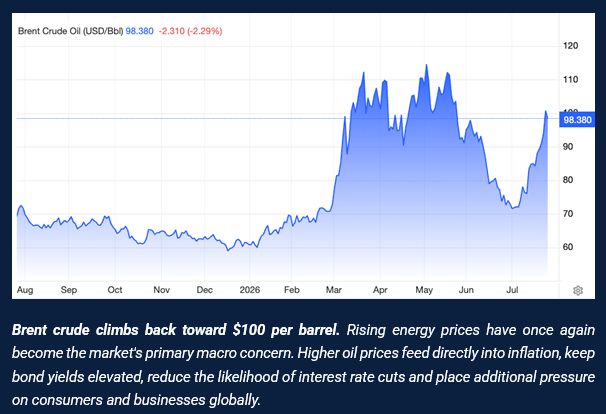
Global markets took a more cautious tone this week as investors navigated renewed geopolitical tensions in the Middle East, rising oil prices, and growing scrutiny over the enormous levels of investment flowing into artificial intelligence. While the long-term outlook for AI remains compelling, investors began questioning how quickly companies will be able to generate meaningful returns from the billions being committed to new infrastructure. This weighed heavily on technology stocks and pushed the Nasdaq down 2.13% for the week, while the S&P 500 declined 0.61% and the Dow Jones Industrial Average slipped 0.38%. Despite the softer week, U.S. equities continue to deliver solid gains for the year, with the S&P 500 up 8.28% and the Nasdaq 7.46% year-to-date. Economic data from the United States remained encouraging. Business activity strengthened during July as the services sector accelerated, while manufacturing continued to expand despite moderating slightly. Labour market conditions also remained exceptionally resilient, with unemployment claims falling to their lowest level in decades. However, the escalation in Middle East tensions has begun feeding into the global inflation picture through higher energy prices and supply chain disruptions. Brent crude oil surged 11.52% over the week to $98.25 per barrel, helping push U.S. Treasury yields higher as investors reassessed the likelihood that the Federal Reserve may need to keep interest rates elevated for longer. Gold also continued to benefit from increased demand for defensive assets, rising 0.74% during the week.

European markets proved more resilient. The Euro Stoxx 50 advanced 0.80%, while the FTSE 100 gained 1.28%, supported by generally constructive corporate earnings and improving economic activity. Manufacturing and services surveys both indicated that business activity across the eurozone continues to recover gradually. The European Central Bank left interest rates unchanged as expected but acknowledged that rising energy prices present renewed inflation risks, leaving the possibility of further policy tightening should inflation remain persistent. In the United Kingdom, stronger-than-expected retail sales and a return to expansion in the services sector suggested that economic momentum has stabilised after a softer start to the year.

Asian markets also delivered positive returns despite heightened global uncertainty. Japan’s Nikkei 225 gained 0.72% as investors continued to price in the prospect of further monetary policy normalisation from the Bank of Japan, supported by gradually strengthening inflation. In China, the Shanghai Composite rose 1.33% while Hong Kong’s Hang Seng Index gained 1.54%. Investor confidence was supported by continued policy measures aimed at stabilising financial markets, including increased state-backed investment into domestic equities and additional liquidity support from the People’s Bank of China. Although technology shares experienced some volatility alongside global AI-related concerns, authorities continue to favour targeted fiscal support rather than broad-based stimulus.

Market Moves of the Week:
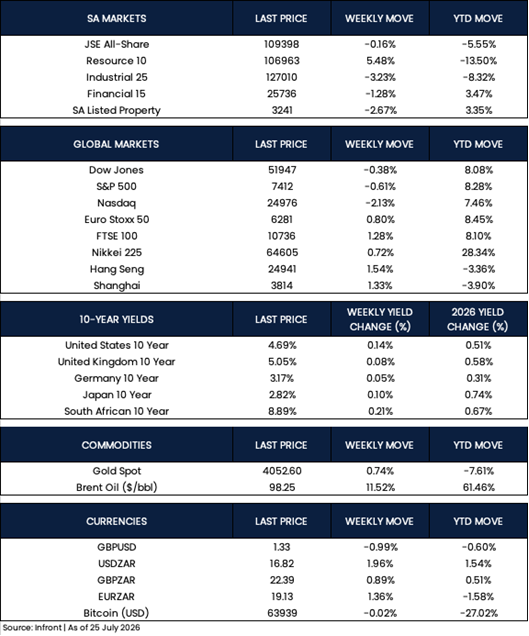
South African markets faced another challenging week. The JSE All Share Index edged 0.16% lower, masking significant divergence beneath the surface. Resource shares rallied 5.48%, benefiting from stronger commodity prices and higher oil prices, while Industrials declined 3.23% and listed property fell 2.67%. The rand weakened 1.96% against the U.S. dollar, while South African 10-year government bond yields rose to 8.89% as investors continued to price in inflation risks.

The week’s key domestic event was the South African Reserve Bank’s decision to leave the repo rate unchanged at 7.00%. The Monetary Policy Committee acknowledged that the economy entered the year with encouraging momentum, but noted that recent developments have significantly clouded the outlook. Although first-quarter growth surprised positively, this was largely driven by exports rather than stronger domestic demand. Since then, consumer confidence has weakened, business sentiment has softened, and higher fuel prices following the renewed Middle East conflict have added further pressure to households and businesses.

Inflation remains above the Bank’s preferred target, with higher fuel costs expected to keep headline inflation above 4% into next year. Encouragingly, food inflation has continued to moderate, helped by favourable harvests and easing supply disruptions, while the rand has remained relatively resilient against the euro, limiting imported inflation. However, services inflation remains elevated across categories such as transport, housing and insurance, and inflation expectations have begun drifting higher among households, businesses and trade unions. These developments reinforce the importance of preventing temporary price shocks from becoming embedded in broader inflation.

Against this backdrop, the MPC voted to keep policy unchanged, with four members favouring a hold and two supporting a further 25 basis point increase. The Bank reiterated that policy remains appropriately restrictive for now and that future decisions will remain entirely data dependent. While its baseline forecast still anticipates interest rate cuts later in the forecast period as inflation gradually returns towards the 3% target, policymakers made it clear that a sustained rise in oil prices or further increases in inflation expectations could require additional tightening. Equally, a more favourable energy environment could allow interest rates to begin easing sooner than currently expected. Ultimately, the SARB emphasised that while monetary policy can anchor inflation, South Africa’s longer-term growth prospects will depend far more on structural reforms, particularly improvements in electricity, logistics, transport infrastructure and local government efficiency.

This week’s market performance served as another reminder that while long-term structural themes such as artificial intelligence continue to underpin global equity markets, shorter-term macroeconomic forces can quickly dominate investor sentiment. For now, oil prices have become the market’s primary focus. Whether the recent spike proves temporary or develops into a more prolonged inflation shock will likely shape both central bank policy and market direction over the coming months.

Chart of the Week:
As always, we appreciate your support and value your trust in LNKD Investment Manager.

Important Information

The information included above as well as individual companies and/or securities mentioned should not be construed as investment advice, a recommendation to buy or sell or an indication of trading intent on behalf of any LNKD Investment Managers product. This material is provided for informational purposes only and is not intended to be investment advice or a recommendation to take any particular investment action. Information contained herein is based upon sources we consider to be reliable; we do not, however, guarantee its accuracy. All charts and tables are shown for illustrative purposes only.

LNKD Investment Managers is an authorised financial services provider (FSP 51257).

Weekly Review: US Inflation Cools, Geopolitical Risk Lingers

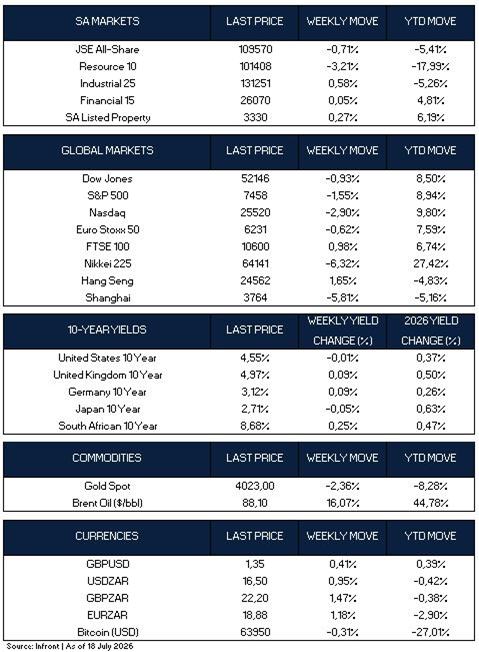
US equities gave back ground this week, reversing the prior week’s large-cap technology leadership. The S&P 500 and Nasdaq Composite bore the brunt of the selling, both down 1.6% and 2.9% respectively over the week while the Dow held up comparatively better, off 0.9%.

Within the S&P 500, information technology and communication services led the decline, as a fresh selloff in semiconductor names weighed on sentiment amid concerns that AI hyperscalers may begin trimming infrastructure capital expenditure, these concerns were further sharpened by recent progress in lower-cost Chinese AI models.Energy was the standout sector, tracking the sharp rise in oil prices as tensions between the US and Iran escalated further.

Earnings season got underway in the US, with several major banks including JPMorgan Chase and Goldman Sachs reporting results ahead of consensus expectations, offering a constructive counterpoint to the broader market weakness.

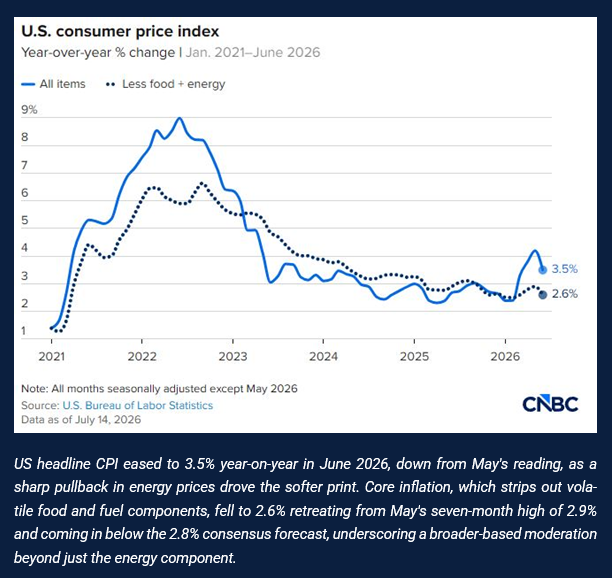
On inflation, the picture was more encouraging than the market’s price action might suggest. June headline CPI came in well below expectations, falling 0.4% month-on-month against a forecast decline of just 0.1%, driven primarily by a sharp drop in energy prices as oil fell from above $90 to roughly $73 a barrel over the course of the month. On an annual basis, headline inflation eased to 3.5% from 4.2%, with core inflation (ex-food and energy) slowing to 2.6% from 2.9%. That relief, however, looks increasingly fragile: fresh US strikes on Iran mid-week sent Brent surging and by Friday crude had extended gains to above $82, its highest level in a month, following reports of Iranian strikes against US-linked targets across Bahrain, Jordan, Kuwait, Oman, Qatar and Syria, and confirmation from US Central Command of a sixth consecutive night of strikes on Iranian military sites.

Consumer inflation expectations have already begun to reflect this with the University of Michigan’s preliminary July survey showed one-year inflation expectations easing to 4.2% from 4.6%, though economists caution the June CPI print may prove short-lived given the renewed conflict.

European markets were similarly unsettled. The STOXX Europe 50 slipped 0.62% as US and Asian technology weakness spread into Friday’s session, with investors weighing corporate earnings against the deteriorating Middle East backdrop and higher oil prices. Eurozone inflation continued to moderate, falling to 2.8% in June from 3.2% in May, the lowest reading since the Iran conflict began though still above the ECB’s 2% target. The UK stood out for different reasons: the FTSE 100, with its comparatively low technology exposure, gained 0.98% on the week, while on the political front Andy Burnham was confirmed as Labour Party leader on Friday and is set to become prime minister on Monday, 20 July.

Asian markets bore the heaviest losses for the week. Japan’s Nikkei 225 fell 6.3% on the week, driven by bearish technology sentiment and mounting doubts over the sustainability of AI-related valuations, compounded by the unfavourable geopolitical backdrop. The yen weakened to around JPY 162.3 against the dollar as rising oil prices stoked concerns over Japan’s terms of trade given its heavy reliance on Middle Eastern energy imports. Chinese equities diverged sharply with the Shanghai Composite off 5.81% on renewed AI and semiconductor-sector selling, while the Hang Seng bucked the trend to gain 1.6% despite sharp Friday losses in technology names. China’s second-quarter GDP growth of 4.3% year-on-year came in below both the 4.5% consensus estimate and the prior quarter’s 5.0% pace, landing below the lower end of Beijing’s 4.5%-5.0% full-year target range, though first-half growth of 4.7% remained within range.

Looking ahead, developments between the US and Iran will remain the dominant swing factor for global risk sentiment and central bank interest rate outlooks following this week’s escalation. The AI trade faces a further test as hyperscalers, chip producers and infrastructure operators report earnings, while the ECB delivers its rate decision and the UK releases inflation, unemployment and retail sales data.

Market Moves of the Week:

The rand came under sustained pressure this week, weakening on Friday as attention turned to next week’s inflation print and monetary policy decision, where the rate call is shaping up to be a genuinely close one. Currency weakness was a theme for most of the week, with escalating Middle East tensions weighing on broader risk sentiment and pushing the rand to its weakest level of the month. The rand ending the week at R16.50/$.

Markets now shift their focus to June consumer inflation data, due Wednesday, for clearer signals on the SARB’s next move. May’s headline inflation print offers a useful reference point: at 4.5% year-on-year, it came in below the 4.7% consensus forecast but still marked a step-up from April’s 4.0% reading. That mixed signal with inflation surprising to the downside relative to expectations yet still trending higher on an annual basis is part of what makes next week’s decision difficult to call, particularly following the SARB’s first rate hike in three years at its previous meeting.

The JSE had a soft week overall, with the JSE All Share Index down 0.7%. Resources bore the brunt of the selling, falling 3.2% on the week and extending their year-to-date decline to 18%. Financials were broadly flat, while industrials and listed property provided the relative bright spots, gaining 0.6% and 0.3% respectively. Bond markets reflected the same cautious tone, with the ten-year government bond yield rising to 8.68% as investors priced in both the uncertain rate outlook and elevated global risk premia.

Chart of the Week:

As always, we appreciate your support and value your trust in LNKD Investment Managers.

Important Information

The information included above as well as individual companies and/or securities mentioned should not be construed as investment advice, a recommendation to buy or sell or an indication of trading intent on behalf of any LNKD Investment Managers product. This material is provided for informational purposes only and is not intended to be investment advice or a recommendation to take any particular investment action. Information contained herein is based upon sources we consider to be reliable; we do not, however, guarantee its accuracy. All charts and tables are shown for illustrative purposes only.

LNKD Investment Managers is an authorised financial services provider (FSP 51257).
Weekly Insights: Geopolitics, AI & Interest Rates Drive Markets

If investors needed a reminder that geopolitics and artificial intelligence remain two of the year’s dominant market drivers, the start of the third quarter provided one. Renewed hostilities between the United States and Iran pushed oil prices higher and briefly unsettled markets, but the equity market reaction was contained. Investors largely treated the escalation as a source of near-term headline risk, while renewed strength in semiconductor and AI shares helped the S&P 500 and Nasdaq recover from earlier weakness.

In the United States, minutes from the Federal Reserve’s June meeting showed that policymakers remain divided over the path for interest rates. A few officials saw a case for raising rates, although they ultimately supported leaving borrowing costs unchanged. Most also favoured removing language that implied an easing bias, reflecting uncertainty around persistent inflation, AI related demand and geopolitical risks.

Economic data remained broadly resilient. The ISM services index eased slightly to 54.0 in June but remained in expansion territory for a 24th consecutive month, while its employment component returned to growth. Initial jobless claims declined to 215,000 and continuing claims rose only modestly, suggesting that the labour market is cooling gradually rather than weakening sharply. Housing remained softer, with existing home sales falling by 2.4% as high prices and borrowing costs continued to constrain affordability.

In Europe, the renewed conflict between the United States and Iran raised concerns that higher energy prices could keep inflation and interest rates elevated. Germany offered some relief as annual inflation slowed to 2.3% in June from 2.6% in May. Other data were generally encouraging, with Dutch household consumption growing at its fastest pace in more than a year, German exports rising unexpectedly and Sweden recording a third consecutive month of economic growth while inflation eased slightly.

In the United Kingdom, politics took centre stage after Andy Burnham secured the support of 322 of Labour’s 403 Members of Parliament in the contest to replace Keir Starmer. Investors will be watching for clarity on his economic priorities, fiscal approach and cabinet appointments. The housing market remained subdued, with both new buyer enquiries and agreed sales still firmly negative as elevated mortgage costs continued to weigh on demand.

In Japan, the ten-year government bond yield ended the week near 2.78%, despite briefly reaching its highest level since 1996. Yields later eased after Finance Minister Satsuki Katayama called on pension funds to increase allocations to domestic assets. Economic data continued to show persistent inflationary pressures, with wholesale prices rising by 7.1% year on year in June. Nominal wages increased by 3.2% in May, but real wage growth slowed to 1.4%, while household spending declined by a smaller than expected 0.4%, suggesting that consumer demand remained relatively resilient.

In China, AI and semiconductor developments supported technology shares early in the week, although some gains were later reversed as investors took profits. Inflation data highlighted the divide between weak consumer demand and rising producer costs, with consumer inflation slowing to 1.0% in June while producer prices rose by 4.1%, the fastest pace in nearly four years. The People’s Bank of China maintained its supportive policy stance and pledged further assistance for domestic demand, technology investment and smaller businesses, but stopped short of announcing broad stimulus.

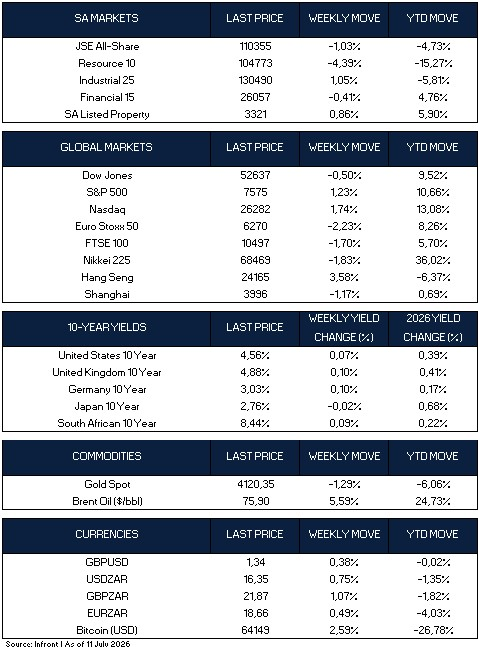
Overall, global markets ended the week on a mixed note. United States equities were broadly positive, with the S&P 500 gaining 1.23% and the Nasdaq rising by 1.74%, while the Dow Jones declined by 0.50%. European markets came under pressure, with the Euro Stoxx 50 and FTSE 100 falling by 2.23% and 1.70% respectively. Asian markets were mixed, as the Hang Seng gained 3.58%, while the Nikkei 225 and Shanghai Composite declined. Government bond yields rose across the United States, United Kingdom and Germany, while Japanese yields edged lower. In commodities, gold fell by 1.29%, while Brent crude oil rose by 5.59% and remains sharply higher year to date. Bitcoin gained 2.59% for the week but remains down by 26.78% in 2026.

Market Moves of the Week:

The outlook for South African interest rates became slightly more supportive after South African Reserve Bank Governor Lesetja Kganyago suggested that the inflationary impact of the Iran conflict may prove temporary, particularly if oil prices remain contained. This marked a softer tone than his comments a week earlier, when he focused more heavily on rising inflation expectations. The July Monetary Policy Committee meeting is therefore now more likely to leave interest rates unchanged rather than increase them by 0.25%, although the decision remains finely balanced.

The inflation outlook has also improved modestly, supported by lower oil prices and a firmer rand. Forecasts point to average inflation of around 3.9% in 2026 and 3.0% in 2027, with inflation potentially falling below 4% in the final quarter of this year. Should these trends continue, the Reserve Bank may be able to resume interest rate cuts in the first quarter of 2027, offering gradual support to household finances, bonds, listed property and other interest rate sensitive assets.

The broader economy remains under pressure. Manufacturing production fell by 4.3% in the year to May, after declining by 2.9% in April, although monthly output improved by 1.1%. Producers continue to face high operating, infrastructure and fuel costs, as well as pressure from United States tariffs. South Africa’s net foreign exchange reserves also declined to $71.34 billion in June from $73.47 billion in May. The improving inflation outlook is encouraging, but weak industrial activity reinforces the need for faster reform and better infrastructure.

Against this backdrop, South African markets ended the week weaker. The JSE All Share Index declined by 1.03%, with the sharpest pressure coming from resource shares, which fell by 4.39% and are now down by 15.27% year to date. Financials declined by 0.41%, while industrials and listed property were the relative bright spots, gaining 1.05% and 0.86% respectively. The rand weakened against major currencies, with the United States dollar ending the week at R16.35, while the South African ten-year government bond yield rose to 8.44%.

Chart of the Week:

As always, we appreciate your support and value your trust in LNKD Investment Managers.

Important Information

The information included above as well as individual companies and/or securities mentioned should not be construed as investment advice, a recommendation to buy or sell or an indication of trading intent on behalf of any LNKD Investment Managers product. This material is provided for informational purposes only and is not intended to be investment advice or a recommendation to take any particular investment action. Information contained herein is based upon sources we consider to be reliable; we do not, however, guarantee its accuracy. All charts and tables are shown for illustrative purposes only.

LNKD Investment Managers is an authorised financial services provider (FSP 51257).
Weekly Insights: U.S. Labour Market Cools

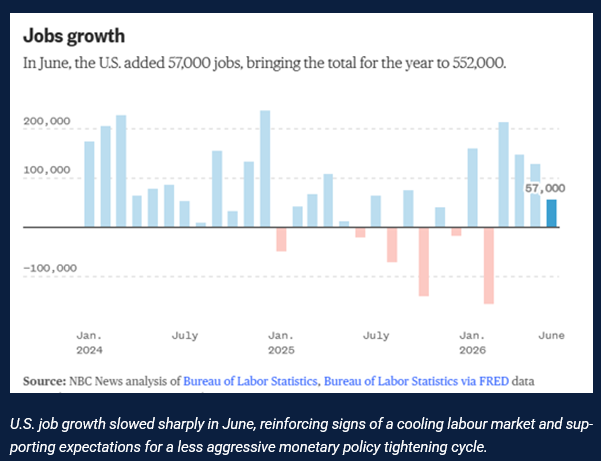
US job growth slowed sharply in June, with nonfarm payrolls increasing by 57,000, well below expectations of 110,000. Payroll figures for April and May were also revised down by a combined 74,000, reinforcing signs of a cooling labour market. Although the unemployment rate edged down to 4.2%, the decline was largely driven by lower labour force participation rather than stronger hiring. The softer labour market led markets to scale back expectations for a September interest rate hike while continuing to price in no change at the Federal Reserve’s July meeting.

Separately, the Institute for Supply Management (ISM) reported that its Manufacturing Purchasing Managers’ Index (PMI) eased to 53.3 in June from 54.0 in May, below market expectations. Despite the decline, the index remained above the 50-point mark for a sixth consecutive month, signalling continued expansion in manufacturing activity. While new orders and production moderated, the sharp decline in the prices paid index pointed to easing cost pressures.

According to Eurostat, annual eurozone inflation eased to 2.8% in June from 3.2% in May, below market expectations. Lower oil prices helped moderate inflationary pressures, while core inflation, which excludes volatile food and energy prices, slowed to 2.4%. Services inflation, a closely watched gauge of underlying inflationary pressures, also eased to 3.2% from 3.5%. Although inflation remains above the ECB’s 2% target, ECB President Christine Lagarde said the central bank no longer needs to respond to inflation with the same force as during the 2022–23 inflation shock.

Meanwhile, the Office for National Statistics (ONS) confirmed that the UK economy expanded by 0.6% in the first quarter of 2026, in line with previous estimates. Growth was driven by the services sector, although real household disposable income declined by 0.8%, highlighting continued pressure on household finances.

The Japanese yen remained volatile, weakening to around JPY 162.5 per U.S. dollar, its weakest level in nearly 40 years, before rebounding on speculation that Japanese authorities could intervene in the foreign exchange market. The yen continues to face pressure from the wide U.S.-Japan interest rate differential, alongside concerns over Japan’s fiscal position and higher energy prices.

China’s June PMI data pointed to continued resilience in the manufacturing sector despite broader economic headwinds. The official Manufacturing PMI rose to 50.3 from 50.0 in May, supported by stronger production, new orders and high-tech manufacturing, while the Non-Manufacturing PMI edged up to 50.2. The private RatingDog Manufacturing PMI eased marginally to 51.7 from 51.8, remaining in expansionary territory. Overall, the data highlighted an uneven recovery, with high-tech manufacturing continuing to outperform more domestic demand-sensitive sectors.

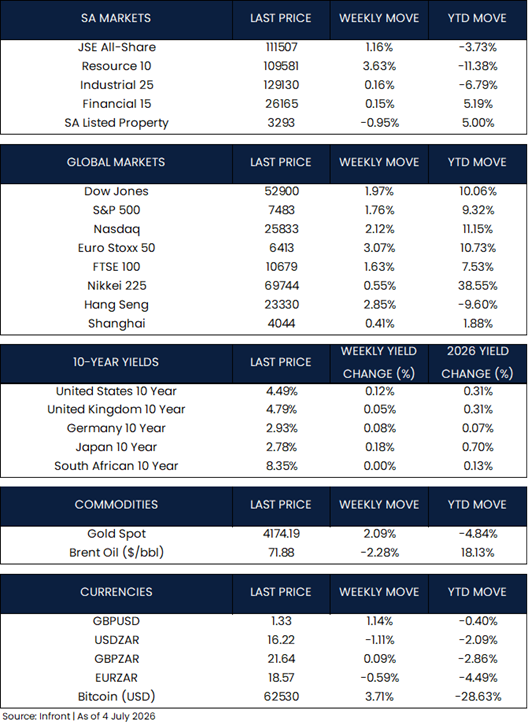
Global equity markets ended the week higher as easing geopolitical tensions, lower oil prices and resilient economic data supported investor sentiment. U.S. equity markets ended the holiday-shortened week higher, with the Nasdaq Composite gaining 2.12%, the Dow Jones Industrial Average rising 1.97%, and the S&P 500 advancing 1.76%.

European equities also posted solid gains, with the STOXX Europe 50 Index rising 3.07% as lower oil prices and easing inflationary pressures supported investor sentiment, while the UK’s FTSE 100 added 1.63%.

In Japan, the Nikkei 225 rose 0.55% over the week, rebounding sharply on Friday after earlier losses driven by profit-taking in technology and semiconductor stocks.

In China, the Shanghai Composite Index gained 0.41%, while Hong Kong’s Hang Seng Index rose 2.85%, supported by better-than-expected manufacturing data and improved short-term liquidity conditions.

Market Moves of the Week:

South Africa’s manufacturing sector lost momentum in June, with the Absa Manufacturing PMI falling to 47.3 from 50.8 in May, signalling a return to contraction. Weaker demand weighed on new orders, although some businesses reported customers delaying purchases in anticipation of lower prices following recent fuel price cuts. In contrast, the S&P Global PMI rose to 50.5 from 49.6, suggesting broader private sector activity remained resilient.

Local equity markets strengthened over the week, mirroring global market trends. The JSE All Share Index rose 1.16%, driven by a strong recovery in resource stocks, which gained 3.63%. Industrials (+0.16%) and financials (+0.15%) were broadly flat, while listed property was the only sector to decline, falling 0.95%. The rand strengthened against the U.S. dollar, ending the week at R16.22/$.

Chart of the Week:

As always, we appreciate your support and value your trust in LNKD Investment Managers. 

Important Information

The information included above as well as individual companies and/or securities mentioned should not be construed as investment advice, a recommendation to buy or sell or an indication of trading intent on behalf of any LNKD Investment Managers product. This material is provided for informational purposes only and is not intended to be investment advice or a recommendation to take any particular investment action. Information contained herein is based upon sources we consider to be reliable; we do not, however, guarantee its accuracy. All charts and tables are shown for illustrative purposes only.

LNKD Investment Managers is an authorised financial services provider (FSP 51257).