

After several data-heavy weeks, markets entered a quieter period, with investor sentiment remaining constructive and volatility falling back towards its 2026 lows despite ongoing geopolitical uncertainty in the Middle East. Inflation remained the key focus, with signs of renewed moderation helping to ease concerns around persistent price pressures and supporting fresh highs in parts of the US equity market. With the Federal Reserve’s next policy meeting only in September, attention now shifts to incoming labour market and inflation data.
US equities ended the week mixed as softer inflation and positive AI-related earnings were balanced against higher oil prices, uncertainty around the Strait of Hormuz and weaker consumer data. Smaller companies outperformed, while the S&P 500 posted a modest gain and the Dow Jones declined. Headline inflation rose 3.4% year on year in July, while core inflation eased to 2.5%, with producer prices also coming in softer than expected. This reduced expectations of another Fed rate increase in September, although policymakers continued to caution that inflation risks remain.
Consumer data was less supportive, with retail sales falling 0.6% in July and consumer sentiment weakening in August. While this points to some moderation in household demand, steady economic growth and supportive earnings expectations continue to underpin markets. Investors will be watching closely to see whether inflation can continue to ease while the US economy maintains its momentum.
European markets were mixed as higher energy prices and shifting sector leadership influenced sentiment. Rising gas and fuel costs added pressure to industrial activity, while extreme heat disrupted French nuclear generation and low water levels on the Rhine affected German logistics. Despite these challenges, eurozone investor confidence returned to positive territory in August. In the UK, second-quarter GDP grew by 0.4%, although industrial activity remained subdued, while persistent inflation concerns kept government bond yields elevated.
Looking ahead, UK labour market and inflation data will be important for the Bank of England. Wage growth is expected to moderate further, but higher energy costs could push headline inflation back towards 2.9%, reinforcing the case for a cautious approach to monetary policy.
Japan was the standout major equity market, with the Nikkei 225 gaining 4.74% and the TOPIX rising 3.00%. Strong technology earnings, semiconductor demand and a weaker yen supported equities, although persistent inflation and currency weakness increased speculation that the Bank of Japan could raise rates again. Producer inflation remained elevated at 7.2% year on year, while the 10-year government bond yield rose to 2.87%.
Chinese markets lost momentum as the week progressed, with the Hang Seng declining 2.15% amid weakness in large technology shares and mixed earnings. Inflationary pressures continued to ease, with consumer inflation slowing to 0.5% and producer inflation to 3.5%. Policy support remained focused on the property sector, with Beijing relaxing homebuying restrictions, while Hong Kong announced plans to broaden the Hang Seng Tech Index to include more AI and robotics companies.
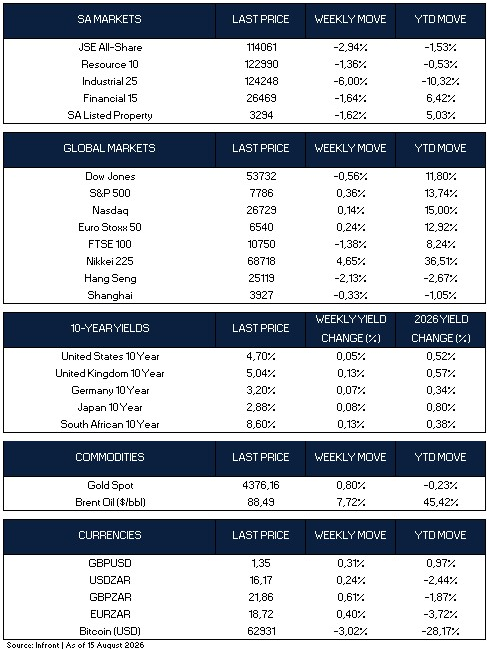
Overall, global markets delivered a mixed performance. The S&P 500 and Nasdaq gained 0.36% and 0.14% respectively, while the Dow Jones fell 0.56%. The Euro Stoxx 50 rose 0.24% and the FTSE 100 declined 1.38%, while Japan significantly outperformed other Asian markets. Government bond yields moved higher across major developed markets. Brent crude oil gained 7.72% for the week and is now 45.42% higher year to date, while gold rose 0.80%. Bitcoin declined 3.02% and remains 28.17% lower in 2026.
Market Moves of the Week:
Turning to South Africa, the labour market weakened in the second quarter, with the official unemployment rate rising to 33.6% from 32.7%, while the number of unemployed people increased to 8.5 million. Employment declined across seven of the ten sectors tracked, highlighting continued pressure on households and the broader economy.
There were, however, some tentative signs of improvement in industrial activity. Manufacturing production increased 0.9% month on month in June, while mining output rose 0.3%. On an annual basis, both sectors remained in contraction, although the pace of decline moderated, with manufacturing down 1.7% and mining down 4.0%.
Elsewhere, the Constitutional Court blocked Shell-led offshore exploration along the Wild Coast, overturning an earlier ruling that had allowed the project to proceed. The decision follows years of legal challenges and again highlights the importance of regulatory certainty and policy execution in attracting long-term investment into South Africa’s energy sector.
Against this backdrop, South African markets had a difficult week. The JSE All Share Index fell by 2.94%, led by a 6.00% decline in industrial shares, taking the sector’s year-to-date loss to 10.32%. Financials and resources also moved lower, declining by 1.64% and 1.36% respectively, while listed property fell by 1.62%. The rand weakened slightly against major currencies, with the US dollar closing the week at R16.17, while the South African 10-year government bond yield increased to 8.60%.
Chart of the Week:
As always, we appreciate your support and value your trust in LNKD Investment Managers.
Important Information
The information included above as well as individual companies and/or securities mentioned should not be construed as investment advice, a recommendation to buy or sell or an indication of trading intent on behalf of any LNKD Investment Managers product. This material is provided for informational purposes only and is not intended to be investment advice or a recommendation to take any particular investment action. Information contained herein is based upon sources we consider to be reliable; we do not, however, guarantee its accuracy. All charts and tables are shown for illustrative purposes only.
LNKD Investment Managers is an authorised financial services provider (FSP 51257).