

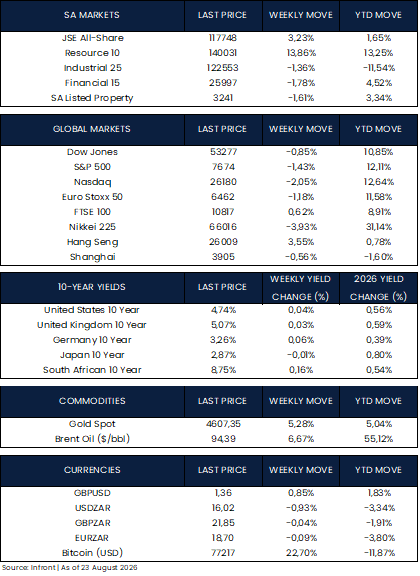
US equities closed the week on a firmer note, with Friday’s session pausing a run of losses after data showed business activity expanding at its fastest pace in more than four years. The S&P 500 added 0.4%, the Nasdaq 100 rose 0.3%, and the Dow gained 518 points on the day. That relief came too late to rescue the week, however, as elevated Treasury yields, renewed US-Iran tensions, higher oil prices and weakness in semiconductor and AI-related names weighed broadly on sentiment. Mixed retail earnings added to the cautious tone. Over the week the Nasdaq Composite shed 2.05% and the S&P 500 lost 1.43%, while the Dow held up comparatively well, down 0.85%.
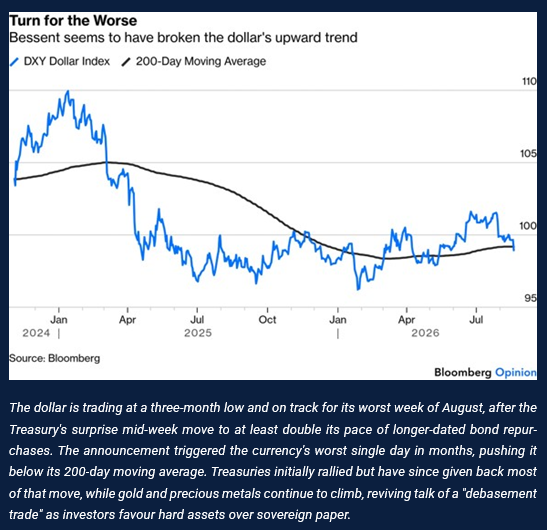
Fixed income remained the dominant story. Long-term Treasury yields pushed higher early in the week, with the 30-year touching its highest level since 2007, as investors grappled with a deteriorating US fiscal outlook and heavy government and corporate issuance. Rising oil prices on the back of renewed US-Iran tensions added a further inflationary layer. The Treasury’s mid-week announcement that it would at least double the size of its planned long-term debt buybacks sparked a rally that pulled 30-year yields down by roughly 8 basis points and weighed on the dollar, but much of that move unwound later in the week as investors questioned whether the buyback programme goes far enough to offset the structural pressures on long-dated bonds.
Minutes from the Fed’s July meeting showed participants generally expecting inflation to moderate through the remainder of the year, though they flagged that the outlook remains highly uncertain with risks skewed to the upside, and that further policy tightening would likely be needed should inflation fail to decline.
On trade, the US imposed 50% tariffs on a tranche of Canadian goods just after midnight on Saturday, after the two countries failed to reach a deal. The measures cover around $20 billion of exports, including niche categories such as wooden ice hockey sticks which represents just over 5% of Canada’s exports to the US, and are unlikely to prove a material economic shock to either side.
European markets were not spared the global bond sell-off, with the STOXX Europe 50 down 1.18% for the week as investors weighed inflationary pressure and uncertainty over a lasting US-Iran peace deal. The UK’s FTSE 100 bucked the trend, climbing 0.62%, even as labour market data disappointed: payrolled employment fell 13,000 in July, a sixth straight monthly decline, while unemployment held at 4.9%, slightly above the 4.8% expected.
Japan saw the sharpest regional drawdown, with the Nikkei 225 falling 3.93% as renewed Middle East risk, higher oil prices and rising yields drove a broad risk-off move, hitting technology and semiconductor names particularly hard. The yen stayed historically weak around JPY 159 to the dollar. Second-quarter GDP growth disappointed at an annualised 1.1%, well short of the 2.0% consensus and down from a revised 1.9% in Q1, with weak capital expenditure and softer consumer spending offsetting resilient exports. Inflation data added to the case for a near-term Bank of Japan hike, with core CPI up 1.8% year-on-year in July, in line with expectations and up from 1.6% in June.
Chinese equities were mixed, with Hong Kong outperforming the mainland. July activity data showed a broad-based slowdown: industrial output grew 4.5% year-on-year, down from 5.3% in June and below expectations despite continued strength in high-tech production, while retail sales growth slowed to 0.6% from 1%, underscoring persistently soft domestic demand. The Shanghai Composite ended the week 0.56% lower in local currency terms.
In commodities, Brent crude held little changed near $94 a barrel on Friday as markets weighed signs that Iran may be seeking a resolution to the conflict, even as this followed a more than 6% rise in oil prices for a second consecutive week. Iranian President Masoud Pezeshkian signalled a preference for ending the war from a position of strength, framing the existing memorandum with Washington as an Iranian win, comments that offered some relief after US Treasury Secretary Scott Bessent warned of the toughest sanctions yet on Tehran. Gold extended its rally to around 5% for the week, climbing above $4,600 an ounce, its highest level since mid-May, supported by renewed concern over US fiscal sustainability following the Treasury’s expanded long-dated debt purchases, which pushed both yields and the dollar lower.
In the week ahead, interest rate and the sovereign yield outlook will remain front and centre as markets weigh elevated energy prices, widening deficits and heavy corporate credit issuance. The Fed’s Jackson Hole Symposium will be the focal point, with FOMC speeches likely to set the tone on the path for monetary policy and balance sheet duration. Elsewhere, the ECB releases its meeting accounts, Germany publishes consumer and business confidence data, and Spain and France report CPI prints, while Japan releases consumer confidence and unemployment data.
Market Moves of the Week:
South African inflation surprised to the downside, easing to 4.3% year-on-year in July from 5.0% in June and below the 4.5% consensus in a Reuters poll. Statistics South Africa attributed the slowdown to softer food inflation, smaller municipal tariff increases and a sharp pullback in fuel costs, with food and non-alcoholic beverage inflation falling to its lowest level in more than 16 years at 0.9%, driven by cereals and meat, while petrol and diesel prices fell 7.1% and 11.7% respectively between June and July. The reading, still comfortably above the SARB’s 3% target, reinforces the case for the central bank to hold rates steady at its next MPC on 23 September, having already surprised the market by keeping rates unchanged in July on the view that policy is sufficiently restrictive to return inflation to target within two years. That said, analysts caution the relief may be short-lived, with renewed US-Iran hostilities having since pushed global oil prices back up; forward rate agreements are currently pricing a 70% probability of a 25 basis point hike at the September meeting rather than a cut.
Local markets had a strong week. The rand firmed through R16.00 to the dollar for the first time since February, trading at R15.99 intraday on Friday, its best level since before the outbreak of the Iran conflict, supported by a weaker dollar following the US Treasury’s expanded long-bond buyback programme, rising gold prices, an improving domestic fiscal backdrop and the currency’s continued appeal in the dollar-funded carry trade given low volatility.
The JSE All Share Index rallied over 3% for the week led by a strong showing from resource counters and precious metals miners in particular as gold extended its rally to a third consecutive weekly gain.
Chart of the Week:
The information included above as well as individual companies and/or securities mentioned should not be construed as investment advice, a recommendation to buy or sell or an indication of trading intent on behalf of any LNKD Investment Managers product. This material is provided for informational purposes only and is not intended to be investment advice or a recommendation to take any particular investment action. Information contained herein is based upon sources we consider to be reliable; we do not, however, guarantee its accuracy. All charts and tables are shown for illustrative purposes only.
LNKD Investment Managers is an authorised financial services provider (FSP 51257).