

US equities gave back ground this week, reversing the prior week’s large-cap technology leadership. The S&P 500 and Nasdaq Composite bore the brunt of the selling, both down 1.6% and 2.9% respectively over the week while the Dow held up comparatively better, off 0.9%.
Within the S&P 500, information technology and communication services led the decline, as a fresh selloff in semiconductor names weighed on sentiment amid concerns that AI hyperscalers may begin trimming infrastructure capital expenditure, these concerns were further sharpened by recent progress in lower-cost Chinese AI models.Energy was the standout sector, tracking the sharp rise in oil prices as tensions between the US and Iran escalated further.
Earnings season got underway in the US, with several major banks including JPMorgan Chase and Goldman Sachs reporting results ahead of consensus expectations, offering a constructive counterpoint to the broader market weakness.
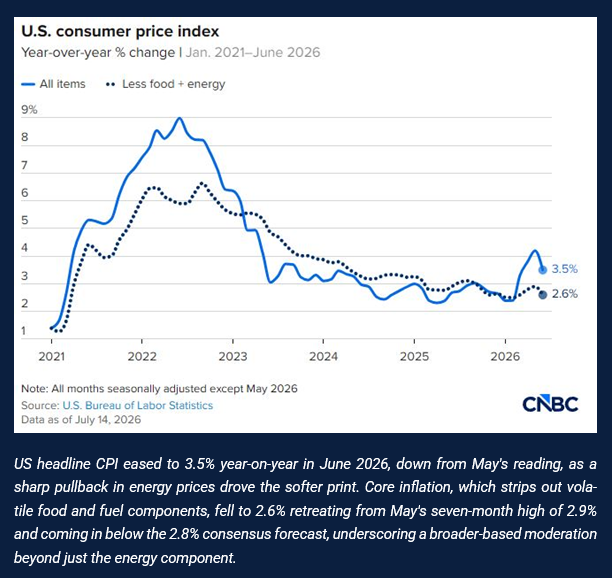
On inflation, the picture was more encouraging than the market’s price action might suggest. June headline CPI came in well below expectations, falling 0.4% month-on-month against a forecast decline of just 0.1%, driven primarily by a sharp drop in energy prices as oil fell from above $90 to roughly $73 a barrel over the course of the month. On an annual basis, headline inflation eased to 3.5% from 4.2%, with core inflation (ex-food and energy) slowing to 2.6% from 2.9%. That relief, however, looks increasingly fragile: fresh US strikes on Iran mid-week sent Brent surging and by Friday crude had extended gains to above $82, its highest level in a month, following reports of Iranian strikes against US-linked targets across Bahrain, Jordan, Kuwait, Oman, Qatar and Syria, and confirmation from US Central Command of a sixth consecutive night of strikes on Iranian military sites.
Consumer inflation expectations have already begun to reflect this with the University of Michigan’s preliminary July survey showed one-year inflation expectations easing to 4.2% from 4.6%, though economists caution the June CPI print may prove short-lived given the renewed conflict.
European markets were similarly unsettled. The STOXX Europe 50 slipped 0.62% as US and Asian technology weakness spread into Friday’s session, with investors weighing corporate earnings against the deteriorating Middle East backdrop and higher oil prices. Eurozone inflation continued to moderate, falling to 2.8% in June from 3.2% in May, the lowest reading since the Iran conflict began though still above the ECB’s 2% target. The UK stood out for different reasons: the FTSE 100, with its comparatively low technology exposure, gained 0.98% on the week, while on the political front Andy Burnham was confirmed as Labour Party leader on Friday and is set to become prime minister on Monday, 20 July.
Asian markets bore the heaviest losses for the week. Japan’s Nikkei 225 fell 6.3% on the week, driven by bearish technology sentiment and mounting doubts over the sustainability of AI-related valuations, compounded by the unfavourable geopolitical backdrop. The yen weakened to around JPY 162.3 against the dollar as rising oil prices stoked concerns over Japan’s terms of trade given its heavy reliance on Middle Eastern energy imports. Chinese equities diverged sharply with the Shanghai Composite off 5.81% on renewed AI and semiconductor-sector selling, while the Hang Seng bucked the trend to gain 1.6% despite sharp Friday losses in technology names. China’s second-quarter GDP growth of 4.3% year-on-year came in below both the 4.5% consensus estimate and the prior quarter’s 5.0% pace, landing below the lower end of Beijing’s 4.5%-5.0% full-year target range, though first-half growth of 4.7% remained within range.
Looking ahead, developments between the US and Iran will remain the dominant swing factor for global risk sentiment and central bank interest rate outlooks following this week’s escalation. The AI trade faces a further test as hyperscalers, chip producers and infrastructure operators report earnings, while the ECB delivers its rate decision and the UK releases inflation, unemployment and retail sales data.
Market Moves of the Week:
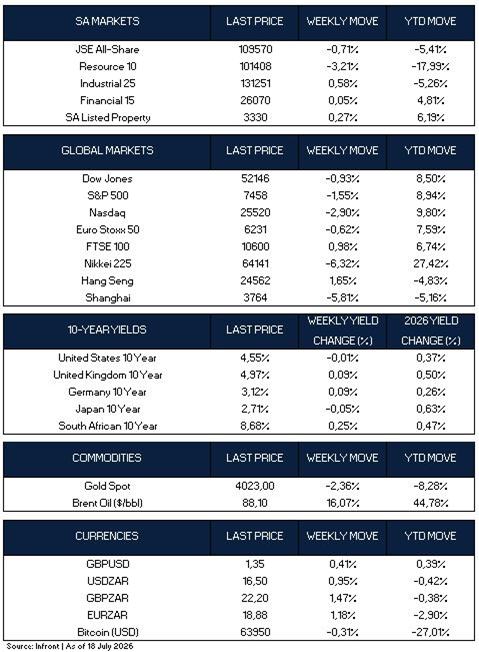
The rand came under sustained pressure this week, weakening on Friday as attention turned to next week’s inflation print and monetary policy decision, where the rate call is shaping up to be a genuinely close one. Currency weakness was a theme for most of the week, with escalating Middle East tensions weighing on broader risk sentiment and pushing the rand to its weakest level of the month. The rand ending the week at R16.50/$.
Markets now shift their focus to June consumer inflation data, due Wednesday, for clearer signals on the SARB’s next move. May’s headline inflation print offers a useful reference point: at 4.5% year-on-year, it came in below the 4.7% consensus forecast but still marked a step-up from April’s 4.0% reading. That mixed signal with inflation surprising to the downside relative to expectations yet still trending higher on an annual basis is part of what makes next week’s decision difficult to call, particularly following the SARB’s first rate hike in three years at its previous meeting.
The JSE had a soft week overall, with the JSE All Share Index down 0.7%. Resources bore the brunt of the selling, falling 3.2% on the week and extending their year-to-date decline to 18%. Financials were broadly flat, while industrials and listed property provided the relative bright spots, gaining 0.6% and 0.3% respectively. Bond markets reflected the same cautious tone, with the ten-year government bond yield rising to 8.68% as investors priced in both the uncertain rate outlook and elevated global risk premia.
Chart of the Week:
As always, we appreciate your support and value your trust in LNKD Investment Managers.
Important Information
The information included above as well as individual companies and/or securities mentioned should not be construed as investment advice, a recommendation to buy or sell or an indication of trading intent on behalf of any LNKD Investment Managers product. This material is provided for informational purposes only and is not intended to be investment advice or a recommendation to take any particular investment action. Information contained herein is based upon sources we consider to be reliable; we do not, however, guarantee its accuracy. All charts and tables are shown for illustrative purposes only.
LNKD Investment Managers is an authorised financial services provider (FSP 51257).