


US markets ended a volatile week lower as investors assessed the midterm election results, renewed concerns over artificial intelligence (AI) investment and stronger economic data. The S&P 500 declined 2.68%, while the technology-heavy Nasdaq lost 3.37% and the Dow Jones fell 0.94%. Democrats’ gains, which gave the party control of both chambers of Congress, initially supported hopes of easing geopolitical tensions. However, attention soon shifted to the possibility of tighter technology regulation and the implications for corporate earnings, contributing to a sharp sell-off before shares partially recovered on Friday.
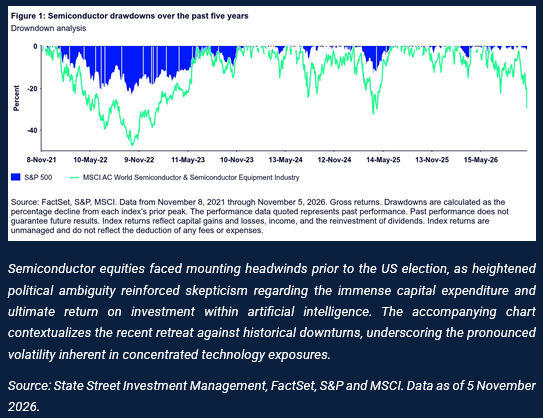
The result changes the balance of power in Washington, giving Democrats greater influence over spending, legislation and scrutiny of the administration. For markets, a divided government could make large policy changes harder to deliver, while increasing the prospect of disputes over fiscal priorities. AI infrastructure emerged as a particular flashpoint, with concerns about electricity demand, water usage and the impact of data centres on local communities. Investors now face questions about both the commercial returns on AI spending and the political obstacles to delivering it. Disappointing forecasts from major semiconductor companies added to concerns about whether substantial spending on AI infrastructure will deliver sufficient profits. Away from technology, economic conditions remained relatively firm. October’s employment report exceeded expectations, unemployment edged lower and manufacturing activity continued to expand. The Federal Reserve held interest rates steady at its latest meeting, with persistent inflation leaving further increases possible. US government bonds benefited from demand for safer assets, with the 10-year Treasury yield ending the week at 4.87%.
UK and European markets delivered mixed results, although continental shares held up better than their US counterparts. The Euro Stoxx 50 gained 0.64%, while the FTSE 100 declined 0.52%. Europe’s lower exposure to large technology companies provided some protection from the AI-related sell-off, while banking shares attracted interest. Brent crude fell 12.99% to $97.69 a barrel as hopes of renewed diplomacy with Iran reduced concerns about further disruption to energy supplies. The decline offered some relief to businesses and consumers facing elevated energy costs, although it weighed on energy producers. Inflation nevertheless remained a challenge for policymakers. Eurozone inflation accelerated as earlier energy price increases continued to feed through, while business surveys and weaker retail sales pointed to slowing economic momentum. In the UK, the Bank of England raised interest rates and indicated that another increase could follow if price pressures persist. Services activity improved, but subdued retail footfall suggested households remained cautious. These contrasting signals leave central banks balancing the need to contain inflation against the risk of weakening growth.
China and Japan moved sharply in opposite directions. Hong Kong’s Hang Seng gained 5.03% and the Shanghai Composite rose 1.39%, supported by fresh measures from Beijing to encourage equity purchases and share buybacks. Investors returned to internet and technology shares following October’s weakness, although the global technology sell-off tempered the recovery towards the end of the week. Economic surveys remained mixed, suggesting that policy support has helped market sentiment while a broader improvement in business conditions remains uneven. Japan’s Nikkei 225 fell 8.99% as semiconductor and AI-related companies came under heavy selling pressure. Concerns about investment spending, valuations and potential US regulatory changes weighed on a market with significant exposure to the technology supply chain. Japanese government bonds benefited as investors sought safer assets. Stronger wage growth, however, continued to support the case for further Bank of Japan interest rate increases, complicating the policy outlook amid the market turbulence.
Market Moves of the Week:
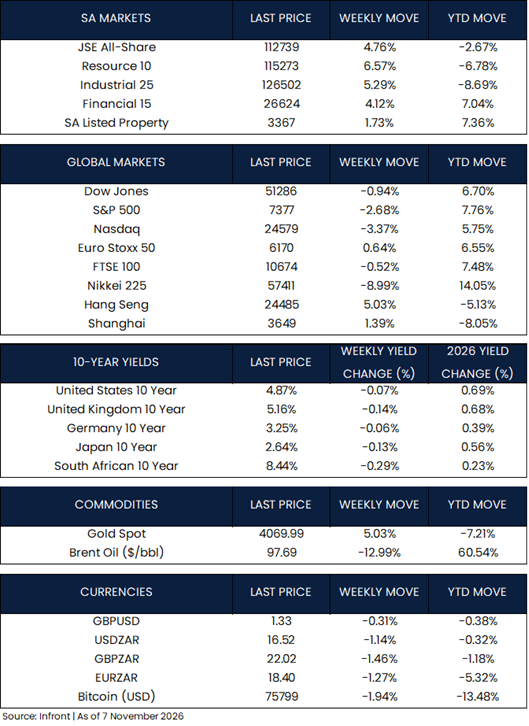
South African markets enjoyed a strong week as investors assessed provisional municipal election results and developments abroad. The JSE All-Share gained 4.76%, led by resources, which rose 6.57%, while industrials advanced 5.29% and financials added 4.12%. Listed property gained 1.73%. Gold climbed 5.03%, providing a supportive backdrop for precious metals producers. The rand also strengthened, with the dollar falling 1.14% against the local currency to R16.52, while the South African 10-year government bond yield declined by 29 basis points to 8.44%.
Politically, the ANC faced a substantial setback, receiving around 31.8% of the national vote with more than 80% of ballots counted, almost 14 percentage points below its 2021 municipal election result. The DA led in Gauteng’s major metros, while MK challenged the ANC’s position in KwaZulu-Natal. With final results still outstanding, attention turned to coalition negotiations and the ability of incoming councils to address deteriorating infrastructure and service delivery.
Johannesburg illustrates the stakes: the city has experienced ten changes of mayor in a decade and faces a reported R220 billion infrastructure spending backlog. Early results put the DA ahead, but forming a workable majority could prove difficult given tensions between potential coalition partners. These elections determine municipal leadership rather than the national government, yet their economic relevance is substantial. Reliable water, electricity, roads and refuse collection directly affect businesses and households, making the durability of coalition agreements particularly important. For investors, the longer-term significance will depend on whether these political shifts produce more stable municipal leadership and measurable improvements in local government. The election results signal a clear demand for change, but the next test will be whether parties can translate that mandate into functioning councils and better services.
Chart of the Week:
As always, we appreciate your support and value your trust in LNKD Investment Managers.
The information included above as well as individual companies and/or securities mentioned should not be construed as investment advice, a recommendation to buy or sell or an indication of trading intent on behalf of any LNKD Investment Managers product. This material is provided for informational purposes only and is not intended to be investment advice or a recommendation to take any particular investment action. Information contained herein is based upon sources we consider to be reliable; we do not, however, guarantee its accuracy. All charts and tables are shown for illustrative purposes only.
LNKD Investment Managers is an authorised financial services provider (FSP 51257).