


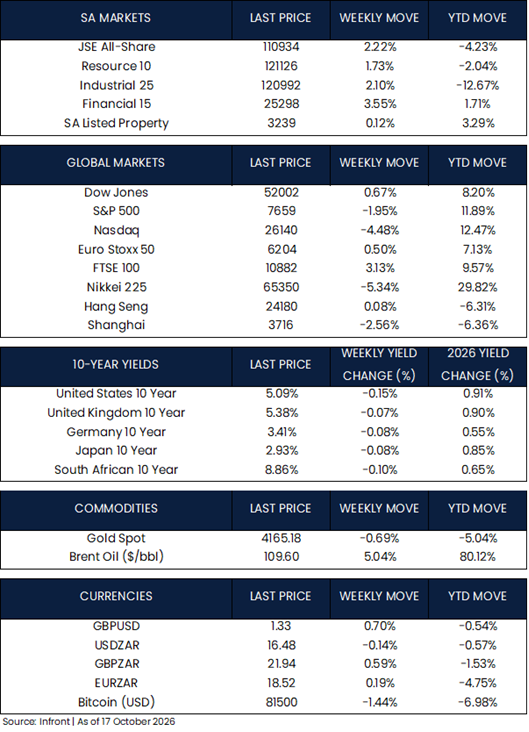
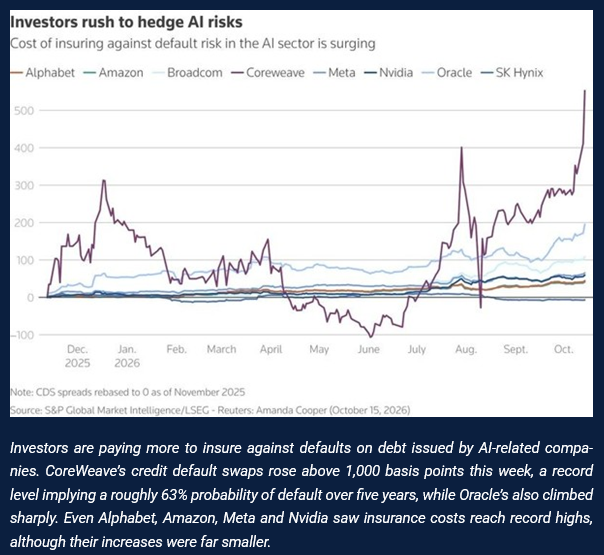
The AI trade ran into a harder question this week: not whether the technology will deliver, but who is financing the build-out and at what price. Investors turned their attention to the scale of borrowing behind the expansion, and the scrutiny quickly spilled into credit markets, where the cost of insuring debt issued by several AI-linked companies rose sharply. The Nasdaq fell 4.48% and the S&P 500 gave up 1.95%, while the more value-orientated Dow managed a 0.67% gain. The rotation out of technology found a home in government bonds, pulling the US ten-year yield down 15 basis points to 5.09%.
The IMF raised its global growth forecast for 2026 to 3.1%, from 3.0% in July, supported by AI investment and resilient trade, while leaving its 2027 forecast unchanged at 3.4%. However, the outlook remains cautious. Although the global economy has so far weathered the energy shock, a prolonged supply disruption and a potential reassessment of AI expectations remain key downside risks.
On the energy front, supply fears intensified after an attack on Saudi Aramco’s headquarters and threats of further strikes on Saudi oil facilities. Hopes of relief from the Russia–Ukraine conflict also faded as the energy ceasefire brokered by Trump collapsed, with Ukraine resuming strikes on Russian energy infrastructure in response to continued Russian attacks on its own facilities. Brent crude closed the week 5.04% higher at $109.60 a barrel, despite US efforts to bring additional Russian diesel onto global markets.
Higher energy costs remained central to the US inflation picture. Consumer prices rose 0.6% in September, lifting annual inflation to 3.7%. Core prices rose a more modest 0.3% over the month and 2.6% over the year. The bigger warning came from producer prices, which jumped 1.3% as increases spread beyond energy into other goods and services. That pipeline pressure keeps the prospect of a further Federal Reserve hike firmly on the table.
Economic data presented a mixed picture, with headline figures masking underlying weakness. Retail sales increased by 0.8%, although underlying sales grew by just 0.1%. Industrial production was more encouraging, rising 0.7%, while manufacturing output increased by 0.3%.
Earnings season opened with a mixed showing from the major US banks. Loan growth held up and consumers kept spending, but softer investment-banking and fixed-income trading activity weighed on parts of the sector. JPMorgan reported its first earnings miss since late 2023 and Bank of America also disappointed, while Goldman Sachs and Citigroup beat expectations.
European markets finished higher, with the Euro Stoxx 50 gaining 0.50% and the FTSE 100 advancing 3.13%. The economic backdrop was less encouraging, with higher energy prices lifting inflation and industrial activity weakening.
Final figures put eurozone inflation at 3.8% in September, up from 3.2% in August, while core inflation edged up to 2.5%. Industrial production fell 0.5% in August, its third consecutive monthly decline.
In the UK, the economy grew 0.1% in August, confounding expectations of a modest contraction. Manufacturing, led by pharmaceuticals, did the heavy lifting while services were flat. Bank of England chief economist Huw Pill pushed back against market pricing of four rate increases over the coming year, though he cautioned that inflation could prove stubborn.
In Japan, wholesale prices rose 6.8% from a year earlier in September, slowing from 7.6% in August. Even so, Bank of Japan Governor Kazuo Ueda said the central bank would keep raising interest rates, warning that underlying inflation could overshoot its 2% target. Core machinery orders, a leading indicator of business investment, rebounded 5.2% in August after falling 3.7% in July. That did little to shield equities, with the Nikkei 225 falling 5.34%.
The retreat from the AI trade hit Asian technology names hardest. South Korea’s Kospi suffered its worst week since October 2008, falling 14.46%, with an 8% slide on Thursday triggering a 20-minute trading halt.
China’s data told a two-sided story. September exports surged 36.3% year on year in dollar terms and imports rose 31.0%, pushing the monthly trade surplus to a record $133.5 billion. Higher energy and commodity costs drove producer price inflation up to 5.0% from 3.8% in August, yet consumer inflation crept up to only 0.9%, held back by weak domestic demand. The Shanghai Composite lost 2.56%, while Hong Kong’s Hang Seng was broadly flat, edging up 0.08%.
Market Moves of the Week:
In South Africa, attention turned to next week’s Medium-Term Budget Policy Statement, as stronger mining tax receipts raised expectations of improved government finances. Bank of America estimates that 2026/27 revenue could exceed February’s budget projections by R70 billion, driven largely by gold and precious-metals producers. The bank nevertheless expects much of the extra revenue to be spent, so the deficit would narrow only slightly, to 3.5% of GDP against Treasury’s 3.7% target. Morgan Stanley anticipates three months of renewed fuel-tax relief in the budget, which it estimates would reduce its inflation forecast by half a percentage point.
Mining activity remained under pressure, with output falling 12.7% year-on-year in August. The decline was led by a sharp 22.5% contraction in platinum-group metals, while coal and iron ore production also recorded significant declines.
Local markets ended the week on a positive note, with the JSE All-Share rising 2.22%, led by a 3.55% gain in financial shares. The rand strengthened 0.14% to R16.48 against the US dollar, while the 10-year government bond yield declined by 10 basis points to 8.86%, reflecting improved sentiment across local asset classes.
Chart of the Week:
As always, we appreciate your support and value your trust in LNKD Investment Managers.
Important Information
The information included above as well as individual companies and/or securities mentioned should not be construed as investment advice, a recommendation to buy or sell or an indication of trading intent on behalf of any LNKD Investment Managers product. This material is provided for informational purposes only and is not intended to be investment advice or a recommendation to take any particular investment action. Information contained herein is based upon sources we consider to be reliable; we do not, however, guarantee its accuracy. All charts and tables are shown for illustrative purposes only.
LNKD Investment Managers is an authorised financial services provider (FSP 51257).