


Global markets ended the week modestly higher as strong NVIDIA earnings renewed enthusiasm around artificial intelligence, while falling oil prices eased some inflation concerns. These gains were tempered by Federal Reserve Chair Kevin Warsh’s Jackson Hole address, which reaffirmed the Fed’s commitment to its inflation target and kept further tightening on the table.
South African assets also performed relatively well. Gains in financial, industrial and property shares offset weakness in resources, while the rand weakened against the dollar but remained stronger for the year.
US equities advanced, led by technology shares. The Nasdaq gained 0.85%, outperforming the Dow Jones at 0.53% and the S&P 500 at 0.49%. Year to date, the Nasdaq has returned 13.60%, compared with 12.65% for the S&P 500 and 11.44% for the Dow Jones.
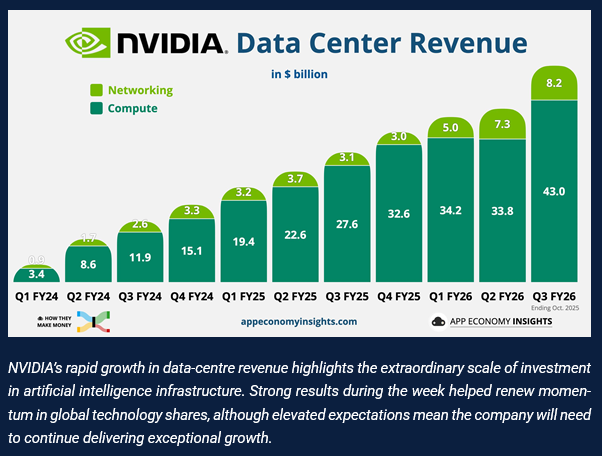
NVIDIA again drove sentiment after reporting strong quarterly results and issuing better-than-expected guidance. Continued investment in artificial intelligence infrastructure supported its shares and the broader technology sector.
The positive corporate backdrop was balanced by a cautious message from the Federal Reserve. Warsh described the economy as resilient, reiterated the Fed’s 2% inflation objective and said further tightening could be required unless inflation moved convincingly towards target. He also advocated less explicit forward guidance to preserve policy flexibility.
Headline PCE inflation rose 3.7% year on year, while core inflation increased 3.3%, in line with expectations. Durable goods orders and employment data remained supportive, although consumer confidence weakened. The US 10-year Treasury yield declined two basis points to 4.72%, even as shorter-dated yields rose following Warsh’s speech, resulting in a flatter yield curve.
European markets delivered modest gains as improving economic sentiment and lower oil prices offset uneven inflation and consumer data. The Euro Stoxx 50 rose 0.36%, taking its year-to-date return to 11.99%, while the FTSE 100 gained 0.07% and is 8.99% higher in 2026.
Eurozone economic sentiment improved for a fourth consecutive month, while Germany’s growth data and business confidence exceeded expectations. This strengthened hopes that Europe’s largest economy may be emerging from its prolonged stagnation.
Conditions were weaker elsewhere. France’s economy stagnated while inflation accelerated, and Spain also reported a sharp rise in headline inflation. In the UK, retail-sector data pointed to continued weakness in consumer demand. The UK 10-year government bond yield was unchanged at 5.07%, while the German 10-year yield rose two basis points to 3.27%.
Asian markets diverged. The Nikkei 225 gained 0.58%, extending its year-to-date return to 31.90%, as lower oil prices and NVIDIA’s results supported Japanese technology and semiconductor shares.
Expectations of further Bank of Japan tightening remained elevated. The Japanese 10-year government bond yield rose five basis points to 2.93%, as inflation data strengthened the case for another rate increase.
Chinese markets were mixed. The Shanghai Composite rose 1.20%, although it remains 0.42% lower for the year, while the Hang Seng declined 1.64% and is down 0.87% year to date. Mainland technology shares benefited from enthusiasm around AI, while Hong Kong was pressured by Alibaba’s large equity placement and concerns about the returns companies may generate from heavy infrastructure spending. Industrial profit data continued to show an uneven recovery, with technology-related industries outperforming sectors more exposed to domestic demand.
Market Moves of the Week:
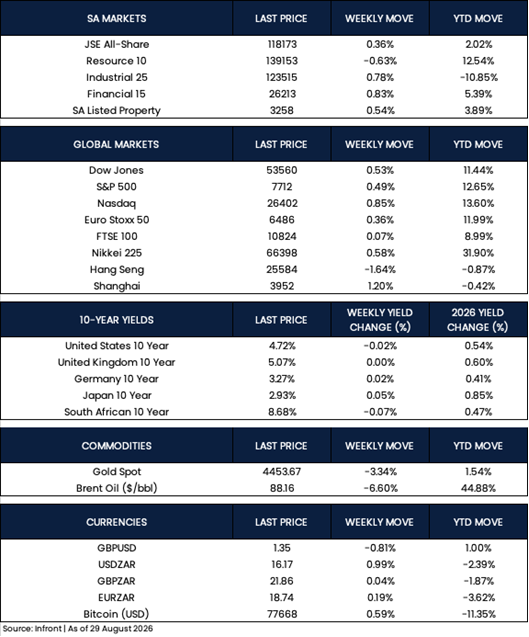
South African equities advanced, with the JSE All-Share Index rising 0.36% and moving 2.02% higher year to date.
The Financial 15 gained 0.83%, the Industrial 25 rose 0.78%, and listed property added 0.54%. Resources underperformed, with the Resource 10 declining 0.63%, although it remains the strongest domestic sector this year with a gain of 12.54%.
Commodity prices weakened. Gold fell 3.34% to approximately $4,454 per ounce, while Brent crude declined 6.60% to $88.16 per barrel. Despite the weekly fall, Brent remains 44.88% higher in 2026, keeping energy prices an important inflation risk.
The rand weakened over the week, with the US dollar rising 0.99% to R16.17. Nevertheless, the rand remains approximately 2.39% stronger against the dollar year to date. The pound fell 0.81% against the dollar, while the euro gained 0.19% against the rand.
Domestic bonds performed well, with the South African 10-year government bond yield declining seven basis points to 8.68%. Investors remained focused on National Treasury’s July budget figures for further indications of the country’s fiscal position.
Chart of the Week:
As always, we appreciate your support and value your trust in LNKD Investment Managers.
The information included above as well as individual companies and/or securities mentioned should not be construed as investment advice, a recommendation to buy or sell or an indication of trading intent on behalf of any LNKD Investment Managers product. This material is provided for informational purposes only and is not intended to be investment advice or a recommendation to take any particular investment action. Information contained herein is based upon sources we consider to be reliable; we do not, however, guarantee its accuracy. All charts and tables are shown for illustrative purposes only.
LNKD Investment Managers is an authorised financial services provider (FSP 51257).