


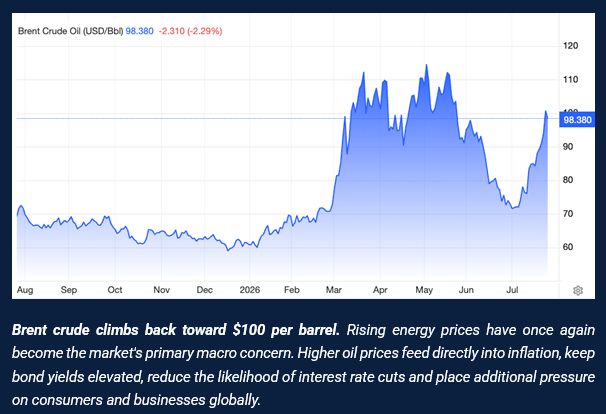
Global markets took a more cautious tone this week as investors navigated renewed geopolitical tensions in the Middle East, rising oil prices, and growing scrutiny over the enormous levels of investment flowing into artificial intelligence. While the long-term outlook for AI remains compelling, investors began questioning how quickly companies will be able to generate meaningful returns from the billions being committed to new infrastructure. This weighed heavily on technology stocks and pushed the Nasdaq down 2.13% for the week, while the S&P 500 declined 0.61% and the Dow Jones Industrial Average slipped 0.38%. Despite the softer week, U.S. equities continue to deliver solid gains for the year, with the S&P 500 up 8.28% and the Nasdaq 7.46% year-to-date. Economic data from the United States remained encouraging. Business activity strengthened during July as the services sector accelerated, while manufacturing continued to expand despite moderating slightly. Labour market conditions also remained exceptionally resilient, with unemployment claims falling to their lowest level in decades. However, the escalation in Middle East tensions has begun feeding into the global inflation picture through higher energy prices and supply chain disruptions. Brent crude oil surged 11.52% over the week to $98.25 per barrel, helping push U.S. Treasury yields higher as investors reassessed the likelihood that the Federal Reserve may need to keep interest rates elevated for longer. Gold also continued to benefit from increased demand for defensive assets, rising 0.74% during the week.
European markets proved more resilient. The Euro Stoxx 50 advanced 0.80%, while the FTSE 100 gained 1.28%, supported by generally constructive corporate earnings and improving economic activity. Manufacturing and services surveys both indicated that business activity across the eurozone continues to recover gradually. The European Central Bank left interest rates unchanged as expected but acknowledged that rising energy prices present renewed inflation risks, leaving the possibility of further policy tightening should inflation remain persistent. In the United Kingdom, stronger-than-expected retail sales and a return to expansion in the services sector suggested that economic momentum has stabilised after a softer start to the year.
Asian markets also delivered positive returns despite heightened global uncertainty. Japan’s Nikkei 225 gained 0.72% as investors continued to price in the prospect of further monetary policy normalisation from the Bank of Japan, supported by gradually strengthening inflation. In China, the Shanghai Composite rose 1.33% while Hong Kong’s Hang Seng Index gained 1.54%. Investor confidence was supported by continued policy measures aimed at stabilising financial markets, including increased state-backed investment into domestic equities and additional liquidity support from the People’s Bank of China. Although technology shares experienced some volatility alongside global AI-related concerns, authorities continue to favour targeted fiscal support rather than broad-based stimulus.
Market Moves of the Week:
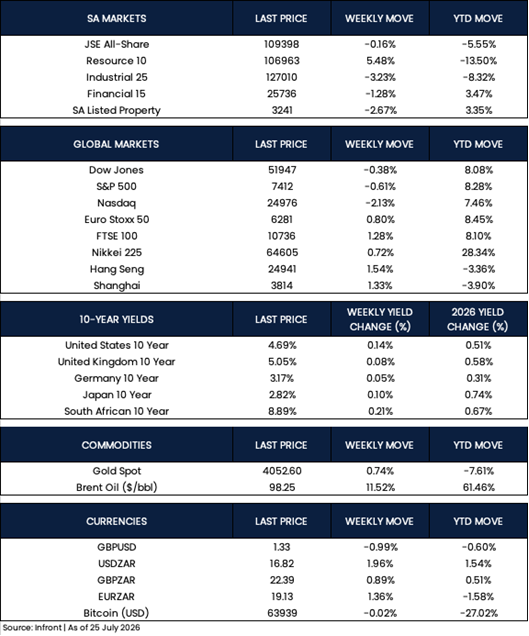
South African markets faced another challenging week. The JSE All Share Index edged 0.16% lower, masking significant divergence beneath the surface. Resource shares rallied 5.48%, benefiting from stronger commodity prices and higher oil prices, while Industrials declined 3.23% and listed property fell 2.67%. The rand weakened 1.96% against the U.S. dollar, while South African 10-year government bond yields rose to 8.89% as investors continued to price in inflation risks.
The week’s key domestic event was the South African Reserve Bank’s decision to leave the repo rate unchanged at 7.00%. The Monetary Policy Committee acknowledged that the economy entered the year with encouraging momentum, but noted that recent developments have significantly clouded the outlook. Although first-quarter growth surprised positively, this was largely driven by exports rather than stronger domestic demand. Since then, consumer confidence has weakened, business sentiment has softened, and higher fuel prices following the renewed Middle East conflict have added further pressure to households and businesses.
Inflation remains above the Bank’s preferred target, with higher fuel costs expected to keep headline inflation above 4% into next year. Encouragingly, food inflation has continued to moderate, helped by favourable harvests and easing supply disruptions, while the rand has remained relatively resilient against the euro, limiting imported inflation. However, services inflation remains elevated across categories such as transport, housing and insurance, and inflation expectations have begun drifting higher among households, businesses and trade unions. These developments reinforce the importance of preventing temporary price shocks from becoming embedded in broader inflation.
Against this backdrop, the MPC voted to keep policy unchanged, with four members favouring a hold and two supporting a further 25 basis point increase. The Bank reiterated that policy remains appropriately restrictive for now and that future decisions will remain entirely data dependent. While its baseline forecast still anticipates interest rate cuts later in the forecast period as inflation gradually returns towards the 3% target, policymakers made it clear that a sustained rise in oil prices or further increases in inflation expectations could require additional tightening. Equally, a more favourable energy environment could allow interest rates to begin easing sooner than currently expected. Ultimately, the SARB emphasised that while monetary policy can anchor inflation, South Africa’s longer-term growth prospects will depend far more on structural reforms, particularly improvements in electricity, logistics, transport infrastructure and local government efficiency.
This week’s market performance served as another reminder that while long-term structural themes such as artificial intelligence continue to underpin global equity markets, shorter-term macroeconomic forces can quickly dominate investor sentiment. For now, oil prices have become the market’s primary focus. Whether the recent spike proves temporary or develops into a more prolonged inflation shock will likely shape both central bank policy and market direction over the coming months.
Chart of the Week:
As always, we appreciate your support and value your trust in LNKD Investment Manager.