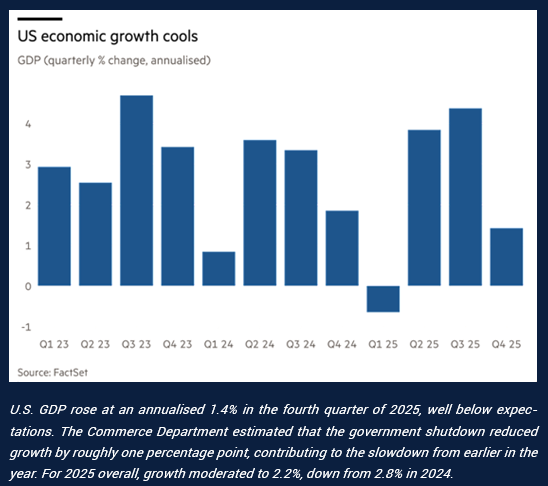
Weekly Insights: US GDP Growth Slows

Data released by the Bureau of Economic Analysis (BEA) showed that U.S. growth slowed more than expected in the fourth quarter of 2025, with GDP expanding at an annualised 1.4%. The deceleration was largely driven by a sharp contraction in government spending amid the shutdown, which weighed on overall activity. Consumer spending remained comparatively resilient at 2.4%, though momentum softened relative to earlier in the year, while government spending declined 16.6%. For 2025 overall, economic growth moderated to 2.2% from 2.8% in 2024.

Separately, the BEA reported that headline PCE inflation rose 2.9% year-on-year in December, edging higher from the prior month and marking its highest level since March 2024. Core PCE — the Federal Reserve’s preferred gauge of underlying inflation, which excludes food and energy — increased 0.4% month-on-month and 3.0% year-on-year, accelerating from November’s 0.2% and 2.8%, respectively.

Minutes from the Federal Reserve’s January meeting, released on Wednesday, highlighted a clear split among policymakers over the next move in rates. While some members indicated that additional easing could be appropriate if inflation continues to cool, others pointed to “the possibility that upward adjustments” may be required should price pressures remain elevated. The minutes also noted that the “vast majority of participants” believe downside risks to employment have eased, though the risk of more entrenched inflation remains a concern.

In a 6–3 decision, the U.S. Supreme Court ruled that President Trump exceeded his authority in using the International Emergency Economic Powers Act (IEEPA) to impose tariffs on nearly all U.S. trading partners last year. President Trump responded critically to the decision and subsequently announced the implementation of a 10% global tariff, signalling continued intent to pursue an assertive trade stance despite the Court’s ruling.

UK CPI eased to 3.0% year on year in January, its lowest level in almost a year, partly due to lower fuel prices. Labour market data were also softer, with unemployment rising to 5.2% in the three months to December and wage growth slowing. The data have supported expectations that the Bank of England may cut interest rates at its March meeting, although inflation remains above the 2.0% target.

Seasonally adjusted industrial production in the eurozone declined 1.4% month on month in December, according to Eurostat, a sharper contraction than expected. In contrast, the preliminary February PMI surprised to the upside, with new orders expanding at their fastest pace in nearly four years
 
The International Monetary Fund expects China’s economy to grow 4.5% in 2026, slightly above its October forecast but below the 5% recorded in 2025. Following its Article IV consultation, the IMF noted that while growth has been resilient, structural challenges are intensifying and emphasised the need for a stronger shift toward consumption-led growth, supported by both macroeconomic measures and deeper reforms.

U.S. equity markets closed the holiday shortened week higher. The Nasdaq Composite led gains, advancing 1.51% and recording its first weekly increase since early January. The S&P 500 rose 1.07%, while the Dow Jones Industrial Average lagged the broader market, ending the week up 0.25%.

European equities delivered solid gains over the week, with the STOXX Europe 50 rising 2.44% in local currency terms. The FTSE 100 also advanced 2.30%, touching a fresh intraweek high.

In Asia, performance was more subdued. Japan’s Nikkei 225 edged 0.20% lower. Mainland Chinese markets were closed for the Lunar New Year from February 16 and will reopen on February 24. Hong Kong trading was suspended from February 17 to 19, following a half-day session on February 16, before resuming on Friday. The Hang Seng Index ended the week down 0.44%.

Market Moves of the Week:
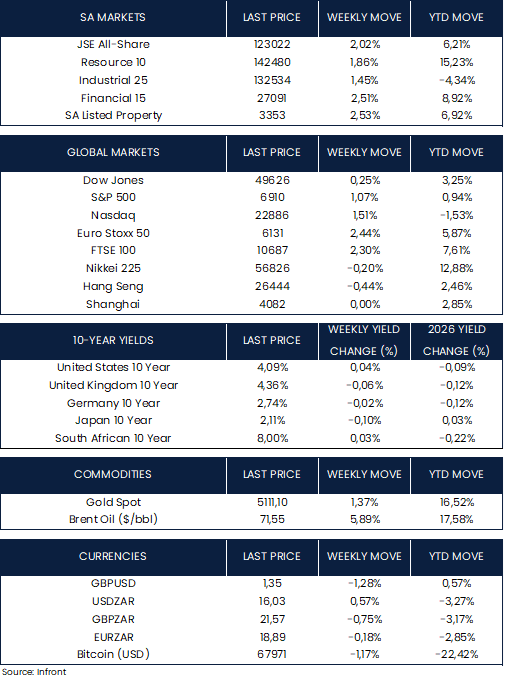
Headline consumer price inflation in South Africa eased to 3.5% year on year in January 2026, down from 3.6% in December 2025, according to Statistics South Africa. The main contributors to the January reading were housing and utilities, food and non-alcoholic beverages, and insurance and financial services. Core inflation, which excludes food, non-alcoholic beverages, fuel and energy, increased to 3.4%, its highest in nearly a year.
 
Separately, Stats SA’s Quarterly Labour Force Survey reported that the official unemployment rate declined to 31.4% in the fourth quarter of 2025, from 31.9% in the third quarter, reflecting a modest improvement in labour market conditions. Overall, South Africa’s labour market shows improvements across multiple measures. However, unemployment levels remain exceptionally high, underscoring the persistence of the country’s structural jobs crisis.
 
The JSE All Share Index also ended the week in positive territory, gaining 2.02%, with broad based strength across all sectors. In contrast, the rand softened slightly, depreciating 0.57% against the U.S. dollar to close at R16.03 on Friday.

Chart of the Week:
As always, we appreciate your support and value your trust in LNKD Investment Managers. 

Weekly Insights: Inflation Cools While the US Labour Market Stays Resilient

The latest inflation data released in the U.S. by the Bureau of Labor Statistics showed further signs of easing price pressures in January. Headline consumer prices rose 0.2% month on month, down from 0.3% in December, while the annual inflation rate slowed to 2.4% from 2.7%, coming in below consensus expectations and marking the lowest level since May. The moderation was largely driven by a notable decline in energy prices, alongside favourable base effects as higher readings from a year ago dropped out of the annual calculation.

Core inflation, which excludes food and energy, increased 0.3% over the month—slightly firmer than December’s 0.2% reading and in line with forecasts. On an annual basis, core CPI rose 2.5%, matching expectations. While the headline data suggests that inflationary pressures are gradually easing, the steadier core reading indicates that underlying price dynamics remain somewhat sticky. Overall, the January report provides cautious optimism that inflation continues to trend in the right direction, even if progress remains uneven. This softer-than-expected inflation backdrop offered Wall Street a degree of relief during the week, strengthening expectations that the Federal Reserve could consider cutting interest rates later this year. Bond yields moved lower in response, with the US 10-year Treasury falling to 4.07% on Friday, its lowest level since early December, as the moderate CPI print reinforced the view that policy easing remains on the table even amid a resilient economy.

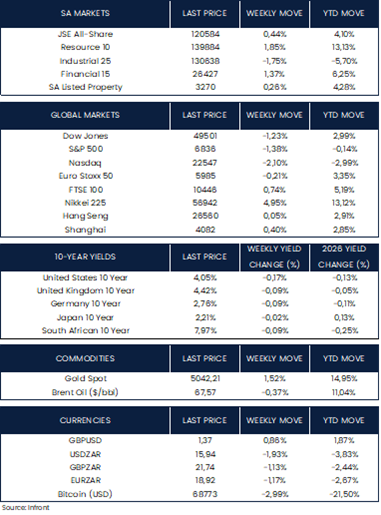
Equity markets, however, closed the week lower. The S&P 500 declined 1.39%, the Dow Jones Industrial Average fell 1.23%, and the Nasdaq Composite shed 2.1%, marking their largest weekly losses since November. Technology shares were particularly volatile, as concerns around artificial intelligence disruption and the significant capital expenditure required to support AI development weighed on sentiment.

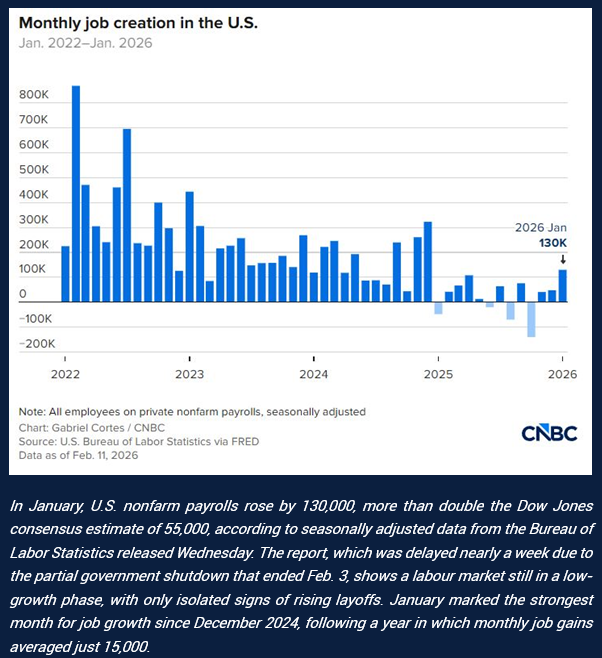
On Wednesday, the Bureau of Labor Statistics released January labour market data that exceeded expectations. Nonfarm payrolls rose by 130,000, well above consensus forecasts, while the unemployment rate ticked down to 4.3% from 4.4% in December. Job gains were led by healthcare, followed by social assistance and construction. The strong employment report highlights the continued resilience of the US economy, tempering expectations for aggressive interest rate cuts even as inflation shows signs of easing.

In Europe, the Euro STOXX 50 Index ended marginally lower as investors digested strong US jobs data and growing concerns about AI competition. Data from Eurostat showed that the eurozone economy expanded by 0.3% in the fourth quarter of 2025, offering modest support to the regional outlook.

In the UK, political uncertainty persisted amid calls for Prime Minister Keir Starmer to resign. Economic data from the Office for National Statistics indicated that real GDP grew by just 0.1% in Q4 2025, while annual growth reached 1%. Manufacturing activity improved over the quarter, though construction contracted. Retail sales rose 2.3% year on year in January, and the FTSE 100 added 0.74% for the week.

Japanese equities outperformed, with the Nikkei 225 surging 4.96% following the February 8 lower house election, where Prime Minister Sanae Takaichi’s Liberal Democratic Party secured a supermajority. In China, markets were modestly higher ahead of Lunar New Year holidays, with the Shanghai Composite Index gaining 0.43% while Hong Kong’s Hang Seng Index was little changed. The People’s Bank of China reiterated its commitment to a “moderately loose” monetary policy stance in 2026 as inflation data pointed to ongoing deflationary pressures.

In commodities, gold rebounded after recent weakness, supported by lower Treasury yields and a softer US dollar. Oil prices, however, edged lower, with Brent crude on track for a second consecutive weekly decline amid easing concerns over potential supply disruptions linked to US-Iran tensions.

Looking ahead, markets will focus on the Federal Reserve’s upcoming meeting minutes, US fourth-quarter GDP data, and income and spending figures. Canada’s inflation release, European PMIs, Japan’s GDP and inflation data, will also provide further insight into the global economic trajectory amid ongoing trade, fiscal, and monetary policy uncertainty.

Market Moves of the Week:

On Thursday night, President Cyril Ramaphosa delivered a candid assessment of South Africa’s most urgent challenges, pledging decisive action on crime, water shortages, dysfunctional municipalities, and the next phase of Eskom’s restructuring. Crime took centre stage, with Ramaphosa describing organised criminal networks as “the most immediate threat to our democracy, our society and our economic development.” He announced a strengthened offensive, including the consolidation of intelligence at the national level and the deployment of multidisciplinary intervention teams aimed at dismantling criminal networks. The South African National Defence Force will also support police operations in hotspot areas.
 
On infrastructure, the government has committed over R156 billion to water and sanitation projects over the next three years, advancing initiatives such as the Lesotho Highlands Water Project and the Ntabelanga Dam. Municipalities that fail to deliver services, Ramaphosa warned, will face consequences. On the energy front, the first round of independent transmission projects will begin this year, enabling private investment to expand the grid, while work continues to address load-shedding caused by transformer overloading and illegal connections.

On the markets, the FTSE/JSE All Share Index ended the week modestly higher, up 0.44%, with mining and resource-linked stocks leading gains thanks to robust demand and favourable commodity prices. Financials also performed well, reflecting continued investor confidence in banks and lenders, while industrials lagged amid currency strength and softer sector performance.

On the currency front, the rand maintained a strong position below the 16.00 level against the dollar, buoyed by high precious metal prices (gold, platinum, palladium) and improved sentiment around South African economic reforms.

Looking ahead, market and economic attention will turn to South Africa’s fourth-quarter unemployment figures, January inflation data, and December retail sales numbers.

Chart of the Week:

As always, we appreciate your support and value your trust in LNKD Investment Managers. 
Weekly Insights: Markets Rotate as Technology Leadership Pauses

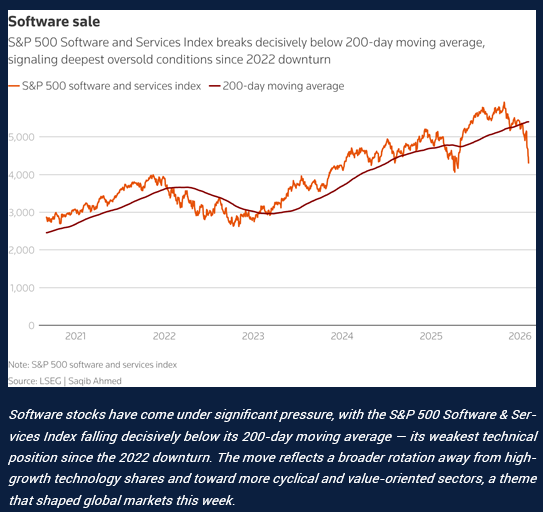
Global markets delivered a mixed performance this week as investors navigated a combination of economic data, shifting policy expectations and evolving sector leadership. While overall index movements were relatively contained, underlying market dynamics pointed to a continued rotation away from narrow technology leadership toward more cyclical and value-oriented areas.

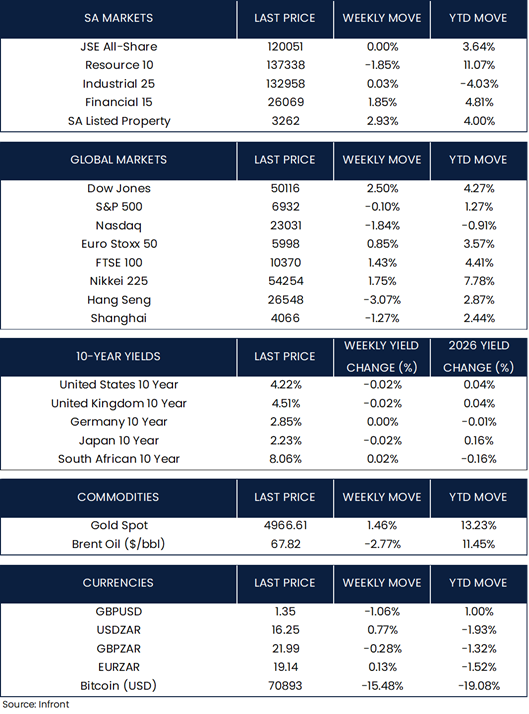
In the United States, equity markets ended the week divided. The Nasdaq declined 1.84%, reflecting pressure on large-cap technology shares, while the S&P 500 was broadly unchanged at -0.10%. In contrast, the Dow Jones Industrial Average rose 2.50%, supported by gains in more traditional and cyclical sectors. The week highlighted a shift in investor positioning, as concerns around the pace of artificial intelligence investment and its impact on corporate profitability weighed on high-growth companies that have driven market returns in recent years. At the same time, investors rotated into areas of the market that have lagged, including financials and industrials, which benefited from improving economic expectations. Economic data releases added to the cautious tone. Labour market indicators were softer than anticipated, with slower private job creation, a decline in job openings to their lowest level since 2020 and a notable rise in layoffs. Despite this, parts of the real economy showed resilience. Manufacturing activity returned to expansion territory for the first time in a year, supported by stronger new orders, while services activity remained stable and continued to expand. In fixed income markets, U.S. Treasury yields edged lower, supporting bond returns, as investors positioned more defensively amid mixed economic signals.

Across the United Kingdom and Europe, markets delivered a steadier performance. The Euro Stoxx 50 gained 0.85% and the FTSE 100 rose 1.43% over the week, supported by easing inflation and a relatively resilient economic backdrop. Policymakers maintained a cautious stance, with the European Central Bank holding rates unchanged and signalling that inflation is gradually moving back toward its 2% target. The Bank of England also left policy rates on hold but indicated that the path toward rate cuts may be approaching, particularly if inflation continues to moderate. Economic data was mixed, with retail activity softening slightly, although broader trends suggest household spending is stabilising. Overall, sentiment across the region remained constructive as investors balanced slowing inflation with steady growth.

Asian markets showed diverging trends. In China, equities struggled, with the Shanghai Composite falling 1.27% and the Hang Seng declining 3.07%. Weakness in technology shares and ongoing concerns about domestic demand continued to weigh on investor sentiment. Economic indicators provided a mixed picture. Private-sector surveys suggested modest improvements in activity, particularly in manufacturing and services, supported by export demand. However, official data pointed to slower overall momentum, highlighting the challenges China faces in reviving domestic consumption. Expectations remain that policymakers will introduce further measures to support growth in the months ahead. In Japan, equity markets moved higher, with the Nikkei 225 rising 1.75% for the week. Investor optimism was supported by expectations of continued fiscal support and political stability ahead of the country’s upcoming election. A weaker yen provided additional support for export-oriented companies, although it also underscores the delicate balance policymakers face in managing inflation and financial stability. Economic data showed that household spending declined, reflecting the ongoing pressure on consumers from rising prices. Bond yields remain elevated, reinforcing concerns around Japan’s fiscal position and the long-term sustainability of its debt levels.

Market Moves of the Week:

South African markets were relatively stable, with the JSE All Share finishing the week unchanged. Performance across sectors was mixed, with financials and listed property posting gains while resources declined amid commodity volatility and industrials were largely flat. The domestic bond market was steady, with the 10-year government yield closing around 8.06%.

On the policy front, South Africa moved to deepen its economic relationship with China through the signing of a new framework agreement aimed at expanding trade and investment ties. The agreement is expected to improve access for South African exports into Chinese markets while encouraging further Chinese investment across sectors such as mining, agriculture, renewable energy and manufacturing. Although still in its early stages, the initiative signals growing economic cooperation and could support longer-term growth and employment prospects. Overall, the week reinforced a key theme shaping global markets: leadership is broadening. After an extended period dominated by large-cap technology, investors are increasingly allocating toward value-oriented sectors, cyclical industries and regions outside the United States. Economic data remains mixed, with labour markets softening in some areas while manufacturing stabilises and inflation continues to ease. For long-term investors, this environment supports the case for diversification across geographies, asset classes and sectors, as markets adjust to shifting growth expectations and evolving monetary policy paths.

Chart of the Week:

As always, we appreciate your support and value your trust in LNKD Investment Managers. 
Weekly Insights: U.S. Confidence Slides in January

After three consecutive cuts, the Federal Reserve left the fed funds rate unchanged at 3.50%–3.75%, in line with expectations, in a 10–2 vote, with two officials favouring a 25-basis-point reduction. The accompanying policy statement struck a more constructive tone on growth, noting activity has been expanding at a solid pace, while inflation remains somewhat elevated and labour market conditions are showing signs of stabilisation. At the press conference, Chair Jerome Powell said rates did not appear “significantly restrictive” given economic momentum and reiterated that decisions would be taken on a meeting-by-meeting basis.

On Friday morning, U.S. President Donald Trump nominated former Federal Reserve governor Kevin Warsh to succeed Jerome Powell as Fed chair when Powell’s term expires in mid-May, subject to Senate confirmation. Warsh served from 2006 to 2011 and was a finalist for the role in 2017. He is viewed as a pragmatist who argues the Fed has strayed from its mandate and that its balance sheet is excessive, with his nomination seen as largely easing recent concerns over central bank independence. The announcement sparked a rebound in the dollar, weighing on precious metals and pushing gold and silver lower after investors had piled into the sector.

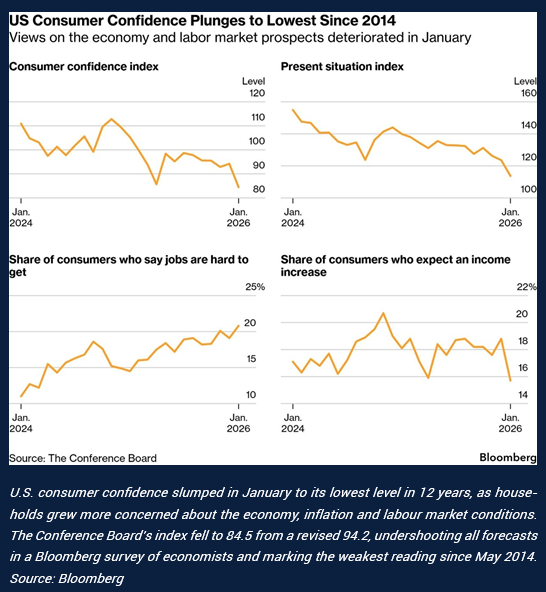
U.S. producer prices climbed by the most in five months in December, partly reflecting pass-through from import tariffs and pointing to renewed inflation pressures. The figures, published by the United States Department of Labor, came in above expectations and were driven mainly by higher services prices, especially trade margins, hotel accommodation and airfares. Goods prices were unchanged, while the data reinforced the likelihood that the Federal Reserve keeps interest rates steady for now. Separately, the Conference Board’s consumer confidence index fell sharply in January to its lowest level since May 2014, undershooting expectations as households reported weaker views on the economy and labour market.

The eurozone economy expanded 1.5% in 2025, up from 0.9% in 2024 and ahead of the European Commission’s 1.3% forecast, as stronger investment, household spending and exports offset political and economic uncertainty. Fourth-quarter GDP rose 0.3% quarter on quarter, slightly above expectations and in line with the prior pace, with faster growth in Germany, Spain and Italy helping to counter sluggish momentum in France.

British Prime Minister Keir Starmer visited Beijing this week to reset relations between the United Kingdom and China after years of strain linked partly to Hong Kong. After talks with President Xi Jinping, Starmer said the UK was entering a new, “sophisticated” relationship, with the two sides agreeing to study greater market access in business and financial services, cut Chinese whisky tariffs from 10% to 5%, and introduce visa-free travel for Britons. In response, U.S. President Donald Trump later warned Starmer that closer UK–China business ties would be “very dangerous.”

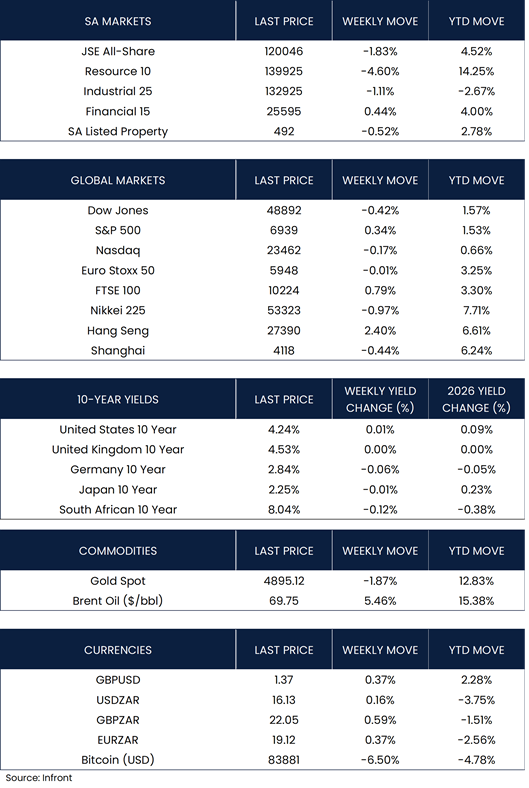
The S&P 500 Index edged slightly higher to finish the week up 0.34%, while the Nasdaq Composite and the Dow Jones Industrial Average ended marginally lower, down 0.17% and 0.42% respectively. In Europe, the STOXX Europe 50 Index was flat at -0.01%, while the UK’s FTSE 100 Index gained 0.79%.

In Asia, markets were mixed. Japan’s Nikkei 225 Index fell 0.97%, while mainland China’s Shanghai Composite Index slipped 0.44%. Meanwhile, Hong Kong’s Hang Seng Index gained 2.40%.

Market Moves of the Week:

The South African Reserve Bank held its repo rate at 6.75% at its first policy meeting of 2026, with the Monetary Policy Committee opting for caution amid ongoing global and domestic uncertainty and inflation expectations still above the 3% target. While two members favoured a 25-basis-point cut, the majority preferred to maintain the current stance, and the Bank’s projections continue to anticipate gradual easing as inflation trends lower. Governor Lesetja Kganyago noted that inflation is contained but services price pressures persist, and decisions will remain data dependent as the economy navigates risks including currency and administered price developments.

Similar to global peers, the JSE All-Share Index fell 1.83% over the week, dragged lower by a 4.60% drop in resources, while industrials (-1.11%) and SA property (-0.52%) also detracted from returns. Financials were the only sector to record gains, rising 0.44%. In currency markets, the rand strengthened earlier in the week to around R16 per dollar—its firmest level since mid-2022 on the back of elevated gold prices—before ending Friday at R16.13 after a rebound in the dollar, leaving it 0.13% weaker over the week.

Chart of the Week:

As always, we appreciate your support and value your trust in LNKD Investment Managers.