Weekly Insights: Bank of Japan raises rates to 30-year high

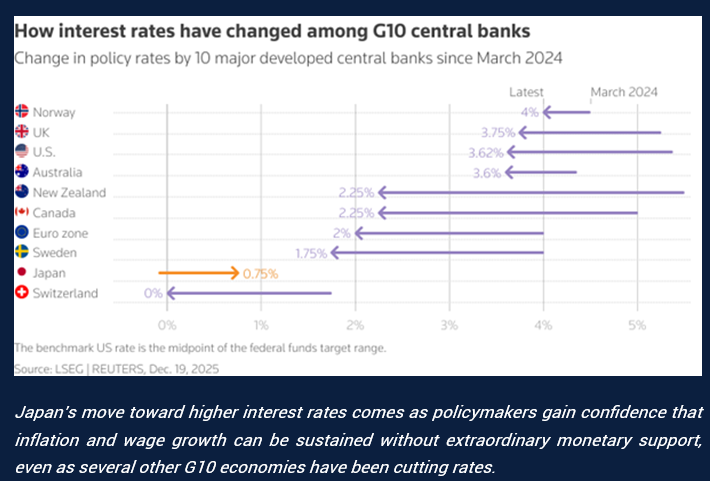
The Bank of Japan delivered a widely expected 25 basis point increase in its benchmark interest rate, lifting it from 0.50% to 0.75%, the highest level since 1995. The decision was unanimous and reflected growing confidence that the central bank’s economic outlook will be realised.

The U.S. Bureau of Labor Statistics reported that nonfarm payrolls rose by 64,000 in November, beating expectations and rebounding from the 105,000 jobs lost in October due to the federal government shutdown. Job gains were led by health care and construction, while the unemployment rate edged up to 4.6%, its highest level in over four years.

US consumer inflation eased more than expected in November, with headline CPI rising 2.7% year on year, down from 3.0% in September and below market expectations. Core inflation, which excludes food and energy, slowed to 2.6% year on year, the softest underlying inflation outcome since early 2021. The Bureau of Labor Statistics noted that data collection was affected by the recent federal government shutdown, while inflation in essential categories such as food and electricity remained relatively elevated.

Meanwhile, S&P Global’s Flash US Composite PMI pointed to a moderation in business activity in December, falling to 53.0 from 54.2 in the previous month. While the index remained in expansionary territory, the reading was the lowest in six months, reflecting slower growth across both manufacturing and services.

UK inflation fell more than expected in November, with headline CPI easing to 3.2% year on year from 3.6% in October, marking its lowest level in eight months. The Office for National Statistics noted that the decline was driven in part by lower prices for certain food items, including cakes, biscuits and breakfast cereals. Following the softer inflation outcome, the Bank of England voted to cut interest rates by 25 basis points to 3.75%, taking the base rate to its lowest level since February 2023.

The European Central Bank (ECB) left the deposit rate unchanged at 2.0% for a fourth consecutive meeting. President Christine Lagarde said policy remains “in a good place,” while reiterating a data-dependent, meeting-by-meeting approach amid ongoing uncertainty. The ECB also marginally lifted its growth outlook, forecasting GDP growth of 1.4% in 2025, 1.2% in 2026, and 1.4% in 2027–28.

In China, data from the National Bureau of Statistics showed that retail sales rose 1.3% year on year in November, the slowest pace since the pandemic, highlighting ongoing weakness in consumption despite government efforts to stimulate demand. Fixed asset investment fell 2.6% over the first 11 months of the year, missing expectations, while industrial output rose 4.8% year on year, underscoring the economy’s continued reliance on exports. Earlier in December, Chinese leaders signalled that they are unlikely to materially ramp up stimulus next year, even as they reiterated support for growth.

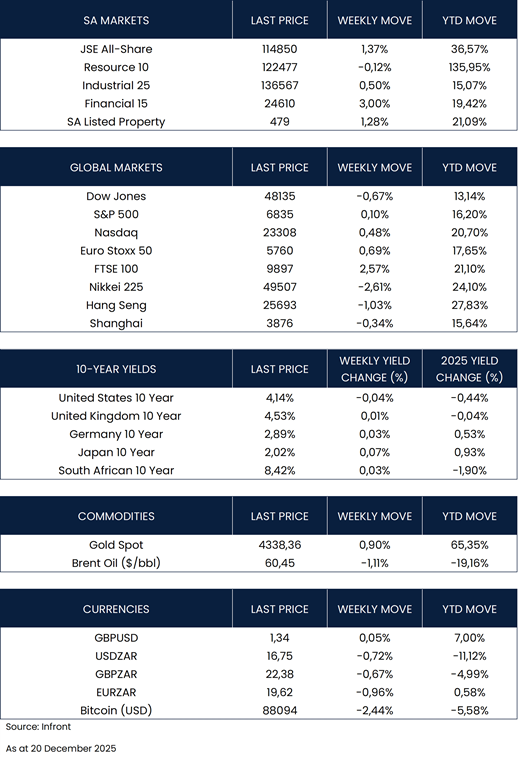
U.S. equity markets ended the final full trading week of the year mixed, as the Dow Jones Industrial Average fell 0.67%, the S&P 500 finished broadly flat, and the Nasdaq Composite rose 0.48%.

European equities posted modest gains in local currency terms, supported by signs of steady economic growth and a more accommodative monetary policy backdrop. The STOXX Europe 50 Index advanced 0.69%, while the UK’s FTSE 100 gained 2.57%.

Asian equities were weaker over the week. Japan’s Nikkei 225 fell 2.61%, pressured by losses in technology stocks amid valuation concerns and elevated spending on artificial intelligence. Chinese markets also declined, with the Shanghai Composite down 0.34% and Hong Kong’s Hang Seng Index falling 1.03%.

Market Moves of the Week:
South African consumer inflation edged lower in November, with headline CPI slowing to 3.5% year on year from 3.6% in October. The moderation was supported by lower fuel prices and a firmer rand, according to Statistics South Africa (Stats SA). Core inflation, which excludes food, non-alcoholic beverages, fuel and electricity, edged slightly higher to 3.2% from 3.1% in October, indicating that underlying price pressures remain broadly stable.

Producer price inflation, which measures changes in the cost of goods before they reach consumers, was unchanged at 2.9% year on year in November, according to Stats SA. Electricity and water producer prices eased to 15.3% from 16.1%, while mining producer inflation rose to 19.9%. While recent readings point to contained inflation pressures, both producer and consumer inflation are expected to trend higher in the months ahead due to base effects.
 
The JSE All-Share Index advanced 1.37% over the week, supported by a strong 3.00% gain in the financial sector. The industrials and property sectors posted modest gains of 0.50% and 1.28%, respectively, while the resource sector marginally declined by 0.12%. Meanwhile, the rand strengthened modestly, appreciating 0.72% against the U.S. dollar to close at R16.75 on Friday.

Chart of the Week:
As always, we appreciate your support and value your trust in LNKD Investment Managers.

The Federal Reserve’s split rate cut

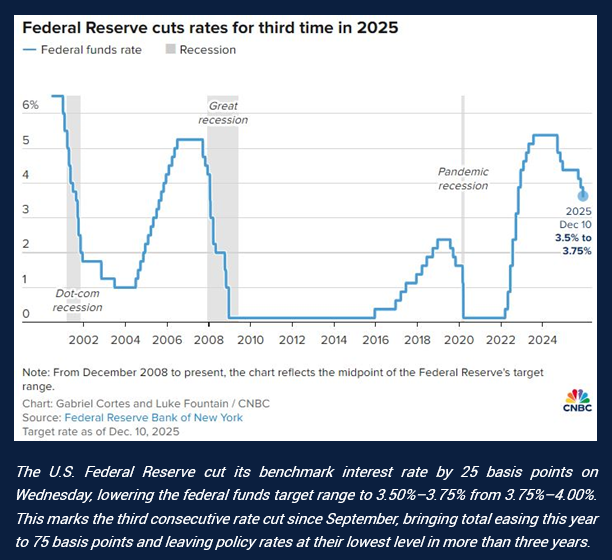
The U.S. Federal Reserve cut interest rates by 25 basis points on Wednesday, as widely expected, marking the third-rate reduction this year. The decision was passed by a 9–3 vote, again highlighting a growing divide within the committee. Hawkish members remain concerned about inflation and favour higher rates, while dovish members are more focused on supporting the labour market through lower borrowing costs.

The Fed’s updated “dot plot” points to a cautious path ahead, with policymakers collectively pencilling in just one additional rate cut in 2026 and another in 2027, underscoring significant disagreement about the future direction of policy. In a further move to support market liquidity, the Fed announced it will resume purchases of U.S. Treasury securities, starting with $40 billion in Treasury bills from Friday.

On the economic outlook, the committee raised its forecast for U.S. GDP growth in 2026 to 2.3%, a half-percentage-point increase from its September projection. Inflation, however, is still expected to remain above the Fed’s 2% target until 2028. The Fed’s preferred inflation gauge showed prices rising at an annual rate of 2.8% in September—well below recent peaks, but still uncomfortably high for policymakers.

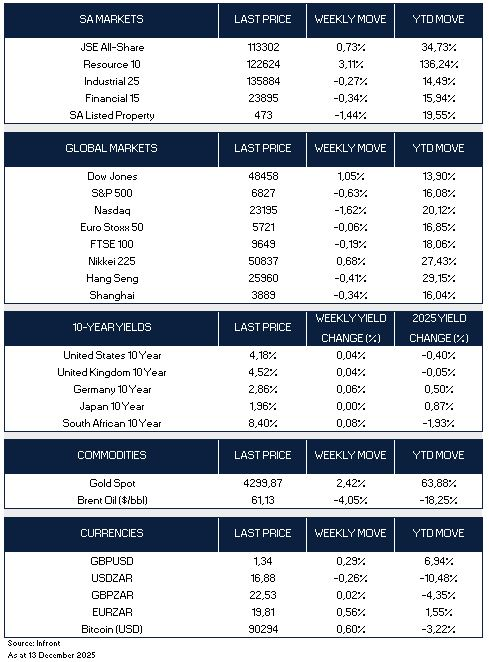
U.S. equities pulled back on Friday as investors continued to rotate out of technology stocks into more value-oriented sectors. Concerns over elevated valuations and whether heavy spending on artificial intelligence infrastructure will deliver sufficient returns weighed on the tech-heavy Nasdaq Composite. For the week, the S&P 500 declined 0.6% and the Nasdaq fell 1.6%, while the Dow Jones Industrial Average bucked the trend, gaining 1.1%.

Divisions within the Fed have increasingly played out in public, presenting a challenge for Chair Jerome Powell as uncertainty around the U.S. economic outlook persists, particularly in light of President Donald Trump’s aggressive trade policies. President Trump has repeatedly pressured the Fed to cut rates and has signalled that former Fed governor Kevin Warsh is now a leading candidate to succeed Powell when his term expires in May, according to reports.

European markets were modestly weaker. The STOXX Europe 50 Index ended slightly lower, while the UK’s FTSE 100 slipped 0.19%. The European Central Bank is widely expected to keep interest rates unchanged at its December 18 meeting, marking a fourth consecutive hold since its June rate cut. ECB officials struck a relatively confident tone during the week, with President Christine Lagarde noting that the European economy appears resilient to trade tensions and could see upgraded growth projections later this month.

In the UK, economic data disappointed as GDP unexpectedly contracted by 0.1% in October, following a similar decline in September. Construction was the weakest sector, while services output also fell.

Asian markets were mixed. Japan’s equities advanced, with the Nikkei Index rising 0.68% for the week. Ahead of the Bank of Japan’s December policy meeting, economists expect a 25-basis-point rate hike to 0.75%, which would mark another step away from ultra-loose policy. In contrast, Chinese markets retreated as investors took profits. The Shanghai Composite fell 0.34% and Hong Kong’s Hang Seng Index slipped 0.41%. Inflation data continued to highlight deflationary pressures in China, with consumer prices rising just 0.7% year on year in November.

Brent crude oil prices stabilised around $61 per barrel but were still on track for a weekly decline of more than 4%, driven by expectations of a global supply surplus. Gold prices climbed above $4,300 per ounce, testing record highs last seen in October, and posted a weekly gain of 2.4% on expectations of further U.S. monetary easing.

The week ahead is packed with key data releases. In the U.S., markets will focus on the delayed jobs reports for October and November, November CPI inflation, and retail sales figures. In Europe, monetary policy will be in the spotlight as both the ECB and the Bank of England hold policy meetings. In Asia, investors will watch a range of Chinese economic indicators, while in Japan attention will centre on the Bank of Japan meeting, where a rate hike to 0.75% is widely anticipated.

Market Moves of the Week:

South Africa’s Communications Minister, Solly Malatsi, has directed the country’s telecoms regulator to amend regulations to allow international players, including Elon Musk’s Starlink, to enter the local market under an alternative empowerment framework. Currently, the Electronic Communications Act requires foreign-owned communications licensees to sell 30% of equity in their South African subsidiaries to historically disadvantaged groups—a requirement that has drawn criticism from Starlink and other global operators.

Under a new policy direction published in the Government Gazette on Friday, so-called “equity equivalent” investment programmes will be recognised as contributing toward empowerment objectives. This change would enable communications companies to bypass the 30% equity requirement, instead meeting empowerment goals through investments such as digital infrastructure and related initiatives, potentially easing market entry for global technology providers.

Investor attention is turning to November consumer inflation data, scheduled for release on 17 December. The data will be closely watched following South Africa’s decision last month to lower its inflation target to 3%, from the previous 3%–6% range. A fourth-quarter survey of business leaders, trade union officials and analysts released on Friday showed a sharp decline in inflation expectations for 2026, suggesting growing confidence in the credibility of the new lower inflation target.

On the Johannesburg Stock Exchange, the JSE All Share Index finished the week 0.73% higher, supported by strong performances from resource companies.

The South African rand was largely steady on Friday, underpinned by firmer gold prices. Currency markets remained cautious ahead of next week’s inflation release, which is expected to provide further insight into the underlying health of Africa’s most industrialised economy.

Chart of the Week:

As always, we appreciate your support and value your trust in LNKD Investment Managers.