


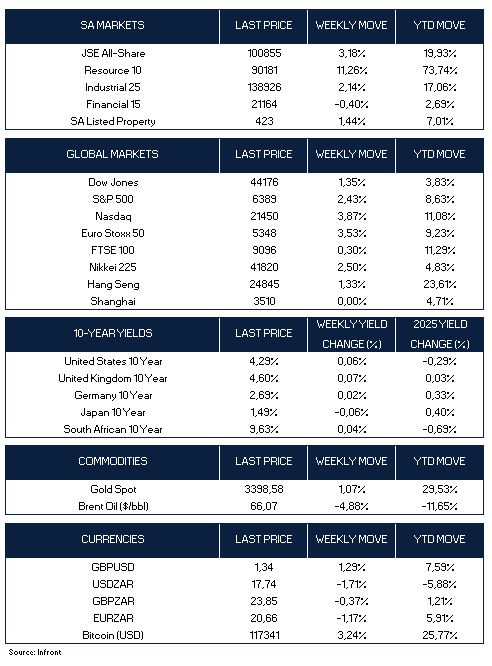
U.S. equity markets posted strong weekly gains, recovering from the prior week’s pullback. The S&P 500 rose 2.4%, the Dow Jones Industrial Average added 1.4%, and the Nasdaq surged 3.9%. Technology shares led the rally, with Apple unveiling a $600 billion U.S. investment plan.
Investor sentiment was further buoyed by expectations of Federal Reserve rate cuts following President Trump’s nomination of Stephen Miran, Chair of the Council of Economic Advisers, to the Fed Board. Markets are now pricing in a ~90% probability of a September rate cut, with several Fed officials signalling openness to multiple cuts before year-end.
US corporate earnings remained robust with 90% of S&P 500 companies having reported Q2 results, blended earnings per share are up 11.7% year-on-year and revenue growth stands at 6.3% (FactSet).
The U.S. implemented a new round of global tariffs on Thursday, including a 50% tariff on Indian exports effective in three weeks due to India’s continued oil purchases from Russia. Tariffs on semiconductor imports were also announced, though exemptions were granted for companies investing in U.S. production facilities, notably benefiting Apple and major Asian chipmakers.
Brent crude fell more than 4% for the week to $66.6/bbl, despite potential supply risks from U.S. tariffs on Indian oil imports. OPEC+ announced that in September it will fully unwind the remaining voluntary 2.2 million barrels per day production cut introduced in late 2023, adding a further 574,000 barrels per day to global supply.
The STOXX Europe 50 Index gained 3.5%, supported by strong earnings and improved economic sentiment with robust retail sales reinforcing signs of a resilient eurozone economy in the second quarter. In the UK, the Bank of England cut rates by 25 bps to 4% in a close 5–4 vote, signalling a slower pace of easing ahead. The FTSE 100 rose 0.3% for the week.
Japan’s Nikkei 225 gained 2.50% for the week on solid corporate earnings. Mainland China’s Shanghai Composite rose 2.11% amid strong export growth (+7.2% YoY) and stable consumer prices, while Hong Kong’s Hang Seng gained 1.43%.
Gold prices held steady at ~$3,400/oz, supported by safe-haven demand from renewed trade tensions.
Looking at the week ahead, markets will watch U.S.–China trade talks ahead of the August 12 tariff deadline, as well as a possible Trump–Putin meeting with additional sanctions on Russian oil shipments remain under consideration if no ceasefire is reached in Ukraine.
Market Moves of the Week:
South African Reserve Bank (SARB) Governor Lesetja Kganyago signalled confidence that the central bank and National Treasury will reach an agreement on a new inflation target, following last week’s announcement that policymakers will now aim for 3%. The move drew criticism from Finance Minister Enoch Godongwana, who called it unilateral and a breach of the “established consultation process.” The two institutions have been reviewing the inflation framework since last year; the target has remained unchanged since its introduction in 2000.
U.S. imports from South Africa are set to face a 30% duty—currently the highest among Sub-Saharan African nations—which kicked in this week on August 8. President Cyril Ramaphosa’s office confirmed that he held a call with U.S. President Donald Trump, with both leaders agreeing that their trade teams would hold detailed negotiations in the coming days in pursuit of a revised arrangement.
For the week, the JSE All Share Index posted strong gains (3.18%), driven by a rally in resource stocks on surging commodity prices. The rand strengthened to around 17.74/$, its firmest level since July 25, supported by a weaker U.S. dollar amid rising expectations of Federal Reserve rate cuts and ongoing global trade uncertainties.
Chart of the Week:
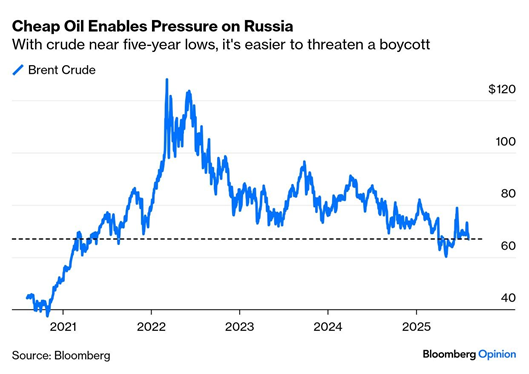
Last weekend’s OPEC+ meeting, which agreed to increase production in an already oversupplied market, pushed oil prices lower this week. Even the announcement of an additional 25% tariff on India (Russia’s largest oil customer, importing up to 1.7 million barrels per day) for purchasing Russian oil failed to stem the decline. Meanwhile, President Trump is pressuring Russia to agree to a ceasefire in Ukraine, warning of 100% “secondary tariffs” on countries continuing to import Russian crude.
As always, we appreciate your support and value your trust in LNKD Investment Managers.